Tidemann The use of alternative project delivery methods is on the rise, as owners increasingly turn to them to help mitigate construction cost increases, risks and ever-changing construction schedules. Yet, the factors that usually give rise to a contractor termination can and will still occur regardless of the project delivery approach. And only subtle differences may arise regarding different project delivery approaches, such as design-build or construction manager at-risk. Most contracts contain provisions addressing an owner’s right to terminate the contractor for miscellaneous or certain contractor breaches or actions/inactions, commonly referred to as a termination for default (T4D). Many contracts
With this issue of Progressive Project Delivery, ENR continues to bring you news and analysis of global project delivery innovations and trends. In today’s dynamic global market, virtually all delivery systems now are mainstream and continue to evolve. By understanding these changes, companies can pick from a broad array of delivery tools to best serve customers’ needs, particularly as schedules shrink and budgets tighten. Here’s a preview of PPD: The cover story features an in-depth look at a new selection process devised by the European Union called “competitive dialogue.” This negotiated procedure was developed for complicated projects and most recently
Michael Goodman/ENR When the public relations man for an emerging, multibillion-dollar real estate development concedes there are probably 10 schemes just as big within an hour’s drive, then you know you must be in Dubai. When complete, Dubai Festival City will have 70,000 residents in 20,000 homes and a daily population of over twice that number. At its site, by Dubai airport, nearly $4 billion of construction is now in hand, representing just a third of the total plan. Over a large tract of desert, stretching south from the city, Dubai is building an entire tourism and leisure industry for
Michael Goodman/ENR Concrete pumps must reach 550 m. Speculation among supertall-building pundits once had the $1.1-billion Burj Dubai rising 800 meters or more. Currently, the developer admits to only 700-plus. The tower’s architect-engineer is sworn to say only 600-m-plus. And the main contractor claims not to know the final height. The secret gets harder to keep as the tower, now at about 80 stories, rises toward its pinnacle, at an average of one floor every three days. Whatever its final stopping point, Burj Dubai is on course to supersede the world record holder, the 509-m-tall Taipei 101, by summer, says
Nakheel Atkins Jumeirah's "stem" is a major transportation corridor, including a monorail, all watched over by Dubai's own Trump Tower. Some 140,000 people will live and work on the reclaimed land. Dubai’s explosive buildout may be no better exemplified than its construction of a series of palm-shaped islands directly offshore of the coastline. Discernable from space, the islands will host a number of pricey, ultra-luxury developments for a wealthy clientele drawn to the emirate’s business centers and leisure resorts. Occupants of villas and apartments built on fronds of Dubai’s 560-hectare artificial Palm Jumeirah island this month are to begin moving
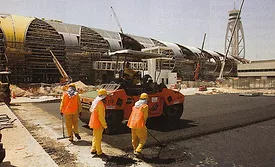
Michael Goodman/ENR Burjuman traffic circle will become of Dubai metro’s new hubs, moving passengers along two lines that connect the existing city to new developments and the airport. Piling rigs around Dubai mark the start of construction of the Middle East’s first metro, intended to abate growing traffic congestion in the hyperactive emirate. Tunneling is due to begin in January on the project, expected to employ up to 9,000 workers through the middle of 2010. In a hurry as ever, the municipality gave a Japanese-led construction joint venture 49 months, until September 2009, to complete the first 52-kilometer Red Line.
Photo:Parsons Corp. Jessica Wright and Mike Kelly are recent interns now working at Parsons. With big demand for engineering and construction talent, the internship is morphing from a way for students to get their feet wet into an inside track to nail post-graduation employment. To attract the best and brightest, employers are offering internships to sophomores—and freshmen—to test their abilities and build relationships. Students get a chance to sample the workplace and their career choices before signing on the dotted line. Often, it is a match made in heaven. “Companies coming in to look at our seniors are finding that
A recently approved educational change to be required for an engineering license in the U.S. won’t take effect until 2015, but the debate over its ramifications is already dividing practitioners and academicians across the country. The National Council of Examiners for Engineering and Surveying, which develops license exams administered by 55 boards across the U.S. and territories, last month voted to extend by 30 the number of extra credit-hours that B.S-degreed engineers must have before being allowed to take the test. The vote came at the council’s annual meeting, in Anchorage. The Model Law Change: Who Can Get A License?
Photo:E. Michael Powers/ENR Apprentice in St. Louis electrical workers' union program will earn college credit. As the construction industry struggles to produce more skilled craft workers, apprenticeship programs are seeking new recognition for the high levels of technical proficiency they provide. That recognition is coming in the form of college credit, and it is creating a short path from training program completion to a two-year diploma from allied schools. In some cases, unions are even eliminating the middleman by having apprenticeship programs certified as accredited post-secondary degree granting institutions. “For a long time our trustees have been discussing the future
 RSS
RSS