Michael Goodman/ENR Tunnel boxes are 26.5 m x 10 m, to be sunk to 47 m below sea level. Concrete troubles threw the 8.2-kilometer-long Busan-Geoje fixed-link project off-course early on. But now the contractor is investing in extra equipment and precast piers are emerging from the choppy waters. With its deep, sunken-tube tunnel, multiple cable-stayed spans and exposed ocean site, the privately financed project will create the sole road link from South Korea's second-largest city, Busan, to Geoje Island, a shipbuilding and tourism hub. Michael Goodman/ENR Transitory tunnels take route through islets and onto bridge. A consortium of Korean contractors,
The construction market for U.S. contractors is hot, and smart contractors now are enjoying a business environment that they hope for, but rarely experience. There is enough work to go around to satisfy contractors in most markets, and there is enough security for them to focus on good business practices. The size of the boom can be seen in the revenue figures from ENR’s Top 400 Contractors. The group, as a whole, generated $262.76 billion in revenue in 2006, up 11.55% from 2005. But this level of increase actually is misleading. Atlanta-based paving giant APAC, which reported $1.96 billion in
As wind farms sprout like sagegrass on the prairie in spring and solar-energy installations move toward ever-larger sizes, ocean energy may be the next frontier for alternative energy generation. That frontier can be found in the heart of America’s largest city, where an array of turbines is being submerged in the New York City’s East River to tap the tidal flow. The demonstration project is riveting the attention of the ocean-energy industry. “That’s a world-leading project,” says Roger Bedard, ocean energy leader at the Electric Power Research Institute (EPRI), Palo Alto, Calif. “It’s the first electrically connected project, the first
Ocean energy essentially is either kinetic or thermal, but those forms of energy can be tapped in various ways. The Roosevelt Island project uses tidal in-stream energy conversion, or TISEC. It generates electricity with a turbine generator driven by the kinetic energy of ebbing and flowing tides. Ideal conditions for TISEC are currents running between 3.6 and 4.9 knots. The density of the water flow means that a TISEC turbine of a given diameter can generate as much energy as a wind turbine four times as large. TISEC currently is one of the two most common types of ocean energy
Gearing up to enforce the historic Louisiana State Uniform Construction Code, passed in the wake of 2005’s Hurricane Katrina, has been no easy task. Of the state’s 64 parishes, 57 didn’t even have a code office when the storm hit. By last December, a month before the code went into effect, most parishes had not “lifted a finger” to prepare for enforcement, says Randy Noel, chairman of the LSUCC Council and president of homebuilder Reve Inc., Laplace. Compounding that, in 2005, the state only had 42 certified building inspectors, he says. Related Links: Digital Tools Make Possible An E-Permitting Utopia Louisiana
When it came time for Chicago to overhaul its permitting system four years ago, city officials thought that giving different-sized projects dedicated express lanes might clear up some of the gridlock. The effect has been a 75% reduction in overall processing time. Standard plan reviews, which make up one-third of the roughly 50,000 permits issued every year, used to sit in city hall for over 120 calendar days. “We are now down to 30 days,” says Richard L. Rodriguez, executive director of the city’s Dept. of Construction and Permits (DCAP). To accomplish this without adding staff and raising fees, the
Guy Lawrence, Nancy Soulliard/ENR Electronic plans can be submitted by computer from any remote location. The year was 1982. The place was New Orleans. The meeting was convened by the National Conference of States on Building Codes and Standards Inc. The problem—the need for regulatory reform—was legendary. The solution—harness the computer to streamline code enforcement—was radical, the tools to reach it were nonexistent and the resistance was palpable. “I don’t want to find a faster way to do a lousy job,” said one building official at the meeting. But the obstacles didn’t stop Robert C. Wible, then communications director for
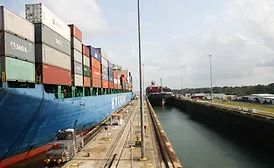
C.J. Schexnayder/ENR Balboa Port, Panama City, Panama. Each day thousands of cargo containers cross almost 50 miles of the Isthmus of Panama. But they aren’t going through the famed Panama Canal. In the past five years, traffic on a 47.6-mile railroad has jumped. It is a cooperative system between Panama Ports Co.—which operates primary container ports on both sides of the isthmus—and the Panama Canal Railroad Co. “The canal is the magnet that draws the cargo here,” says Dave Starling, president of the Panama Canal Railway Co. “Once the cargo is in Panamanian waters you have the opportunity for transshipment.”
 RSS
RSS