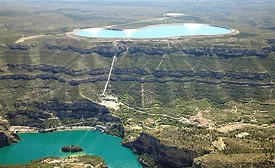
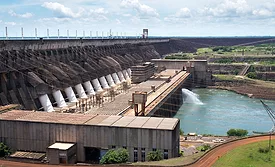
Pumped-storage hydroelectricity, a mature technology first developed in the 1890s, is playing an increasingly important role in the current era as wind and solar power advance. ENR takes a look at some of the largest pumped-storage facilities in the world.
New York state could replace electricity from the Indian Point nuclear power plant through improved efficiency and imported hydropower, says a Feb. 23 study by the Natural Resources Defense Council and Riverkeeper.
Work on the much-delayed 3,600-MW Soviet-era Rogun hydro dam in Tajikistan is resuming under a $3.5-billion deal with Milan-based Italian contractor Salini Impregilo S.p.A.
Critics from industry and academia are raising questions about a study from the University of Oxford's Saïd Business School about the true cost of large hydropower dams.
To help remote communities and developing nations adopt sustainable energy infrastructure, Oregon State University researchers recently released an open-source, small-scale hydropower assessment modeling package.
The U.S. Army Corps of Engineers has signed an agreement with the Tennessee Valley Authority; the Tennessee Valley Public Power Association, which represents regional utilities; and the U.S. Southeastern Power Administration, a federal hydropower marketing agency, to provide $1.2 billion over 20 years for the repair of hydropower facilities.
The contract involves the construction, with financing from Italy’s credit agency Servizi Assicuative de Commerce Estero, of the 2,200-MW Koysha Dam on the Omo River in the southern part of the country.
A combination of economics, technological advances and rapid change in the electricity business has halted a Sacramento Municipal Utility District (SMUD) project to construct a 400-MW pumped-storage hydroelectric project.
When the U.S. Congress adjourned in December, it scrapped a water-rights settlement package meant to end years of bitter haggling in California and Oregon’s Klamath Basin among farmers, fishermen, utilities ratepayers and environmentalists.
Investigating safety concerns posed by the $4.8-billion Grand Renaissance Dam in Ethiopia, a joint committee comprising representatives from Egypt, Ethiopia and Sudan, among others, recently made its last trip to the hydropower-plant site before compiling its report.