A Senate committee has approved an $11-billion water-resources bill authorizing funds for 27 new Army Corps of Engineers projects. But in a striking change from similar past measures, the new one has an array of drinking-water and wastewater provisions, too, including a new trust fund.
Judging from figures in spending bills making their way through Congress, the Army Corps of Engineers civil-works program is in line for a modest fiscal year 2017 funding increase that will nudge the total to a new high.
Hopeful signs are emerging on Capitol Hill that Congress will pass a Water Resources Development Act, or WRDA, this year, just two years after the last one became law.
Eight senators and an industry-and-labor coalition are lobbying for 2017 funds for a long-delayed Army Corps of Engineers navigation and environmental program in the Midwest.
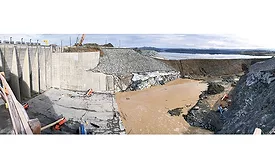
After a Kiewit employee detected a leak early on Jan. 20 in a temporary cofferdam protecting workers and downstream interests on the $900-million Folsom Dam Auxiliary Spillway Project in California, the U.S. Army Corps of Engineers evacuated a dozen crew members and equipment while the U.S. Bureau of Reclamation (USBR) closed the bulkhead gates to prevent catastrophic flooding in the event of a cofferdam failure.
A little more than three months into his tour as the 53rd U.S. Army Chief of Engineers and Commanding General of the Corps of Engineers, Lt. Gen. Thomas P. Bostick is analyzing what he has learned from a round of site visits and assessments of the state of the Corps.