UK and Finnish technologies provide designers quicker reads of embodied carbon impacts of their structural and materials choices. "We've been waiting for [something like this] for as long as I've been in the industry," says one engineering firm manager.
Growing up, Brian Earle’s family moved every couple of years. He was born in Heidelberg, Germany; relocated several times to U.S. cities; and attended high school in Seoul, where he lived within artillery range of the North Korean border.
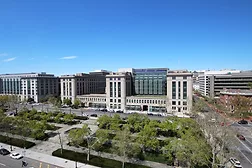
Amazon’s 2.1-million-sq-ft Metropolitan Park office development near the nation’s capital could become a model for other large-scale sustainable projects. The building team is tracking a 15% reduction in embodied carbon in the project's 200,000 cu yd of concrete and the two 22-story buildings are on course to qualify as net-zero operational carbon.
President calls for ambitious emissions reductions in federal buildings government-wide that would require a long-term commitment over several succeeding administrations.
The Structural Engineering Institute of the American Society of Civil Engineers, which has kicked off the first U.S. campaign aimed at reducing embodied carbon in structural systems, is issuing a call for engineers to join the crusade.
In an unprecedented collaboration, Amazon, Facebook, Google, Microsoft and Salesforce, along with floor covering supplier Interface are showing their collective commitment to embodied carbon reduction by joining the board of Building Transparency—a nonprofit formed recently to further develop a free-to-use digital tool for estimating embodied carbon in building construction, called the Embodied Carbon in Construction Calculator.
HeidelbergCement unit launches feasibility study to install technology to capture and store almost all carbon emissions for potential resale on the market.
The U.S. Green Building Council recently announced LEED Positive – a vision statement and LEED development roadmap that USGBC hopes will lay the foundation for a “regenerative” built environment.