Military Construction
Corps of Engineers Advances $986M San Antonio Cyber Center with Progressive Design-Build Delivery
600,000-sq-ft secure complex will support the US Air Force's cybersecurity efforts
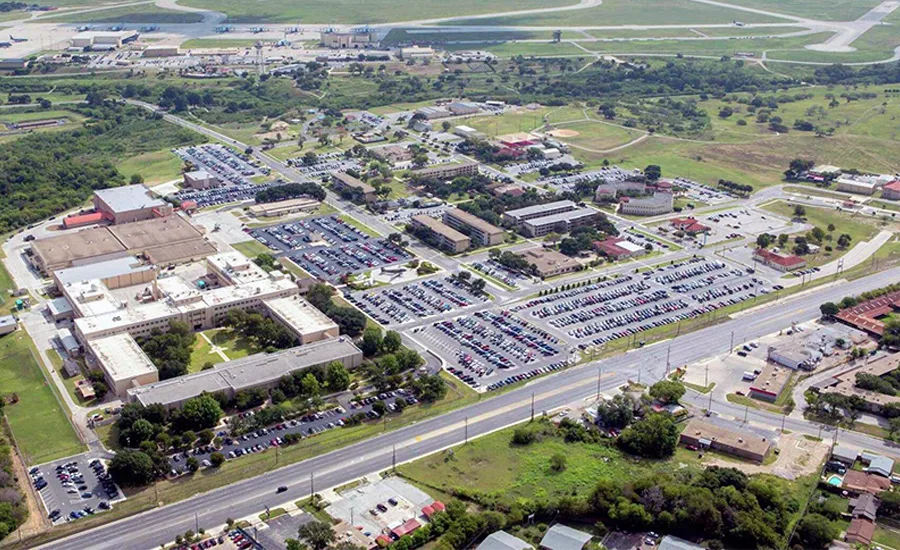
The planned $986-million cyber and intelligence operations center at Lackland’s Security Hill would be among USACE’s first progressive design-build projects using Other Transaction Authority.
The U.S. Army Corps of Engineers on July 22 released new schedule and scope details for a cyber and intelligence operations center at Joint Base San Antonio-Lackland programmed at $986 million, moving what the Corps describes as one of its first progressive design-build projects using Other Transaction Authority toward competition.
Industry-day slides describe an approximately 600,000-sq-ft main facility and a separate 12,500-sq-ft central utility plant. The Corps anticipates posting the request for qualifications Aug. 26, with responses due Sept. 25. The center would support the 16th Air Force’s cyber, intelligence, surveillance, reconnaissance, electronic warfare and information operations missions.
A spokesperson for the Corps told ENR it received a directive for the facility within the fiscal 2028 military construction program at Lackland’s Security Hill, with planned occupancy exceeding 3,000.
The Corps had identified the progressive design-build and OTA structure in a June 15 special notice. The July 22 update added the industry-day slides and an attendee sign-in sheet. The notice says industry-day questions and answers will be posted later, and the solicitation has not yet been issued.
According to the procurement notice, the multistory facility would use a high-performance structural-steel frame on a reinforced-concrete foundation and incorporate enhanced security measures, including resistance to progressive collapse. An integrated visitor control center would manage access to the secure campus.
A substantial portion of the building would house a purpose-built cyber operations data center supporting high-performance computing, artificial intelligence server clusters and machine-learning systems. Plans call for scalable, high-density electrical infrastructure capable of future expansion.
The Corps issued an enterprise playbook for progressive design-build through OTA this year. The document calls the method a “fundamental evolution” in how the Corps delivers mission-critical infrastructure. OTAs operate outside the Federal Acquisition Regulation, the work is governed by the negotiated agreement rather than the standard federal contracting framework.
Looking for quick answers on construction and engineering topics?
Try Ask ENR, our new smart AI search tool.
Ask ENR →
The Corps previously tested construction OTAs on a $40-million Fort Campbell barracks renovation awarded in 2024, its first construction agreement using the authority.
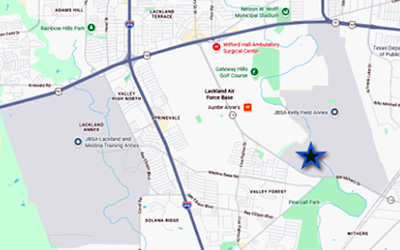
The planned 600,000-sq-ft cyber and intelligence center would be built on Lackland’s Security Hill, southeast of the installation’s airfield and near Valley Hi Drive.
Map courtesy of USACE
“The success of this project is reshaping how USACE approaches construction acquisition, especially for projects requiring speed, flexibility and innovation,” Louisville District Engineering Design Branch Chief Carl Mudd said of the Fort Campbell pilot.
There will be an initial firm-fixed-price award for design and preconstruction services, followed by an option for final design and construction. The progressive design-build team will be selected primarily on qualifications and experience before the project’s final design, construction price and schedule are established.
The government plans to shortlist up to three teams for mandatory one-on-one pitch meetings testing technical expertise, communication and problem-solving before making a “most qualified best-value” selection not based on lowest price.
The notice says teams in the first phase typically advance the design to approximately 60% to 90% completion while providing open-book cost estimates, constructability reviews and value-engineering recommendations. The selected team would then submit a commercial proposal for the remaining design and construction work.
RELATED
Defense Authorization Bill Signed Into Law, Locking in Progressive Design-Build
If the Corps accepts the price and schedule, it would authorize the second phase. If the parties cannot reach agreement, the Corps could use an off-ramp allowing the government to take the completed design and procure construction through another method.
The notice also requires firms to be entirely U.S.-owned and operated, maintain Level 2 Cybersecurity Maturity Model Certification and provide personnel experienced with secure facilities and eligible for security clearances. Teams also must document at least $1.2 billion in bonding capacity.
A spokesperson for the Corps referred further questions to the Air Force Civil Engineer Center. The value, construction schedule or funding status of the initial phase have not been publicly disclosed.

Bryan Gottlieb is the online editor at Engineering News-Record (ENR).
Gottlieb is a five-time Society of Professional Journalists Excellence in Journalism award winner with more than a decade of experience covering business, construction and community issues, including finance, law and real estate. He has reported for Adweek and the San Diego Daily Transcript and led a community newsroom in Santa Monica, Calif. He served as editor-in-chief of the Detroit Metro Times and as managing editor at Roofing Contractor, where he helped shape national industry coverage. At Engineering News-Record, Gottlieb covers breaking news, large-scale infrastructure and megaprojects, regulatory developments and business trends across the U.S. and global construction sectors.
email: gottliebb@enr.com | office: (248) 786-1591


