Megaprojects
UAE Advances World's Second-Largest Offshore Oil Field Into EPC Phase
Years of engineering and procurement culminate in tender awards for the next phase of the offshore field expansion
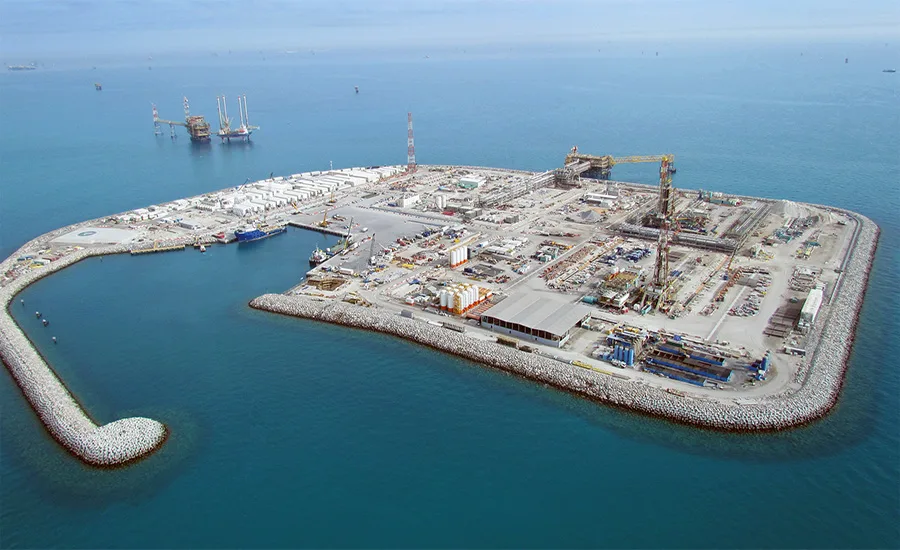
An artificial island at the United Arab Emirates' Upper Zakum offshore oil field supports drilling, processing and utility infrastructure as part of the country's long-running expansion of one of the world's largest such developments.
Abu Dhabit National Oil Co., the state-owned energy company of the United Arab Emirates, and its partners have issued engineering, procurement and construction tender awards for the next phase of the Upper Zakum offshore oil field expansion, according to a June 26 disclosure by project partner INPEX.
Upstream, an offshore energy publication, subsequently reported that UAE-based NMDC Energy, U.S.-based contractor McDermott and Italian contractor Saipem received the awards, although neither the oil firm, known as ADNOC, nor the reported contractors have publicly confirmed the awards or immediately responded to ENR's requests for comment.
Neither INPEX nor ADNOC disclosed package values. Industry reports have described the expansion as a program valued at more than $10 billion.
Upper Zakum is operated in partnership with ExxonMobil and Japan Oil Development Co., an INPEX subsidiary.
Located about 52 miles northwest of Abu Dhabi in the Persian Gulf, Upper Zakum is part of the Zakum field, which ADNOC describes as the world's second-largest offshore oil field. Oil was discovered there in 1963; ADNOC launched development of the Upper Zakum reservoir in 1977.
INPEX's June 26 disclosure follows several years of engineering, design and procurement activity, including front-end engineering and a three-package procurement process for the current Upper Zakum expansion previously reported by MEED, a Middle East business publication.
The project is intended to increase Upper Zakum's production capacity to 1.5 million barrels per day, the latest milestone in a decades-long effort to expand and modernize the offshore field.
Looking for quick answers on construction and engineering topics?
Try Ask ENR, our new smart AI search tool.
Ask ENR →
According to ExxonMobil, the development is built around four artificial islands, the largest of which is roughly the size of 135 American football fields. The islands were designed using hydrodynamic modeling tailored to local tidal and wave conditions.
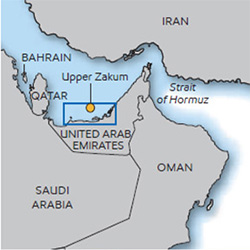
Map shows the location of the Upper Zakum offshore oil field in the Persian Gulf, about 52 miles northwest of Abu Dhabi, United Arab Emirates.
Map courtesy of ExxonMobil
ExxonMobil says the island concept supports higher-capacity land drilling rigs while replacing portions of the field's legacy offshore platform and pipeline network with more durable and capital-efficient infrastructure, combining extended-reach drilling with fewer wells and drilling locations.
Earlier phases established much of the infrastructure supporting the current development. A 2011 Technip engineering contract covered front-end engineering for process units, including gas separation, gas-lift compression, booster gas compression, power generation, utilities, interconnecting pipelines and modifications to existing facilities.
Engineering documents from an earlier Upper Zakum expansion reviewed by ENR describe additional island-based surface facilities, including water-injection plants, produced-water treatment and disposal systems, well manifolds, local equipment rooms, production debottlenecking and helipad facilities, as well as integration with “Project Lightning,” ADNOC’s offshore electrification program.
The $3.8 billion, 3.2-GW electrification initiative uses two high-voltage direct-current subsea transmission links, each extending more than 80 miles, to connect offshore operations to the UAE's onshore power grid and replace offshore gas-fired electricity generation. ADNOC says the network is the first high-voltage, direct-current subsea transmission system in the Middle East and North Africa.
RELATED
UAE Awards Petrofac $615M EPC Contract for Carbon-Capture Project
ADNOC's artificial-island development strategy has also enabled increasingly longer extended-reach wells.
In 2022, the company announced it had drilled the world's longest oil and gas well from Umm Al Anbar Island, reaching a measured depth of 50,000 ft—about 9.5 miles—while accessing additional portions of the reservoir without expanding the offshore footprint.
INPEX said the EPC awards support its strategy to expand its business by 60% by 2035.

Bryan Gottlieb is the online editor at Engineering News-Record (ENR).
Gottlieb is a five-time Society of Professional Journalists Excellence in Journalism award winner with more than a decade of experience covering business, construction and community issues, including finance, law and real estate. He has reported for Adweek and the San Diego Daily Transcript and led a community newsroom in Santa Monica, Calif. He served as editor-in-chief of the Detroit Metro Times and as managing editor at Roofing Contractor, where he helped shape national industry coverage. At Engineering News-Record, Gottlieb covers breaking news, large-scale infrastructure and megaprojects, regulatory developments and business trends across the U.S. and global construction sectors.
email: gottliebb@enr.com | office: (248) 786-1591