Highways
New Park Over I-35E in Dallas Exemplifies a Transportation Trend
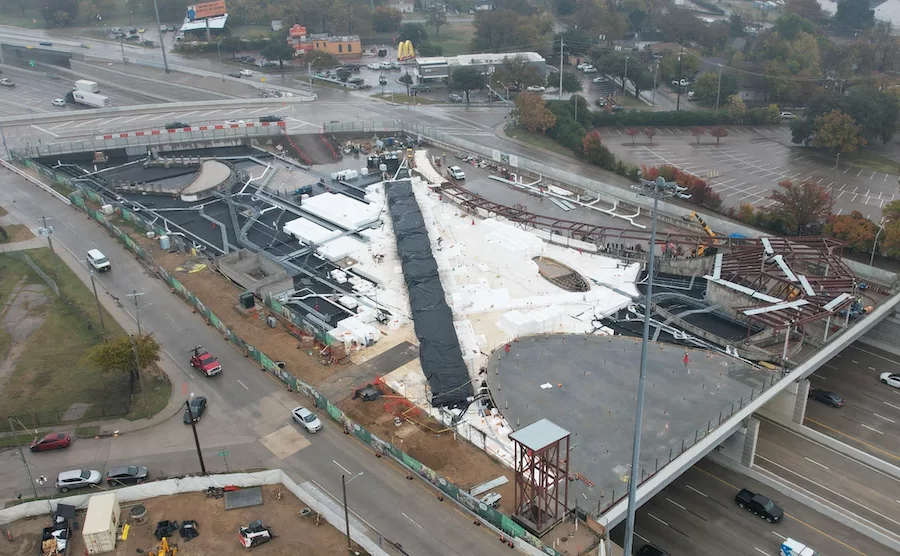
Crews installed 450,000 cu ft of geofoam on the highway cap for the new park sited over I-35E in Dallas.
Design of the second phase of Halperin Park over Interstate 35E in Dallas is underway, following the initial opening of the first 2.8 acres last month. The $300-million cap project that reconnects neighborhoods divided by the original highway construction included widening of the highway and the bridge “cap” atop it. The design, led by SWA for landscaping and HKS for architectural elements, will expand Halperin Park to more than five acres.
The highway cap project is one of many across the country that aims to reconnect communities divided by 1950s-era interstate highway construction. Project officials emphasize the extensive input of the communities of Oak Cliff in shaping the vision for the park atop the cap. In its role as project program developer and owner's rep, Bjerke Management Solutions coordinated the array of project and community stakeholders.
“With [the Texas Dept. of Transportation] putting in a platform for the deck based on a previous design, much of what we did was to take the community’s hopes and dreams, and coordinate with TxDOT,” says Russell Crader, global practice director of culture and principal with HKS. “We were fine-tuning weights, materials; it was a jigsaw puzzle.” Community input influenced every element “down to a tree,” he adds.
In a joint press release, the design firms note: “In 2017, as TxDOT initiated a full reconstruction of I-35E, community leaders identified an opportunity to reverse that legacy by building a park atop the highway, creating new public land where none existed and bridging together the severed neighborhood.
“Halperin Park was designed to feel grounded in Oak Cliff’s unique landscape, history, and daily life," the press release noted. "Sculpted landforms echo the area’s escarpments and topography, while a variety of programmed spaces support recreation, performance, learning and retreat.”
Highlights include a 12th Street Promenade running north-south across the deck, forming the primary pedestrian spine and lined with trees, seating and cultural elements; a “great lawn,” a timber bandshell performance space; programmed water features; perennial gardens; a wood pavilion and shaded plaza hosting vendors and performances; a series of steps forming an outdoor venue accommodating 300 people; a playground with wood structures, stone benches and a future grove; and a roof terrace that will be expanded in Phase 2.
The release continues: “Sculpted landforms rise from the deck to form an abstracted escarpment that references the chalk, shale and limestone strata underlying the Oak Cliff neighborhood. Formed with glass fiber-reinforced concrete panels, the escarpment provides visual identity while buffering views and sound from Interstate traffic below.”
Looking for quick answers on construction and engineering topics?
Try Ask ENR, our new smart AI search tool.
Ask ENR →
As TxDOT began its I-35E expansion, the release notes, the Southern Gateway Public Green Foundation formed an Equitable Development Plan Task Force, led by Dr. Lorin Carter of C-Suite Equity Consulting. The task force engaged more than 500 residents, businesses and organizations to shape the park’s Community First Plan, which addresses six focus areas: history and culture, economic development, health and wellness, education, housing stability and neighborhood safety.
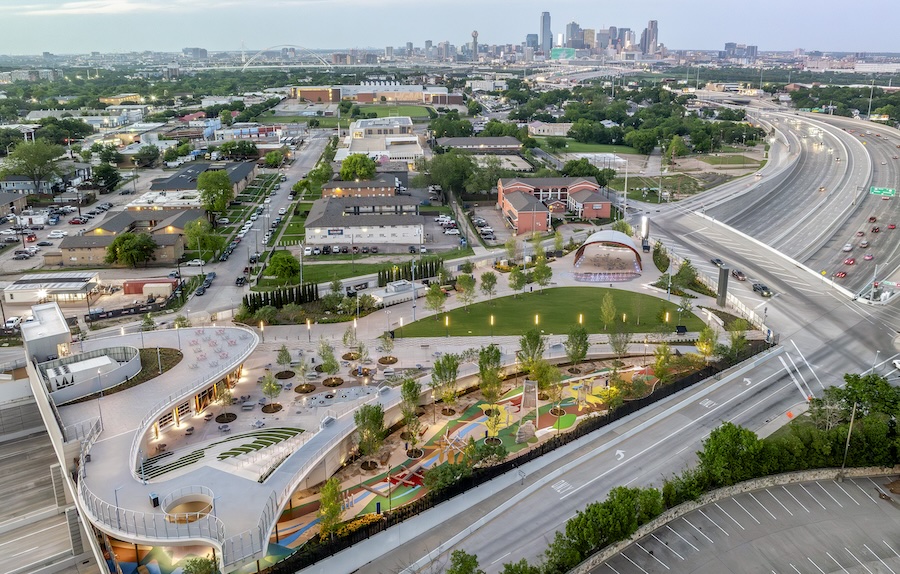
Halperin Park's design was heavily informed by community stakeholders.
Photo courtesy SWA/Bill Tatham
“We spent a year on that plan,” says April Allen, the foundation’s president and CEO. While there was an initial conceptual design, “Our board wanted to start fresh—with community ideas at the center of the work. We initiated a new RFP process to identify and select a design team … made up of people who understood our communities.”
The foundation formed a public-private partnership to raise the funds, which include philanthropic donations, bonds and a $25-million IIJA grant. The TxDOT-led cap project over the highway was approximately $47 million.
A preliminary analysis by the University of North Texas at Dallas estimates that Phase I alone could attract more than two million visitors annually and generate over $1 billion in economic impact within its first five years, including increased property tax revenue and retail activity, notes the release.
“Community engagement was the first step,” says Todd Strawn, principal with SWA. Despite the pandemic, the engagement continued. “We were gathering as much information as we could,” he recalls, with 15 design sketches as a result. “We knew it would be phased. The key program elements – water, playground, green space, bandshell, multipurpose [facilities] —would be in Phase 1. Phase 2 will add more playgrounds and gathering spaces.”
Lawns and Loads
WSP analyzed the cap and the various loads involved with the park, including the 250,000-lb canopy and the various structures, says Mofid Nakhaei, lead structural engineer. “We couldn’t analyze it like a typical bridge. We worked with the designers to revise some of the loads to accommodate the existing bridge superstructure.” For example, the team used geofoam for soundproofing and for its lighter weight compared to conventional materials, at 2.5 lb per cu ft, Nakhaei says.
The joint venture of McCarthy and EJ Smith in its approximately $58-million contract installed 450,000 cu ft of geofoam in five months, says senior project manager Thomas Shepheard. “We waterproofed the bridge deck and created a bathtub 4.5 ft deep from adjacent roadways, and put utilities in.”
Building a structure on the edge of the new bridge with the Interstate some 65 ft below, “we had to figure out how to build up to the edge without compromising safety,” adds Shepheard. TxDOT allowed the team to do 30 nights of up to two lane closures for night work. “We worked with a trade partner, BakerTriangle Prefab, who prefabbed the wall panels,” Shepheard says. The 13 cold-form metal panels range from 20- to 32-ft tall and 8-ft to 10-ft wide.
KSC Inc. served as metal panel fixture fabricator for architectural facades on three panels and Equity Glass and Glazing worked with Baker to install windows horizontally in a shop environment, he adds. Crews also installed glass fiber-reinforced cornices for the elevated zoo landing structure.
With elevation changes of some 8 ft, the park is essentially a two-story space, says Allen, with the promenade as the backbone in the middle. Crader adds that the multipurpose building, double-curved bandshell gateway and playground equipment together constitute “one of the biggest uses of mass timber in Dallas.”
The multipurpose building consisted mostly of southern yellow pine from Alabama, fabricated in Tennessee, says Shepheard. Crews installed a dozen columns of Douglas fir in front, with roof panels as heavy as 3,000 lb and beams up to 2000 lb. The cross-laminated timber roof consists of 3 layers, each 4.5 in. thick.
Timber and Trees
The bandshell canopy consists of seven arches of Germany larch. “We hired StructureCraft—they designed, procured and installed them in a turnkey job,” says Shepheard. “There are three components of double-curved glulaminate for each arch. It takes on a saddle shape.”
The arches’ clear spans range from 45 ft to 55 ft, with heights of 20 ft in the back, and more than 27 ft in front, held together with round metal perlins. Manufactured and preassembled in Germany, the arches arrived by boat and were erected with a 200-plus-ton crane.
The park’s planting design emphasizes resilient species capable of withstanding North Texas’ seasonal temperature swings and periodic drought, the team says. More than 100 trees representing roughly ten species are beginning to establish canopy across the site. Evergreen plantings provide year-round structure, while more than a dozen flowering perennials and shrubs introduce seasonal color. Native grasses of six species add texture and movement while supporting habitat and ecological health.
Design for phase two to add 2.4 more acres of park may take around two years, and may include a dog park, a second pavilion and bridge linking to the Dallas Zoo. Because of the extended cover over the highway, “fire-life safety will be a significant design item," Nakhaei says, noting potential jet fans, lighting and electrical systems.
Some current WSP staff and McCarthy were involved with a similar previous cap-and-park project in Dallas—Klyde Warren Park. “It helped [McCarthy] understand how to build [cap parks],” Shepheard says. Like Halpern, Klyde Warren Park will also expand by some two acres, with construction expected later this year.
With other highway expansions such as an $888-million, 2.3-mile I-30 Canyon Project between the I-35E and I-45 interchanges in downtown Dallas, more projects like Halperin Park are anticipated for the region, Nakhaei says. “In the next five to ten years, we’ll likely see many more deck parks.”