Construction Technology
Trunk Tools Launches Cortex AI Platform to Interpret Construction Drawings
Platform is designed to connect drawings, RFIs, specs and submittals while supporting workflow agents across project documents
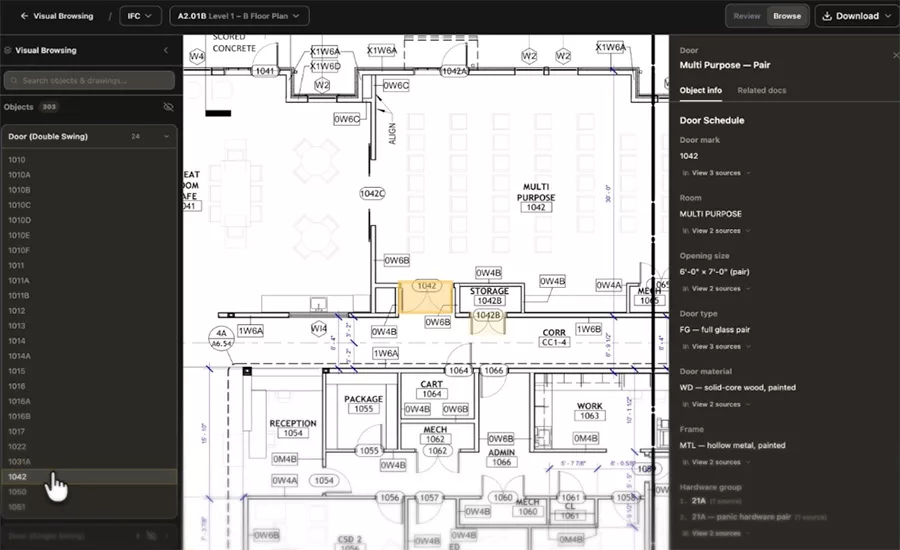
Trunk Tools' Cortex platform displays a floor plan alongside linked project information, allowing users to select a drawing object and view associated specifications, schedules and other project records.
New York-based construction technology vendor Trunk Tools on June 17 unveiled Cortex, a new AI intelligence layer in its platform trained to interpret construction drawings and connect them with specifications, RFIs, submittals, schedules and change orders.
The AI layer is trained on construction drawings, markups and the visual language of construction. The company says the platform powers seven AI workflow agents and is the product of four years of development alongside some of the nation's largest general contractors.
While AI tools have expanded across construction, Trunk Tools and many large contractors continue to say drawings and their interpretation remain a significant obstacle because software must interpret symbols, revisions and relationships across hundreds or thousands of sheets in a single project set while connecting those elements to project records.
"What we've built with Cortex isn't just a better AI tool; it's a new architecture for how construction gets done," said Sarah Buchner, founder and CEO of Trunk Tools. "We've gone from agents that assist individuals to agents that work together, sharing context and acting without waiting for a human to connect the dots."
The launch comes as construction technology providers race to expand AI capabilities, with Procore integrating recent acquisition DataGrid and its AI agents while contractors, including Gilbane, have deployed earlier Trunk Tools AI agents.
"We have trained for years AI models specifically on construction drawings," Buchner said. "We're now at a point where our AI can detect hundreds of different objects on drawings and actually compare different drawings to each other."
Among the Cortex capabilities is the ability to identify changes that occur outside revision clouds, a common source of missed scope changes and downstream rework.
Looking for quick answers on construction and engineering topics?
Try Ask ENR, our new smart AI search tool.
Ask ENR →
Trunk Tools says Cortex can compare revised drawing sets, identify modifications and analyze how those changes affect related project documentation.
"We can tell you exactly what changed," Buchner said of revised drawing sets. "We can tell you exactly what changed, what the architects are trying to hide."
She cited a recent example involving an electrical-related issue outside a revision cloud that she estimated carried approximately $60,000 in project impact.
Cortex also supports drawing review, RFI analysis, bid comparison and submittal workflows. While 3D models have been generally touted as a solution to such issues coming out from 2D drawings, the majority of construction, worldwide, is still based on documents as the single source of project truth for reasons of both practicality and legal risk.
RELATED
Gilbane Rolls Out Trunk Tools AI Agents Across Its Jobsites
Contractor Reports Early Results
Cleveland Construction, based in Mentor, Ohio, began piloting Trunk Tools before expanding its use. Elliot Christiansen, the contractor's senior vice president of operations, said submittal review is often assigned to less-experienced project engineers despite being one of project management's more technical responsibilities.
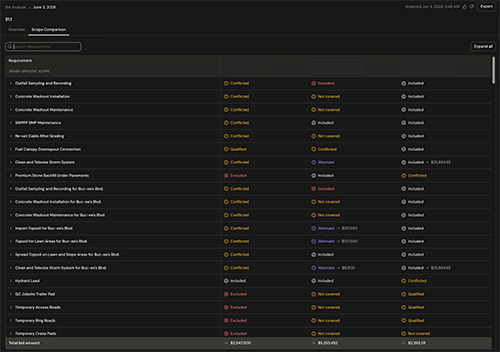
Trunk Tools' compliance review categorizes requirements as compliant, partially compliant, or non-compliant, helping teams focus on exceptions instead of reviewing all requirements. Cleveland Construction reports these workflows reduce review times and detect issues earlier.
Courtesy of Trunk Tools
"Inherently in the business and construction, we give the most inexperienced part of the project management staff the submittal review for whatever reason," Christiansen said. "And it's probably one of the hardest technical things to wrap your head around as somebody new in the industry."
The company reported reducing submittal review times from roughly two hours to less than 10 minutes by routing submittals through Trunk Tools before project staff review them.
The software compares product data against specification requirements and categorizes items as compliant, partially compliant or non-compliant, allowing project teams to focus their attention on potential issues.
One recent example involved a waterproofing membrane specified for an underground elevator shaft. Christiansen said the Cortex AI identified a warranty discrepancy buried in fine print within product documentation.
"The warranty in the specifications was supposed to be a 10-year warranty," he said. "On the product data, buried in this really fine text at the bottom of the table, was that the warranty for the product was only one year."
Christiansen said the discrepancy was identified before installation. He added that the system also helps identify missed ASTM and ANSI standards and other specification requirements that less-experienced staff may overlook.
The contractor reported reducing average submittal cycle times from 55 days to 13 days by improving first-pass accuracy and reducing revise-and-resubmit cycles.
Christiansen said Cleveland now provides architects with compliance review tables generated by the system alongside submittal packages, which has improved review efficiency and strengthened relationships with design teams.
In one pilot project in Orlando, Fla., an architect was sufficiently impressed with the process to recommend Cleveland Construction for another project, Christiansen said.
"The biggest problem around AI adoption is not which tech you choose or security or data," Buchner said. "The biggest one is how do you get your workforce AI-ready?"
Contractors that have seen the most success, she said, are those where leadership drives adoption rather than waiting for field teams to discover the tools on their own.
"If there's any additional work required in the field—where you make anybody's job any harder—they're just not going to [use] it," Christiansen said of construction technology adoption. "They're going to keep doing it how they've always done it.”

Bryan Gottlieb is the online editor at Engineering News-Record (ENR).
Gottlieb is a five-time Society of Professional Journalists Excellence in Journalism award winner with more than a decade of experience covering business, construction and community issues, including finance, law and real estate. He has reported for Adweek and the San Diego Daily Transcript and led a community newsroom in Santa Monica, Calif. He served as editor-in-chief of the Detroit Metro Times and as managing editor at Roofing Contractor, where he helped shape national industry coverage. At Engineering News-Record, Gottlieb covers breaking news, large-scale infrastructure and megaprojects, regulatory developments and business trends across the U.S. and global construction sectors.
email: gottliebb@enr.com | office: (248) 786-1591