Building Information Modeling
Startup Illoca Brings Tracing Paper Feel to BIM/CAD Design
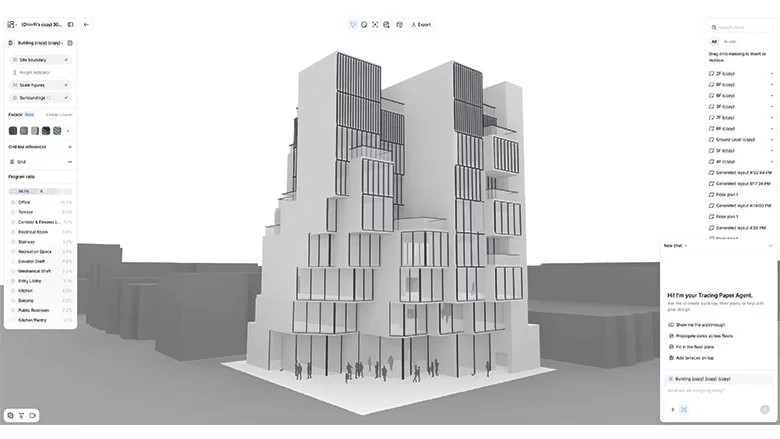
This Illoca model was created from a human drawing with AI assisting the math.
Well-funded startups including Motif Systems and Arcol have brought more architect-friendly, web-native design tools to market in recent years. In May, another approach came from Illoca, a startup whose artificial intelligence-native design engine was made to return creative agency to all designers.
Illoca closed a $13-million seed financing round led by Bessemer Venture Partners, with participation from AIX Ventures, Root Ventures and Alt Ventures in May. Unlike other upstarts looking at replacing authoring tools such as AutoCAD and Revit with a web-based, SaaS option, Illoca’s interface product is Tracing Paper, a digital interface that lets design professionals create on a digital canvas instead of a parametric interface that demands x- and y- axes be locked to reference planes.
“We are looking to provide the experience of how natural collaboration and design iteration happen in any architecture and construction firm,” says Chin-Yi Cheng, an Illoca co-founder and CEO with experience at Google’s Deep Mind and as Autodesk’s principal research scientist. “We use Tracing Paper, we pin up, we discuss, we iterate, we express ourselves using visual communication—like sketches, diagrams, mock ups. That’s the most accurate interaction pattern, so we want to provide that [and] enhance that, instead of adding another layer on top of existing modeling.”
Tracing Paper allows designers to use sketches, markups and natural language, while Illoca’s AI agents understand those inputs and generate 2D and 3D designs from them. Cheng—who co-founded the company with Chiaowei Yu, formerly Tesla’s virtual design and construction manager—stressed that Tracing Paper is not just an architectural design tool, but a platform for all disciplines, giving designers and contractors a decision-making process that values the whole building team’s input.
“Structural design, MEP design—it’s all about how much you iterate and discuss and balance and use your professional judgment to balance the trade-offs,” she explains. “Our tool is not a button you click on and the AI magically makes everything happen, but it’s a tool to enhance the way you compare the trade-offs of one approach or another.”
While it’s still early in the adoption of browser-based design tools, Illoca has already seen adoption from companies such as Japan’s Kajima Corp., one of the world’s largest design and construction companies.
“Early-stage design exploration is where creativity matters most, but it’s also where traditional tools are the most limiting,” says Yasuhiro Nakano, chief architect at Kajima. “Illoca allows our team to iterate through multiple options … while preserving the architectural intent behind every concept.”
Looking for quick answers on construction and engineering topics?
Try Ask ENR, our new smart AI search tool.
Ask ENR →