Construction History
From the Archives: August 16, 1984


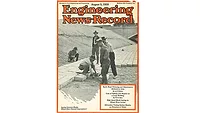
This 1984 cover depicts the world’s first full-scale tension leg platform. Positioned in the North Sea, 260 miles off the Scottish coast, above the Hutton oil field, it was anchored to the seabed in 485-ft-deep water by 16 steel tethers.
The floating structure could swing to either side of its foundations like an inverted pendulum by up to 68 ft, eliminating vertical movement and revolutionizing deepwater oil and gas extraction.
Its 300-ft-by-300-ft base featured pontoons which supported six, 200-ft-tall columns built in a dry dock, with a 26,000-ton hull and a 19,000-ton 250-ft-by-243-ft steel deck. Developer Conoco UK Ltd. employed Bechtel Great Britain Ltd.; Brown & Root (UK) Ltd., and British naval architect Vickers Offshore Ltd. to design the floating vessel and foundations.
Each of the tethers (also known as tendons) consisted of a 106-ton string of 17 specially designed 10-in.-dia steel pipes threaded together. Each tendon had a ball joint at the top and bottom, which had to carry loads of up to 3,100 tons.
The bottom ball joints joined connectors which incorporated hydraulic rams, which passed fluid up and down the 3-in.-dia core of the tendons. Murdoch Machine and Engineering Co., a subsidiary of Lockheed Aircraft Corp., employed by Vickers, designed the tendons using technology Lockheed developed for swivel sprockets on space vehicles.
The 62,000-ton platform, which accommodated up to 100 crew members, operated until 2001. The topsides were purchased by a subsidiary of Gazprom and installed on a new platform in the Barents Sea. The hull was decommissioned in Scotland.
Looking for quick answers on construction and engineering topics?
Try Ask ENR, our new smart AI search tool.
Ask ENR →