Government
FEMA Report Steps Up Push to Put States in Driver’s Seat of Disaster Recovery
Review council recommendations, some of which would need congressional approval, come as the current agency chief is fired
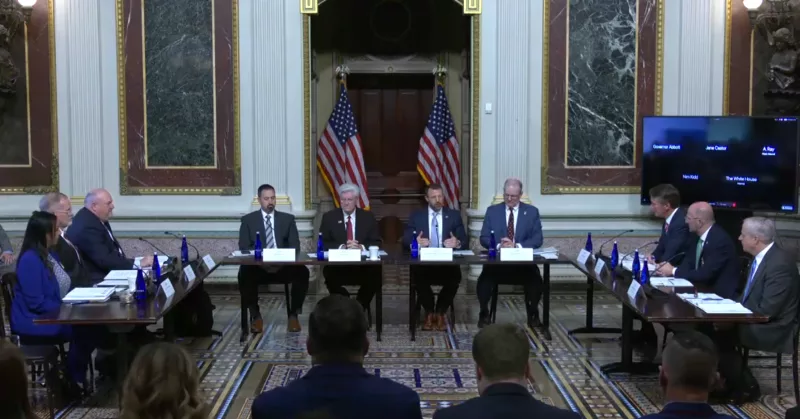
FEMA Review Council released recommendations based on public comment, emergency management personne surveys, and state and local leader input.
The Trump administration’s long-awaited final report on Federal Emergency Management Agency reforms aims to make states chiefly responsible for disaster recovery while tapping resources of the federal agency for support.
“FEMA is not the first responder, but rather a force multiplier standing shoulder to shoulder with states, tribes and local governments to ensure rapid and effective recovery,” U.S. Dept. of Homeland Security Secretary Markwayne Mullin said in a statement announcing release of the FEMA Review Council final report on May 7. The department oversees FEMA, and Mullin co-chairs the 12-member review council ordered by President Donald Trump..
The council report aligns with his repeated calls for states to lead disaster recovery efforts and makes 10 broad-based recommendations for doing so. Some could be made through executive orders but others would require congressional action. Trump initially called for abolishing FEMA,
The council, which Trump set up in January 2025, said it made the suggestions informed by more than 12,000 public comments, more than 1,300 responses to a nationwide survey of emergency management stakeholders in state and local governments; and 16 in-person and virtual feedback sessions with state and local government officials.
“The feedback received underscores widespread support for FEMA reform aimed at addressing inefficiencies, reducing bureaucratic barriers and enhancing support for disaster survivors and local governments,” the council said in the report.
Suggested Reform Measures Raise Concerns
Chad Berginnis, executive director of the Association of State Floodplain Manager, said, overall, the report lacks specificity. In some cases, it offers recommendations that would not necessarily fix stated problems, and in others, it is unclear what the solution would be, he added. The report “seems to impose a lot of standards and caps and requirements without showing much in the way of assistance and help to do that,” Berginnis noted.
Looking for quick answers on construction and engineering topics?
Try Ask ENR, our new smart AI search tool.
Ask ENR →
As an example, he said council recommendations related to the Hazard Mitigation Grant Program, a major focus for his group. The report recommends replacing the grant program with a state-managed one under a two-phase funding structure in which project priorities are nationally set and environmental reviews are done locally.
Berginnis said he is befuddled as to “why the report focuses on [the hazard grants] when it is the one program among three FEMA mitigation programs that largely does already what this administration wants to do. That is, it’s state-led.”
The program is mostly administered by states, but the report suggests replacing it with one aligned with federal priorities, “which is bizarre,” Berginnis said. “They’re kind of sticking their federal nose under the tent and rerouting some of that to federal priorities as opposed to following state priorities.”
Expert Critiques Report Reforms
Berginnis also pointed to the report’s mention of Office of Inspector General audits that show oversight of the grant program property acquisitions lack consistency across FEMA regions.
“We know of several states — Ohio, for example, is one of them — that have great online tools that track property acquisitions very carefully,” Berginnis said. “So why are you changing an entire program to deal with some states that maybe have bad tracking?”
The report suggests developing what it refers to as “rapid mitigation advance,” which would provide up to 5% of the federal government’s contribution to enable immediate residential mitigation within the first 30 days of the disaster. It would also implement “strategic mitigation allocation,” which would provide up to the remaining 10% of the federal contribution to improve performance by mitigating properties and critical infrastructure based on certain priorities.
Berginnis said those are good examples of the report providing solutions that will not fix problems.
“Having developed hundreds of mitigation projects in my career, I can say that advancing money in 30 days doesn't do anything for me because [hazard mitigation] projects, by their nature, tend to be more complex,” he said. Berginnis has worked with FEMA at various organizations for 33 years. “You have a process where you’re really needing to get community buy-in and think through some of the mitigation solutions," he said.
With large disasters, 30 days would not be enough time to even complete local ordinance requirements to determine if a building is substantially damaged or which codes it must comply with, he added.
The report also addresses concerns that a substantial portion of grant funding is spent on administrative and management expenses at federal, state and local levels. It recommends reducing such costs by replacing grant programs with direct funding that does not require administrative management.
Another recommendation calls for a review and rebalance of the ratio of staff at FEMA Washington headquarters and field offices “to reduce the agency’s bureaucratic bloat,” according to the report. The review would take place over two to three years and depend on implementation of the council report.
There are some positive aspects of the report, said Berginnis. These include plans to update hazard and risk information under the National Flood Insurance Plan. “We’ve only mapped a third of our flood risk in this country,” he said.
The report follows rumors that FEMA has begun hiring back some staff in preparation for hurricane season start June 1 and World Cup soccer trounaments this summer in the U.S., according to The New York Times. FEMA slashed more than 2,000 jobs last year and cut a number of its Cadre of On-Call Response/Recovery (CORE) positions earlier this year under fired Homeland Security secretary Kristi Noem.
The report also comes as Trump fired his latest appointed FEMA administrator, Karen Evans, in the job since last December, according to a May 12 report by Politico E&E News. Her temporary replacement is Robert Fenton, a veteran career agency manager who manages FEMA's California-based region operations.
Additionally, on May 11, Trump nominated Cameron Hamilton as the first permanent FEMA administrator in the president’s second term in office. Hamilton was acting head of FEMA from January to May 2025 but was fired after testifying before the House Appropriations subcommittee that he believed that FEMA should not be eliminated.