Safety & Health
Maryland Touts Work Zone Safety Improvements But Challenges Remain

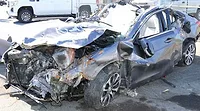
A 2017 Acura TLX was totaled after crashing into a highway work zone in Baltimore on March 22, 2023, killing six construction workers.
The state of Maryland has made strides in improving work zone safety since the deaths of six workers in a high-profile 2023 crash in Baltimore, but two recent highway fatalities provide grim reminders of the challenges all states face in protecting roadside activities.
On April 28, a Maryland Dept. of Transportation worker was killed when his stationary vehicle was rear-ended by another motorist as he reportedly tended to a maintenance project, according to local media reports. The worker was pronounced dead at the scene, while the other driver and a passenger were treated for their injuries.
 Matyland has made strides to reduce state highway work zone crashes, Chart courtesy of state of Maryland
The incident, which remains under investigation, occurred three days after a state DOT highway safety patrol worker was killed during a crash scene response on a ramp to the I-495 Capital Beltway. According to Maryland State Police, the worker was setting up traffic cones when he was struck by an oncoming vehicle.
As with other states, Maryland has relied on awareness campaigns such as the recent National Work Zone Awareness Week to alert motorists to the dangers routinely faced by the estimated 1,000 workers deployed each day at approximately 300 work zones statewide. The National Highway Transportation Administration reports that while work zone fatalities—including workers, drivers and passengers—decreased nationally by about 6% during 2023-2024, the percentage of fatal work zone crashes where speeding was a factor has increased, as did those involving rear-end collisions.
Excessive speed was found to have been the main factor in the deadly 2023 incident in Baltimore, when a collision between two vehicles traveling more than twice the posted 55-mph speed limit sent one careening through a work zone access opening where it struck miscellaneous construction materials and the six workers. Both drivers pled guilty to multiple counts of vehicular manslaughter. Lisa Lea, 57, whose vehicle was found to have initiated the crash and entered the work zone, was sentenced earlier this year to 30 years in prison. The second driver, Malachi Brown, 20, received an 18-month sentence.
In the following months, a multi-disciplinary work group chaired by Lt. Gov. Aruna Miller, herself a former transportation engineer who won a 2023 ENR Newsmaker Award, drew on input from technical experts and the public to craft regulatory and operational recommendations in education, engineering and enforcement. One outcome of that effort, the Maryland Road Worker Protection Act of 2024, authorized the State Highway Administration to expand its deployment of speed cameras and other technologies in construction, maintenance and utility work zones while also establishing an updated tiered system of fines based on the speed a vehicle travels above the posted speed limit. Fines are doubled when workers are present.
Looking for quick answers on construction and engineering topics?
Try Ask ENR, our new smart AI search tool.
Ask ENR →
In addition, the legislation has given that agency greater latitude in its use of speed cameras. “Where once the radar had to have an operator present, we’re now able to use more mobile, unmanned equipment to support work zones, as well as other types of operations,” says its Administrator Will Pines. “For bigger projects, we’re using point-to-point enforcement to calculate vehicle speed through longer areas encompassing work zones.”
Agency data shows that that in 2025, the program’s first full year of implementation, the number of work zone crashes also dropped by 12% in 2025, to 1,148. Nine work zone fatalities were recorded last year, a decrease of 25%.
“Interestingly, we’ve deployed more cameras statewide, but citations are lower by 17%,” adds Pines. “Our motorists, as well as those passing through Maryland, are starting to understand that excessive speed that puts workers at risk is not acceptable.”
The agenxy is also promoting deployment of other technologies at work zones, including automated flagging systems and wearable emergency lights for safety vests.
Although preliminary data for 2026 shows a continued, gradual downward trend in work zone crashes, Pines says the real challenge is changing cultural perceptions of speed. Among citations issued for work zone speed violations in 2025, 19 involved drivers traveling in excess of 130 mph.
“We love speed, and assume it’s good,” Pines says. “We need to educate people that it’s not the case.”
Highway contractors and their employees should be part of that effort as well, he adds.
“We encourage them to have conversations with families and friends about being safer, and set a good example themselves when they’re behind the wheel,” Pines explains. “Everyone deserves to get home safely.”
_ENRready.webp?height=200&t=1706203957&width=200 "Maryland Lt. Gov. Aruna Miller (D)")