Ten Minutes With Jacobs' Patrick Hill
Hill chatted with ENR about working in a variety of sectors around the world, de-risking projects and addressing resilience.
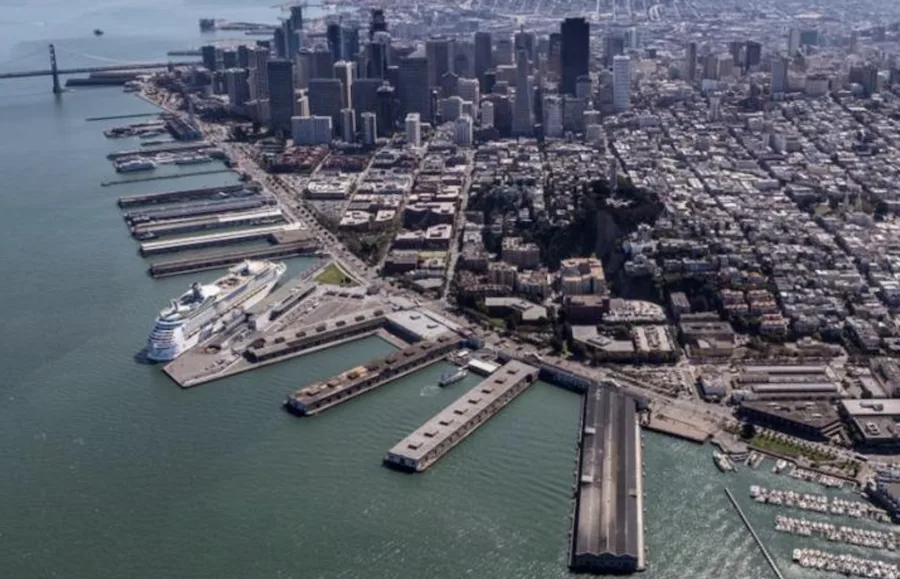
Jacobs leads a team working on making the Port of San Francisco's waterfront more resilient.
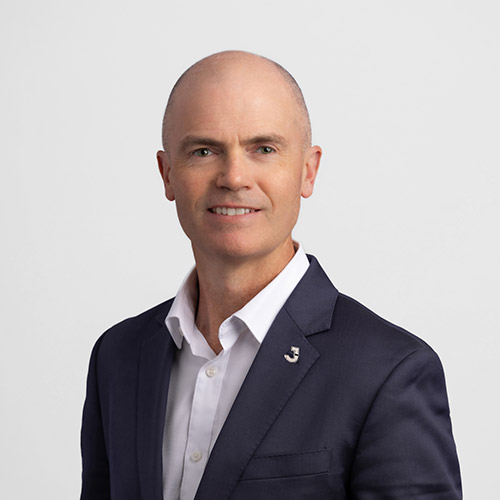
Patrick Hill
Patrick Hill is president of Global Operations at Jacobs, leading teams that serve clients and communities across North America, Europe, the Middle East, Asia, Australia and New Zealand. His experience at Jacobs spans more than 25 years, crossing multiple sectors and operations. He holds a Bachelor of Engineering degree in chemical engineering from the University of Melbourne and is based in Melbourne, Australia.
Hill chatted with ENR Deputy Editor Aileen Cho about working in a variety of sectors around the world, de-risking projects and addressing resilience. A few days after this interview, Jacobs on April 21 introduced Flood IQ, an AI-powered intelligence solution to help cities, utilities and government agencies anticipate, manage and recover from flooding events. The tool aims to transform fragmented water and drainage system data into actionable intelligence for preparedness, response and long-term resilience planning.
This interview has been edited and condensed.
ENR: What countries have you worked in? What are the key sectors?
My career really has spanned across the globe. In terms of permanent location, Australia and the U.S. have been the two primary locations, but my responsibility across the entire globe includes the Middle East, Europe, Asia.
We’re really focused on critical infrastructure and advanced facilities. Water and energy, transportation, et cetera, advanced life sciences and electronics—from delivering for the Australian mining industry during a major iron ore construction boom in the 2000s to working in the North American telecom sector. We've delivered water infrastructure projects during a period of major drought in water-scarce parts of the world. At the moment, our teams are looking at delivering the refurbishment of the British Houses of Parliament.
How many countries would you say you've worked in?
Looking for quick answers on construction and engineering topics?
Try Ask ENR, our new smart AI search tool.
Ask ENR →
I think it would be somewhere between 40 and 50 countries that I've visited as a result. We have a permanent presence in over 30 countries, but we deliver projects in many, many more than that.
If I look at the public infrastructure sector at the moment, we're seeing a real emergence of alternative delivery methods in the U.S. market. In other parts of the world, that's been probably the dominant delivery mechanism. Not one size fits all. It depends very much on an owner's preferences, how much front-end work they've done, how much appetite for risk, is schedule more important than cost, how strong is their supply chain. For us, really it comes down to leveraging that global expertise to deliver very locally for our clients.
So what have you found to be effective ways to reduce and control risk?
I almost sort of think about risk in two elements. One is the more regular form that we would think about, and I might sort of talk about that second. I think that there's also a risk that exists about whether or not we're actually solving the right problem.
For all risk management, the earlier you can address it, the much better it is. Your ability to manage risk becomes more limited as you move through the execution phase. But one of the things that I think is really important is, are we solving the right problem? Is the owner creating a project that they don't need? Or should they be drawing a different boundary around it?
There's a great example of a project that we delivered in the Asia-Pacific region. We had a water client that had to [address] an odorous sewer outfall from one of their treatment plants. It was smelly and they were getting complaints. If the client solved that on their own with a tight boundary around it, it would have delivered a certain outcome. But nearby, there was also a major power station that was drawing on cooling water. There was a major paper mill that had processed-water demand and industrial effluent. And there was also a nearby irrigation district that was producing about 6% of the nation's dairy products. And so if you draw a different boundary around that project and you think about what it could achieve, then you end up with a very different solution. You treat the water to a certain level; it opens up a whole lot of recycling opportunities and you can relieve the demand on the local water catchment to create more environmental flows, and then unlock productivity at the irrigation district and also still solve some of those industrial issues as well. So I always sort of come back to that as being a great example where if you draw a different boundary around something, you can solve three or four problems, or five problems.
I do think that there's more opportunity for front end loading to be done to really de-risk projects, whether it's geotechnical or surveying or data collection or [mitigating] contaminated land, or land acquisition; to really take those sorts of things off the critical path. There's an obligation we owe to the communities that we serve to perhaps do more of that.
In these politically unstable times, how do you adapt? How does it affect project portfolios?
We've chosen the portfolio of markets that we work in very deliberately. We've transformed a lot in the last decade to be very focused on these markets around critical infrastructure and advanced facilities. We think that those markets are really highly resilient in all periods of an economic cycle. Typically what would happen is if the economic cycle is strong, then you would see both the public and private sector investing heavily to make the most of those economic conditions. Often you would see that when there's a moderation of an economic cycle, governments would often stimulate public infrastructure. We probably don't see the ups and downs that we all might read in the press about uncertainty and volatility, whether they're economic conditions or climate conditions or geopolitical conditions. If anything, we may even see some increased demand as a result of that.
Take the pandemic as an example. Since then, I think that we've seen nations wanting to secure their sovereign supply of critical materials or commodities or essential medicines. If you think about the trade negotiations over the last 18 months, we're seeing nations or different parts of the world looking to secure their local supply chains—and that's prompted more investment in things like semiconductors or defense equipment. And I think that the geopolitical context has also created a different need for infrastructure. The best example is in Europe, where we've obviously seen some conflict there in recent years, but the whole disruption to the energy system has prompted certain projects to be delivered. One of the ones that we're delivering at the moment is the Suedlink Interconnector. It's A 700-kilometer underground cable that connects the north of Germany to the south. It really provides an opportunity to connect renewable energy to the key demand centers there.
What are some projects you're working on that address resilience in the face of climate change?
It's certainly reshaping how we look at design principles.I would say that resilience is really a core requirement of any work that we're doing at the moment just to make things future ready. We're seeing really extreme conditions, whether it's around heat or flooding or sea level rise, that drive different projects. Nature-based solutions alongside engineered solutions is something that we're seeing more of. For example, one of the major utilities in California is looking at a huge undergrounding program to completely rethink their asset base so that they can minimize their risk and exposure to wildfire risk.
It's interesting when you think about climatic conditions in places like the Middle East or Europe. We automatically think the Middle East is hot and dry; Europe is cool or rainy. But the reality is that Dubai airport, as an example, in 2024 had a huge flooding event. So we're actually seeing a lot of capital planning around flooding in the United Arab Emirates at the moment, and a lot of thought going into their water infrastructure. On the flip side, with some of the heatwave conditions that we've seen in Europe, the aviation sector has had to completely rethink its pavements, whether it's changing the asphalt blends or adding polymers. I think that we're seeing [climate events] drive project planning more and more across the board. Not only are there productivity issues, whether it's flight cancellations so that goods or people can't move around cities—but also financially, the [ripple effect in] the insurance sector has completely changed the way that people think about it. So more and more it's at the forefront of everything that we do.
We're in the process of delivering the Bolivar Roads Gate System on the Gulf Coast in Texas. It will probably be one of the world's largest storm surge barrier systems. There’s some $800 billion of critical energy assets that it protects. We've also done some really interesting work at the Port of San Francisco. There’s 7.5 miles of waterfront there. There are beautiful historical buildings, but there's also some critical utilities that run along that waterfront. So we've been looking at both the seismic risk and the flooding risk during extreme weather events, and then also sea level rise.
How did you get into this business?
I started as a chemical engineer and built my career in the water sector. I started off working on some really great projects, especially in drought-affected parts of Australia. I spent some time working on projects throughout the South Pacific, delivering fresh water for some communities in Fiji and things like that. I felt a real sense of purpose in what I was doing. Then I started moving into different leadership roles and had the opportunity to work across a number of sectors and geographies.
The projects are very complex and often we think about the technical elements, but the reality is that it's the people and the trust that's built that often ends up being the things that really determine the success of projects—the level of collaboration and the way that you tap into innovation. My role today is about how to really enable people to do their best work, and connecting teams or removing barriers, or helping them connect with owners of these assets. We've got almost 45,000 people across the globe, and they are very, very smart. It's a great privilege to work with so many clever people.