Mideast Construction
Cancelled Contracts Signal Rethink for Saudi Arabia’s $500B NEOM Megaproject

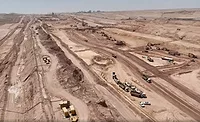
Site preparation and foundation work had started in 2024 for the first segments of The Line in northwest Saudi Arabia.
Screen capture from video released by THE LINE at NEOM
Cancellation in March of several contracts by Saudi Arabia’s high-profle NEOM development—a key component of its Saudi Vision 2030 program—signals that the estimated $500-billion megaproject is being recalibrated as several news reports released earlier this year have suggested.
NEOM was launched in 2017 as a futurist development in the northwestern Tabuk region of Saudi Arabia along the northern Red Sea coast. The project, which is owned by Saudi Arabia’s Public Investment Fund, is the ultra-modern brainchild of Saudi Crown Prince Mohammed Bin Salman, who also is chair of the country’s sovereign wealth fund.
NEOM's mega-investment would create a number of huge and luxurious resorts, residential areas, offices, shops, schools, marinas and high-tech industrial zones, among them the Sindala island resort, Magna coastal resorts, Trojena outdoor ski resort, Oxagon semi-offshore industrial zone, and most significantly, The Line, a 170-km long city and railroad running from the coast to the Saudi interior.
As originally envisaged, The Line would stand 500 meters tall and 200 meters wide. It would be able to accommodate about nine million people who would not use cars for transport but instead rely on a rail system contained inside the continuous building. Everything in The Line would operate on advanced technologies and function entirely within the mirror-covered structure.
That image of The Line and the Trojena ski resort are now expected to change as financial reviews of NEOM begun by the sovereign fund in 2024 have prompted a serious rethinking of development that is now leading to cutbacks. It is now being proposed that The Line be adapted to become an artificial intelligence data center, which the country expects would bring a greater short-term financial return.
Contracts Get Cancelled
It was announced that NEOM had cancelled three contracts last month, two pertaining to the Trojena resort, which had been set to host the 2029 Asian Winter Games. Saudi Arabia has withdrawn its offer to host the games. A third cancelled contract covered tunneling for The Line railroad.
Italy-based Webuild announced that construction of three dams for a freshwater lake as well as an architectural structure called “The Bow” located at the Trojena site also were canceled by Neom. Malaysia’s Eversendai Corp. Berhad announced that its contract to supply steel to Trojena was canceled and Hyundai Engineering and Construction of South Korea said its contract to build a 12.5-km twin-running tunnel had also been cancelled.
Looking for quick answers on construction and engineering topics?
Try Ask ENR, our new smart AI search tool.
Ask ENR →
None of the companies said they anticipated any financial fallout from the cancellations. The preliminary estimate of the value of the contracts is estimated at more than $6 billion. Saudi Arabia's cancelling of the contracts was not openly linked to the ongoing U.S.-Israel-Iran war that began on Feb. 28.
The scaling back of Saudi Vision 2030 also has resulted in a halt to construction of the estimated $50-billion Mukaab tower. Work on the massive, cube-shaped skyscraper sited for the center of the Saudi capital of Riyadh was halted in January while its financing and feasibility undergo a reassessment. The tower, which would be large enough to fit 20 Empire State Buildings inside it, would have boasted 2 million sq m of interior floor space. The future of the colossal structure is uncertain.
The contract cancellations come in the wake of a decision by the Saudi sovereign fund to pivot from futuristic projects and instead concentrate investment on the World Expo 2030 plan and the 2034 World Cup. The fund reassessment followed release of the fund's 2024 annual results in August 2025 that showed an $8-billion writedown across its giga-project portfolio over a period of three years, according to a report on the House of Saud's website.
As the prime source of funding for Saudi Arabia’s giga-projects, the sovereign fund has shifted to a position of deliberate recalibration encouraged by the fact that oil prices were moving in the $60-$70 per barrel range. To balance its budget, Saudi Arabia needs oil to fetch somewhere around $90-$110 per barrel.
The current war has pushed oil prices to near $115 per barrel and lower prices are not expected until hostilities are over.