Workforce
Iron Workers' IMPACT Conference Sees Mass Timber, Nuclear Energy Job Growth
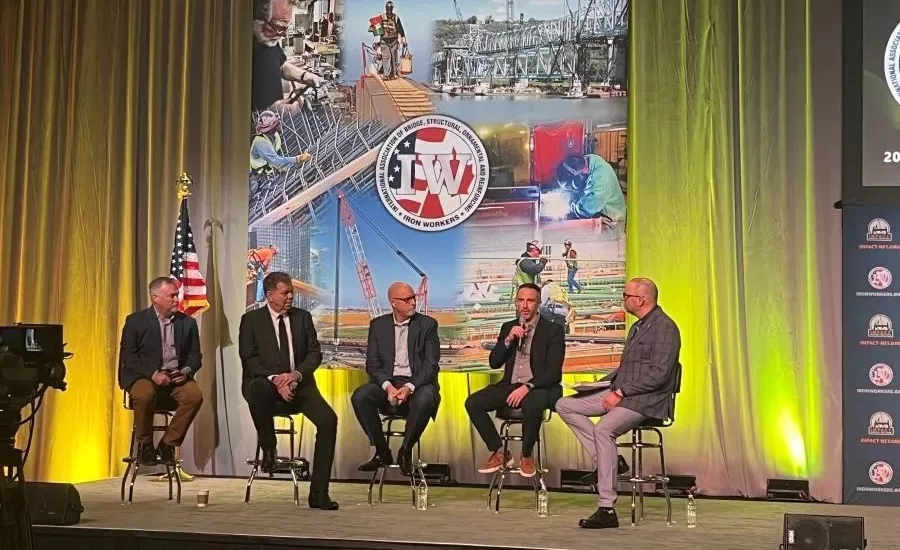
Representatives from Eli Lilly, Microsoft, U.S. Steel and Ontario Power Generation (left to right) spoke with IMPACT CEO Aaron Bast (far right) about anticipated labor shortages on megaprojects over the next several years.
This story was updated to include comments from Ironworkers' outgoing general president Eric Dean.
New leaders of the ironworkers' union and its labor-management group said they planned to emphasize strong organizing to boost its ranks, and see solid North American growth opportunities for organized labor and contractors in markets such as nuclear power, artificial intelligence and mass timber construction work, according to comments at the union’s annual IMPACT conference in Las Vegas Feb. 23-25.
Kevin Bryenton, who assumed the General President role on Jan. 1, told ENR he was “in lockstep” with predecessors Eric Dean, who stepped down in December after a decade, and Walter Wise, who held the title from 2011-2015 and died Feb. 12. Bryenton, a member of a Toronto union local, also had been the ironworker's union executive director of Canadian affairs.
“There is no deviation from the plans that they had and what they wanted to do,” Bryenton said. Top priorities championed by Dean and Kevin Hilton—who formerly led the Ironworker Management Progressive Action Cooperative Trust (IMPACT)—included increasing labor’s market share on large megaprojects, and creating more awareness about mental health issues, substance use and availability of support for workers and families.
Aaron Bast, now CEO of the ironworkers' IMPACT labor-management group and former business manager/secretary-treasurer of union Local 5 in Washington, D.C., told ENR he also hopes to build on existing initiatives.
Organizing will be a primary focus, Bryenton said. At both the local level and in Ontario, Bryenton shepherded increases in the number of union members and apprentices, and he hopes to replicate that success. “If we want to grow, we’ve got to continue to be relevant” and to find more “opportunities for our people ... with more contractors, and more diversified work for them to do.”
Outgoing general president Dean told ENR he is proud of the emphasis the union has placed in recent years on boosting membership through organizing, training and safety, and he expects the new leadership to maintain that focus.
Looking for quick answers on construction and engineering topics?
Try Ask ENR, our new smart AI search tool.
Ask ENR →
Dean said he is concerned, though, about labor's ability to keep pace with the demand megaprojects are creating, with "schedules that seem more compressed, complex and so many bid under non-disclosure agreements, making it difficult to plan for craft ramp ups."
While union ironworkers have seen opportunities reduced by the Trump administration on projects funded under the Biden-era Infrastructure Investment and Jobs Act, Inflation Reduction Act and CHIPs Act, labor shortages are real and are expected to worsen over the next few decades, said conference speakers from several top corporate project owners, including U.S. Steel, Eli Lilly, Microsoft and Ontario Power Generation.
Patrick O’Brien, director of government affairs and communications for nuclear power developer Holtec International, said he anticipates that opportunities will be abundant into the foreseeable future. “The energy landscape has completely changed [over the past] 11 years," he said, noting that climate change impacts, a push for decarbonization, growing concern about grid reliability and the proliferation of AI have "really created a huge demand."
Not only are significant percentages of the current fleet of nuclear power plants nearing the end of their useful lives, but also “if the goal is to get off of fossil fuels, [we’re] going to have to build those baseload resources as well.” Holtec is currently working with the U.S. Nuclear Regulatory Commission to reopen the shuttered Palisades nuclear power plant at a site in Michigan that will also include three SMR-300 small reactors, he said.
Mass Timber Workers Needed
Mass timber projects, particularly hybrid cross-laminated timber buildings, are another growth area, according to Brandon Brooks, program manager for Woodworks-the Wood Products Council's mass timber construction management program. He emphasized that ironworkers don’t need to worry about losing jobs with more mass timber projects being built.
“Mass timber is not replacing our workers. What it is doing is just changing the way that you apply your skills on a different material and some structures.”
Mark Bridges, a principal at Continuum Capital, spoke about using artificial intelligence to “augment, not replace” workers on projects, helping those who are lower-performing or inexperienced to accelerate the learning curve to work more productively. “There’s an opportunity to look at the training and the applications of these tools to help individuals as part of the apprenticeship process and as part of the training at companies … to use these tools to raise production and outcompete non-union competition,” he said.
Bast noted that IMPACT has used AI to translate its curricula into multiple languages and has incorporated it into training materials to prepare apprentices for the future workforce.