Government
Partial Federal Shutdown Extends Through Tuesday, House Speaker Says
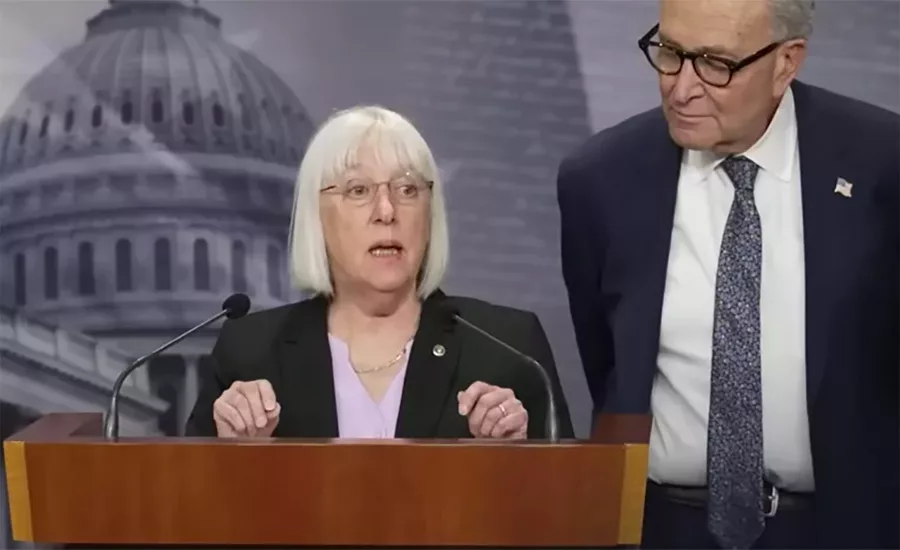
At the lectern, Senate Democrats Patty Murray (Wash.) and Minority Leader Charles Schumer (N.Y.) said they will not support a new Homeland Security department spending bill beyond the two weeks covered under the continuing resolution approved Jan. 30—without certain conditions.
The partial government shutdown will continue until at least Tuesday, Feb. 3, according to congressional leaders.
The Senate voted 71-29 on Jan. 30 to approve five more fiscal 2026 spending bills through the end of the fiscal year on Sept. 30—and the U.S. Dept. of Homeland Security for two weeks under a continuing resolution—while lawmakers negotiate with the White House and the administration to add changes to that department spending bill to rein in Immigration and Customers Enforcement operations, which have led to widespread public outrage, injuries and at least two deaths since mid-January in Minneapolis.
But also caught up in the Homeland Security funding controversy is the Federal Emergency Management Agency, which is part of the department.
Lawmakers approved the six other appropriations bills in two batches in November and January, and those measures have since become law.
In an interview on NBC News’ Meet the Press Feb. 1, House Speaker Mike Johnson (R-La.) said he was “confident” that Republicans would vote to approve the Senate package of bills by Tuesday, then continue to “negotiate in good faith” with leaders from both parties to be able to fund Homeland Security through the end of the fiscal year, which is Sept. 30, although he placed the onus on Democrats to prevent another partial shutdown. He said the GOP is “ready” to keep the government operational and would agree to most changes requested by Democrats, noting, however, that some sticking points could stall progress.
But in a post-vote press briefing Jan. 30, Senate Democratic Leader Charles Schumer (N.Y.) said the chamber's Democrats will not vote to support funding for the department beyond the two-week period funding if the revised bill does not including language requiring that ICE agents be mask-free, required to wear body cameras; have appropriate warrants prior to arrests and searches; and cease operation of roving patrols.
“If our colleagues are not willing to enact real change, real strong change, they should not expect Democratic votes. We have only a few days to deliver real progress for the American people. I hope Republicans get serious or they will learn once again they will not have our votes,” Schumer said.
Looking for quick answers on construction and engineering topics?
Try Ask ENR, our new smart AI search tool.
Ask ENR →
The five non-controversial spending bills, once passed, will fund the departments of Defense, Transportation, Education, National Security Administration, Health and Human Services, Education, State and Housing and Urban Development.
One key bill with industry significance is the $113-billion appropriations package funding the Transportation and Housing and Urban Development departments, through the end of fiscal 2026. At the post-vote press briefing, Sen. Patty Murray (D-Wash.) noted that the conferenced bill boosts funding for Amtrak, which had been targeted to be zeroed out, and restores funding to the DOT’s Capital Investment Grant program for public transit and rail projects. The Trump administration had requested the program be cut by 98% over fiscal 2025 enacted levels.
“The guardrails we secured for the [Capital Investment Grant program] are one of several updates we fought for throughout these bills to protect those funds from political interference if Trump and [OMB Director Russell] Vought try to rob our communities again,” said Murray, who serves as vice chair of the Appropriations Committee.

.webp?height=200&t=1767740772&width=200 "interior-cole-maloy")