Transit
Hungary Opens $1.1B P3 Tender for Budapest Airport Rail Link
Concession would link city center to the airport and shift construction and lifecycle risk to bidders
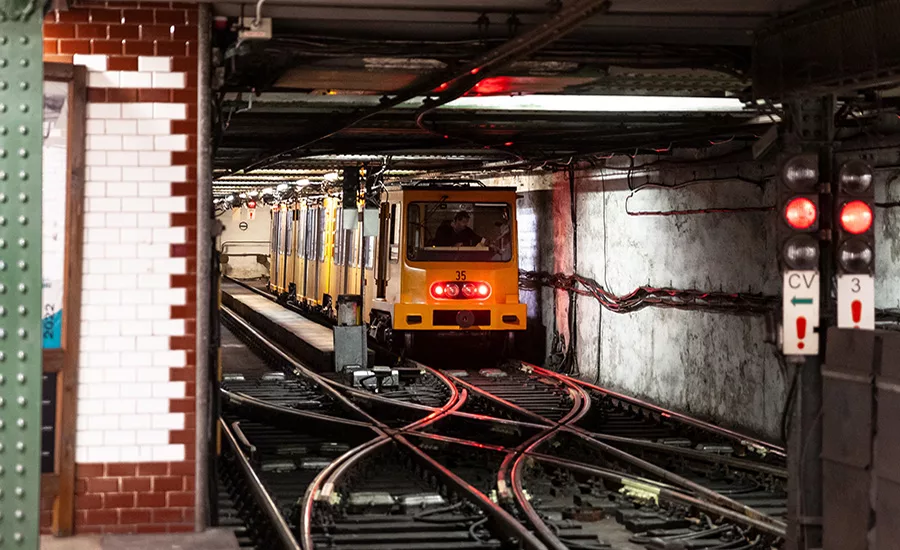
A Budapest Metro Line M1 train—the system’s oldest line—waits in an underground section of the network in Budapest, Hungary, illustrating the tight clearances and legacy infrastructure shaping modernization and expansion plans.
Hungary has opened a multi-stage procurement for a rail link from Budapest’s city center to Ferenc Liszt International Airport, setting a Feb. 6 deadline for bidders competing for a 35-year airport rail public-private partnership that includes deep underground station construction.
The Hungarian National Concessions Office dispatched the contract or concession notice on Jan. 6, which now starts a multi-stage market-facing procurement competition for railway construction, operations and maintenance under a long-term concession arrangement.
Tender documents call for construction of an approximately 27-km, electrified, double-track railway, totaling about 60.6 track-km, designed for operating speeds ranging from 80 kph to 200 kph, depending on alignment and interfaces with existing corridors.
The line is specified for a 225-kN axle load and must comply with European rail interoperability and TEN-T requirements. Scope includes both new alignment construction and rehabilitation, as well as capacity upgrades along portions of the existing national rail network serving eastern Budapest.
Works encompass track and subgrade, overhead catenary systems, traction power supply, signaling, telecommunications and train control systems, along with associated civil structures needed to accommodate airport services alongside conventional rail traffic.

A map of Budapest’s rail network shows the approximate location of Budapest Ferenc Liszt International Airport southeast of the city center, beyond the Kőbánya rail hubs. Map for illustrative purposes; final alignment has not been released
Image courtesy of Adobe/Design by ENR
A central technical requirement is construction of a deep underground station at the airport, identified in the tender as a minimum condition. That element places the project among the most technically demanding airport rail programs now entering procurement, requiring excavation and structural works beneath active aviation facilities, integration with terminal buildings, and installation of fire-life-safety, waterproofing and passenger circulation systems while maintaining uninterrupted airport operations. The tender does not include project-specific geotechnical data, leaving bidders to assess subsurface risk ahead of later design stages—an important consideration given Budapest’s variable alluvial soils and groundwater conditions in areas surrounding the airport.
Comparable challenges have shaped other airport rail projects ENR has reported on, including Ireland’s Dublin MetroLink, which combines a city-center–to–airport rail connection with extensive underground construction beneath dense urban fabric and active airport facilities.
Looking for quick answers on construction and engineering topics?
Try Ask ENR, our new smart AI search tool.
Ask ENR →
RELATED
Procurement Begins in 2026 for $12.6B Dublin MetroLink Rail Line
The project illustrates how deep-station design, subsurface uncertainty and procurement structure can materially influence cost, schedule and bidder appetite on airport-serving rail lines. In the U.S., the AirTrain Newark replacement has underscored how constructability, systems integration and lifecycle performance can complicate procurement when work must proceed within an operating airport environment.
Those lessons are amplified by Budapest’s concession structure. Operations and maintenance obligations extend across the full 35-year term, shifting long-term performance risk to the private partner and forcing bidders to weigh upfront construction decisions against lifecycle durability.
Track geometry, power and signaling systems, tunnel assets and underground station infrastructure will all be subject to long-term reliability and renewal requirements, elevating the importance of constructability and whole-life cost in bid design.
While the tender does not assign a final capital value, market estimates have consistently placed the airport rail link at roughly $1.1 billion. The project is structured as a privately financed concession rather than a traditionally funded public works contract.
RELATED
$3.5B AirTrain Newark Replacement Re-Forms After Bids Blew Budget
The bidding stage follows public commitments made last fall by Hungarian officials to pursue the airport rail link through private finance. In October, economy minister Márton Nagy described the project as a competitiveness and tourism investment.
Construction and transport minister János Lázár characterized the rail connection as a long-delayed national infrastructure priority and confirmed a concession-based delivery approach. Local Hungarian reporting has framed the airport rail link as a long-overdue competitiveness project for Budapest, while acknowledging that delivery has repeatedly stalled amid funding and execution challenges.
Budapest’s rail network serves a metropolitan area of roughly 2 million residents split by the Danube into Buda and Pest.
For international rail contractors, designers and concessionaires, attention now shifts to technical risk allocation and long-term operational exposure as teams assess whether to pursue qualification.

Bryan Gottlieb is the online editor at Engineering News-Record (ENR).
Gottlieb is a five-time Society of Professional Journalists Excellence in Journalism award winner with more than a decade of experience covering business, construction and community issues, including finance, law and real estate. He has reported for Adweek and the San Diego Daily Transcript and led a community newsroom in Santa Monica, Calif. He served as editor-in-chief of the Detroit Metro Times and as managing editor at Roofing Contractor, where he helped shape national industry coverage. At Engineering News-Record, Gottlieb covers breaking news, large-scale infrastructure and megaprojects, regulatory developments and business trends across the U.S. and global construction sectors.
email: gottliebb@enr.com | office: (248) 786-1591