Clean Energy
$11B Virginia Offshore Wind Project Is Latest to Win Its Day in Court
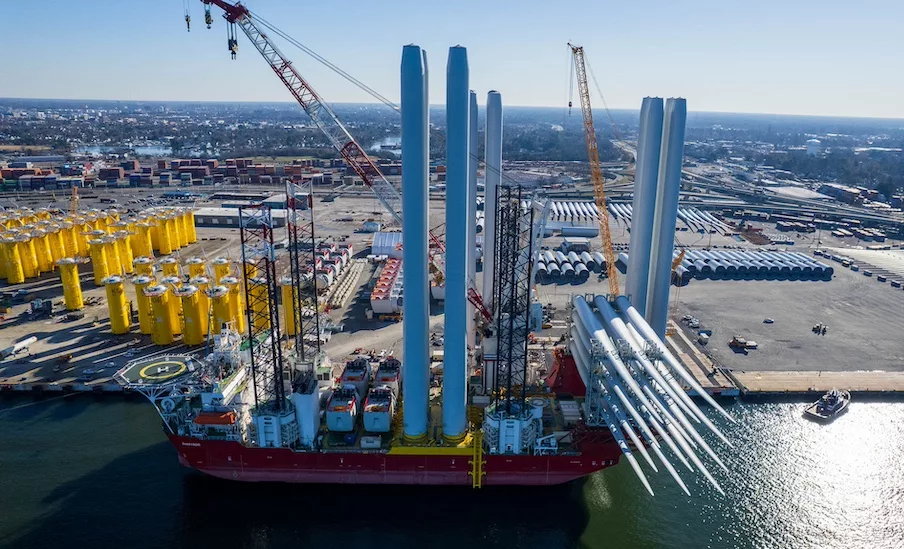
Coastal Virginia Offshore Wind project components idled at Portsmouth, Va., assembly site since administration-ordered project halt on Dec. 22 now will be transported for installation with Jan. 16 court ruling lifting the work shutdown.
A Norfolk, Va., federal district court judge on Jan. 16 granted the country's largest offshore wind project now being built—the 2.6-GW Coastal Virginia Offshore Wind—a reprieve from an ongoing federal shutdown, awarding the developer a preliminary injunction against the Dec. 22 order. The action will allow construction to continue while the court considers merits of the lawsuit filed by its developer, Dominion Energy.
The decision immediately followed a hearing on the request before Judge Jamar Walker, who told attorneys for the U.S. Interior Dept. and project owner Dominion that the agency's stop-work order, based on "national security" risks that are claimed in a U.S. Defense Dept. report, was too broad to address the project specifically and pertained to wind farm operation, not construction. The project is being built 27 miles off the coast of Virginia Beach.
Dominion Energy and other developers said that projects' radar interference risks were previously known and mitigated in earlier stages of development, with project approvals given by the U.S. Defense Dept.
The ruling follows two others this week in the Washington, D.C., federal district court that also reversed construction halts—one on Jan. 12 against the 704-MW Revolution Wind project being developed by Orsted between Connecticut and Rhode Island, and the other on Jan. 15 against the 810-MW Empire Wind, an Equinor project off the New York coast. Attorneys general from the three states filed separate lawsuits challenging the shutdowns as harmful to state power delivery.
Virginia officials did not do likewise for CVOW, with state political leadership in transition. But Gov.-elect Abigail Spanberger, a Democrat with inauguration on Jan. 17, had previously criticized the shutdown, and outgoing Republican Gov. Glenn Youngkin had supported the project as needed for power supply.
Dominion said it has so far invested about $8.9 billion to build the 176-turbine project, about 60% complete, with its total cost estimated at $11.2 billion. The company said in its lawsuit that the shutdown was costing about $5 million per day. Construction of CVOW's turbine monopile foundations and its 12 offshore power substation pin pile foundations is complete, project spokesman Jeremy Slayton confirmed to ENR,with installation of turbines, each 14.7 MW, as a primary activity.
The project resumes operation of Charybdis, the first U.S.-manufactured installation vessel that complies with existing martime law for transporting components but having initial operational issues when delivered to the site last October. The 472-ft-long vessel includes a unique Dutch-made crane that can raise 2,200 tonnes.
Looking for quick answers on construction and engineering topics?
Try Ask ENR, our new smart AI search tool.
Ask ENR →
Work also includes installation of about 365 miles of export cable and completion of three offshore substations to connect generated power to the onshore grid, which Dominion said could start by the end of the first quarter.
“Our team will now focus on safely restarting work to ensure CVOW begins delivery of critical energy in just weeks,” Dominion said. “While our legal challenge proceeds, we will continue seeking a durable resolution of this matter through cooperation with the federal government.”
In what is considered an unusual action, grid operator PJM Interconnection, which regulates power transmission in a 13-state region that includes east coast states where offshore wind projects are located, filed a legal brief in support of CVOW's lawsuit.
With Its region including Virginia, now a major U.S. hub for existing and future data centers, the grid operator said "rapidly increasing demand for ... for new power generation has become increasingly urgent," adding that CVOW “is an integral component of needed new generation that PJM has been relying upon to achieve timely commercial operation." The operator said that "given the size of the project and the long lead times associated with development of alternatives, further delay of the project will cause irreparable harm to 67 million residents of this region who depend on continued reliable delivery of electricity."
Sean McGarvey, president of the National Association of Building Trade Unions, whose members make up most of the projects' primary workforce and that also filed supporting legal briefs in the three lawsuits, said the group “applauds this week’s federal court rulings restarting U.S. offshore wind projects ... so many [union] members can finally return to jobsites."
In response to the Virginia project ruling, Trump administration spokeswoman Taylor Rogers repeated a previous statement that it expects "ultimate victory" related to its legal claims, but she has not said whether the government will appeal the latest decision and the two others.
Rulings are still to come on two other halted projects. The 924-MW Sunrise Wind also in development by Orsted to provide power to New York but in earlier stage construction and set to operate in 2027, has a hearing date believed to be in early February in the D.C. federal district court.
The 800-MW Vineyard Wind, with developers Copenhagen Infrastructure Partners and Avangrid, which is 95% complete in construction of 62 turbines 15 miles off Martha's Vineyard island and set to wrap on March 31, filed suit in U.S. district court in Boston on Jan. 15. No hearing date is yet specified, but about half of its turbines are operating and have been allowed to continue to send about 572 MW of power under the shutdown order.
The project, the first in the U.S. to be permitted, said in its filing that it has spent about $4.5 billion so far in development but that Interior Dept. officials, while agreeing to a Dec. 30 meeting, "refused to either identify the supposed national-security threat posed by the project or discuss possible mitigation measures." It estimated direct and indirect shutdown costs at $2 million per day, with shutdown threatening its contracted access to the project installation vessel.


.webp?height=200&t=1766484839&width=200 "Wind-Farm-Pause-(2)")