ENR 2025 Top 25 Newsmakers
Chris Olsen: California Municipal Exec is Core to Major Work on the Two Largest US Water Treatment Projects to Reduce PFAS
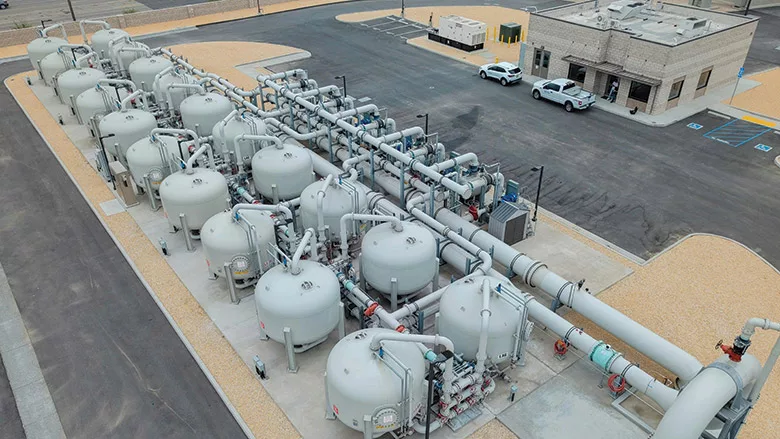
Building PFAS filtration for all 19 groundwater wells in Anaheim, Calif., could cost $275 million, its largest capital project.

Related Article:
ENR 2025 Top 200 Environmental Firms: Facing New Realities
Back to:
25 Top Newsmakers
Orange County, Calif., had long depended on groundwater for most of its drinking water, tapping a 270-sq-mile basin to supply a major West Coast population hub. But that changed drastically in 2019 when state officials mandated testing for PFAS chemicals and set strict new limits for the contaminants.
The action forced the county to shut some 60 wells and replace lost supply from other state sources and beyond—a move that cost one of its larger communities, the city of Anaheim with more than 350,000 residents, as much as $2 million per month and forced a 10% annual rate increase to all county users. With that response unsustainable, the district adopted a different approach—first launching a record-size pilot program to test different PFAS treatment processes.
Resulting projects in Anaheim and in nearby Yorba Linda are deemed the two largest such U.S. efforts, and Chris Olsen, district executive director of engineering and water resources, is central to their execution by multiple teams. The district is financing all treatment infrastructure design and construction, and splitting operation and maintenance costs with 19 cities and agencies, he says. “Water is essential for life and I fully support our mission, which is to provide a reliable, high quality water supply in a cost-effective and environmentally responsible manner,” says Olsen.
Anaheim is completing two key phases of its construction effort, involving ion exchange with resin technology for 35 separate treatment systems, which required hiring CDM Smith as design-build lead in the city’s first use of that alternative delivery approach. Four completed plants have a combined capacity to treat 39.2 million gallons per day.
Once fully built out by 2027, Anaheim will treat up to 73.2 million gallons per day. “Several locations lacked sufficient room for new treatment systems, prompting the DB team to employ 3D modeling to minimize plant footprints,” says Jacob Hester, Anaheim water engineering manager. “The program increased operation cost by about 40 percent, but it is nearly half the cost of imported water.”
Olsen says the 25-million-gallon per day, roughly $28-million Yorba Linda PFAS plant on which he was project manager, also uses ion exchange technology. It “has exceeded expectations” in operating since 2021," he says. The plant’s “resin life is lasting longer than anticipated, which is a significant cost savings.”
Tetra Tech led its design and construction management team, with Pacific Hydrotech as contractor. Olsen says a Tetra Tech 3D virtual walkthrough enabled Yorba Linda operators to virtually tour the treatment plant and suggest key design changes, such as location and access points of piping, fittings and equipment.
Looking for quick answers on construction and engineering topics?
Try Ask ENR, our new smart AI search tool.
Ask ENR →
According to Olsen, PFAS-related costs are set to reach $1.8 billion in Orange County over the next 30 years for capital and operations and maintenance costs, involving multiple treatment plants across 10 cities and more than 50 wells. Current enforceable federal limits for PFAS in drinking water, set in April 2024, are 4 parts per trillion for PFOA and PFOS chemicals individually. But the Trump administration could change these and also push back the current 2029 compliance deadline for water systems.
The district has allocated $85.2 million for construction of PFAS treatment facilities in its 2025-26 fiscal year budget. To boost required investment, the water district has secured $94.4 million in low-interest federal WIFIA loans and more than $120 million in state and federal grants.
The district also has gained $78 million in legal settlements to date with PFAS manufacturers that include 3M and Dupont, says Olsen, “with additional payments expected.”