Economics
ABC Backlog Pullback in November Signals Rising Competitive Pressure for 2026 Work
Reading hits lowest level since early 2024, tightening pricing leverage for firms without infrastructure or data center access

Associated Builders and Contractors reported that construction backlog fell to 8.1 months in November, the lowest level since February 2024, with the sharpest declines among smaller contractors and continued strength tied to infrastructure and data center work.
Associated Builders and Contractors reported Dec. 16 that its Construction Backlog Indicator fell to 8.1 months in November, the lowest level since February 2024, signaling mounting pressure on contractors’ pipelines heading into 2026.
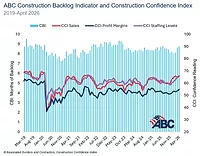
The reading declined 0.3 months from October 2025 and was also 0.3 months lower compared to the previous year, according to an ABC member survey conducted from Nov. 20 to Dec. 8.
The downturn was broad-based across most firm sizes and regions, with backlog declining on both a monthly and annual basis for every contractor size category except firms with more than $100 million in annual revenue. Smaller contractors experienced the sharpest pullback.
Firms with less than $30 million in annual revenue reported a backlog of 6.9 months in November, down 0.4 months from October and 0.5 months from a year earlier, marking their lowest reading in more than four years.
At 8.1 months, November’s backlog level suggests contractors are entering 2026 facing intensifying bid competition and reduced pricing leverage, particularly for firms without access to infrastructure and data center work.
RELATED
Large Projects Hold Up Backlog as Small-Firm Activity Slips, ABC Says
Historically, backlog readings in this range have coincided with more aggressive bidding, tighter contingencies and heightened sensitivity to material and labor cost swings.
Looking for quick answers on construction and engineering topics?
Try Ask ENR, our new smart AI search tool.
Ask ENR →
By sector, infrastructure contractors continued to report the strongest pipeline at 9.6 months, although that figure declined by 0.2 months from October. Commercial and institutional backlog decreased to 8.3 months, while heavy industrial backlog experienced the largest drop, falling to 7.1 months, down 1.7 months month over month.
Regionally, backlog declined most sharply in the Middle States and the South. The Northeast was the only region to post a monthly increase, rising to 8.3 months, while the West held steady at 8.1 months but remained below its level the same time last year.
“Backlog declined sharply in November and is now at the lowest level since February 2024,” ABC Chief Economist Anirban Basu said in a statement. “The decline was particularly steep for the smallest contractors; ABC members with under $30 million in annual revenues registered their lowest backlog reading in over four years.”
Basu pointed to uneven access to high-growth markets as a key factor supporting backlog among larger firms.
Fewer than 6% of ABC members with less than $30 million in annual revenue reported being under contract for data center projects, compared with 37% of contractors with more than $100 million in annual revenue.
That disparity has become increasingly consequential as data centers and related power infrastructure remain among the most active construction segments nationally.
Despite the backlog erosion, contractors’ near-term outlook for activity remained expansionary, though more cautious.

Construction employment rose in November even as backlog declined, with nonresidential jobs driving monthly gains while residential employment continued to contract, according to data from ABC and the U.S. Bureau of Labor Statistics.
Graph courtesy of ABC
ABC’s Construction Confidence Index showed the sales expectations reading ticking up to 59.8 in November, while profit margin expectations fell to 51.1 and staffing expectations dropped to 58.2. All three readings stayed above 50, the threshold indicating expectations for growth over the next six months.
The composition of those expectations, however, shifted toward tighter operating conditions. Only 33.6% of contractors expect profit margins to increase over the next two quarters, the lowest share in more than a year, while nearly 27% anticipate margin declines.
That softening outlook comes as materials prices have begun to rise after several quarters of relative stability, adding uncertainty to bid pricing and cost recovery.
RELATED
Power Sector Debates New Federal Rules for Data Center 'Large Load' Links to Grid
“Despite the decline in backlog, contractors remain broadly optimistic that their sales and staffing levels will expand over the next six months,” Basu said. “At the same time, just 33.6% of contractors expect their profit margins to expand over the next two quarters. That likely reflects growing anxiety about materials costs.”
ABC noted that reference months for both the Construction Backlog Indicator and Construction Confidence Index were revised in May 2020 to reflect survey timing better.
The backlog indicator measures work under contract based on the most recent available financials, while the confidence index gauges contractors’ outlook for the next six months.

Bryan Gottlieb is the online editor at Engineering News-Record (ENR).
Gottlieb is a five-time Society of Professional Journalists Excellence in Journalism award winner with more than a decade of experience covering business, construction and community issues, including finance, law and real estate. He has reported for Adweek and the San Diego Daily Transcript and led a community newsroom in Santa Monica, Calif. He served as editor-in-chief of the Detroit Metro Times and as managing editor at Roofing Contractor, where he helped shape national industry coverage. At Engineering News-Record, Gottlieb covers breaking news, large-scale infrastructure and megaprojects, regulatory developments and business trends across the U.S. and global construction sectors.
email: gottliebb@enr.com | office: (248) 786-1591