ENR 2025 Global Best Projects
Project of the Year Finalist, Best Airport/Port: Marine Works Package at Vũng Ang II Thermal Power Plant

Marine Works Package at Vũng Ang II Thermal Power Plant
Ky Anh, Vietnam
Best Project, Airport/Port
Submitted by China Harbour Engineering Co. Ltd.
Owner: Doosan Enerbility Vietnam Co. Ltd.
Lead Design Firm: China Harbour Engineering Co. Ltd
Contractor: China Harbour Engineering Co. Ltd
A 1.2 GW coal-fired plant is the most immediate answer for Vietnam’s power grid woes, according to the government, project owner Doosan Enerbility Vietnam, designer and contractor China Harbour Engineering and multinational investors that include Mitsubishi, KEPCO, Chugoku Electric Power and Shikoku Electric Power.
Vietnam has faced challenges in meeting its national power demands since at least 2023, when a heat wave forced mandatory blackouts nationwide. Average peak demand in the north-central region has grown roughly fourfold since 2006 to 42.5 GW in 2021, says the government. The country hosts manufacturing hubs for tech giants such as Samsung and Foxconn, but Ky Anh City in central Vietnam has struggled to meet its electrical demands. As the Vũng Ang II thermal plower plant is located on the northern coast, extensive marine work is necessary to complete China Harbour Engineering’s design. The project is one of six under-construction coal-fired plants in Vietnam’s national power development Plan VIII.
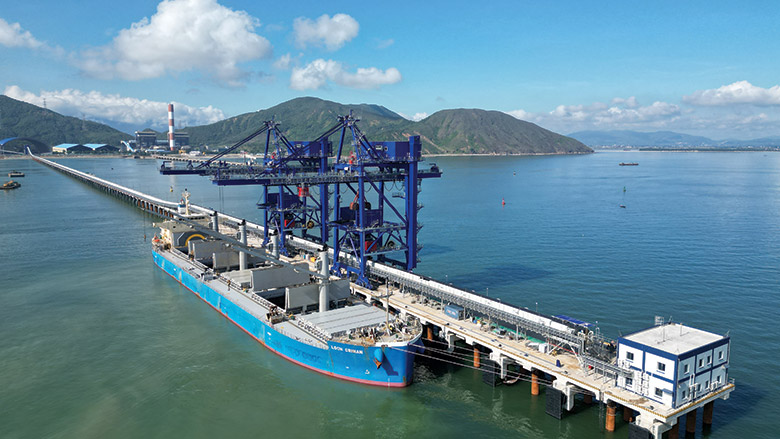
Photo by Wang Guangbiao for China Harbour Engineering Co. Ltd.
Work on the plant involved a complex process of placing 70 segments of precast box culverts for intake and 212 segments for discharge. To place the box culverts—which are intended to be temporary and will be demolished after construction of the power plant is complete—contractor and lead designer China Harbour Engineering Co. mobilized multiple 600-ton crane barges and one advanced large pipe-jacking machine manufactured in China. The equipment, and the Chinese technical team’s expertise with underwater works, helped the project to complete expeditiously.
An international team from the U.S., China, Vietnam and South Korea came together to build the harbor and box culverts and connect the underwater piping to the future plant. The project involved constructing a jetty to unload coal, a trestle, and cast-in-place box culverts and prefabricated ones, as well as to do underwater installation of culverts and underground pipe jacking near the inland coast.
The weight of each of the 70 precast box culvert pieces was about 500 tons. Installing them required a high level of precision and execution, with placement using crane barges and connection to the pipe serving the plant.
China Harbour Engineering had to jack the pieces into place through variable ground conditions underwater. As Vietnam lacks specialized heavy-lift marine assets and advanced pipe jacking equipment, multiple 600-ton crane vessels and the advanced large pipe jacking machine brought in from China.
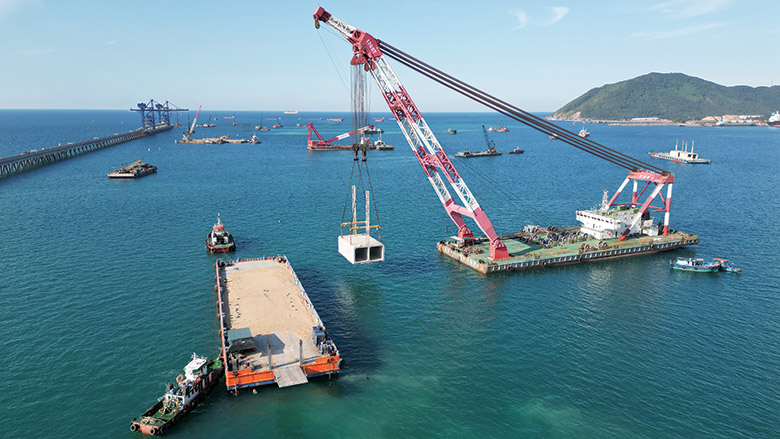
A 70-ton box culvert is placed underwater by a crane barge to build a port structure and create power supply pipe networks for the Vung Ang II Thermal Power Project.
Photo by Wang Guangbiao for China Harbour Engineering Co. Ltd.
Interdependent sub-projects with continuous overlapping activities all had to be executed simultaneously. The safety management team from India provided support and developed a comprehensive management system that ensured rigorous on-site implementation.
Looking for quick answers on construction and engineering topics?
Try Ask ENR, our new smart AI search tool.
Ask ENR →
The methodologies and adherence to standards minimized near-misses and significantly reduced serious accident potential—resulting in a project with no lost-time incidents, accidents or injuries in more than 3 million worker-hours.
The plant’s inherent international complexity involved cross-border contracts, as well as varying construction standards and compliance obligations. A seasoned UK-based legal team provided comprehensive support covering contract administration, risk mitigation, dispute resolution and adherence to international and local laws.
The use of 3D models replaced conventional 2D drawings and allowed the multilingual designers and contractors to visually understand complex spatial relationships, sequences, and construction processes—identifying risks and optimizing planning and resource allocation during pre-construction that allowed for more informed decision making.
For the underwater box culvert installation, a system combining global navigation satellite system coordinates, underwater sensors, real-time feedback and 3D modeling helped achieve millimeter-level precision positioning even in challenging tidal conditions, according to the project team submission.
Real-time deviation data allowed dynamic adjustments for the culverts, drastically reducing installation time and misalignment risk. For China Harbour Engineering, this was a shift from experience-based to data-driven marine construction and a replicable solution for other offshore projects. The first 600-MW turbine of the Vũng Áng II power plant began operation in September and the second one is expected to start by the end of the year, providing power to the state utility, Vietnam Electricity, under a 25-year energy purchase plan.