2025 Texas & Southeast Best Projects
Project of the Year Finalist; Best Airport/Transit: IAH Mickey Leland Int'l Terminal D
IAH Mickey Leland International Terminal D
Houston
Project of the Year Finalist and Best Airport/Transit
KEY PLAYERS
Submitted by: Austin Commercial
Owner: Houston Airport System
Lead Design Firm: Fentress Architects
General Contractor: Austin Gilbane Joint Venture
Civil Engineer Burns & McDonnell
Structural Engineer Walter P Moore
MEP Engineer Arup
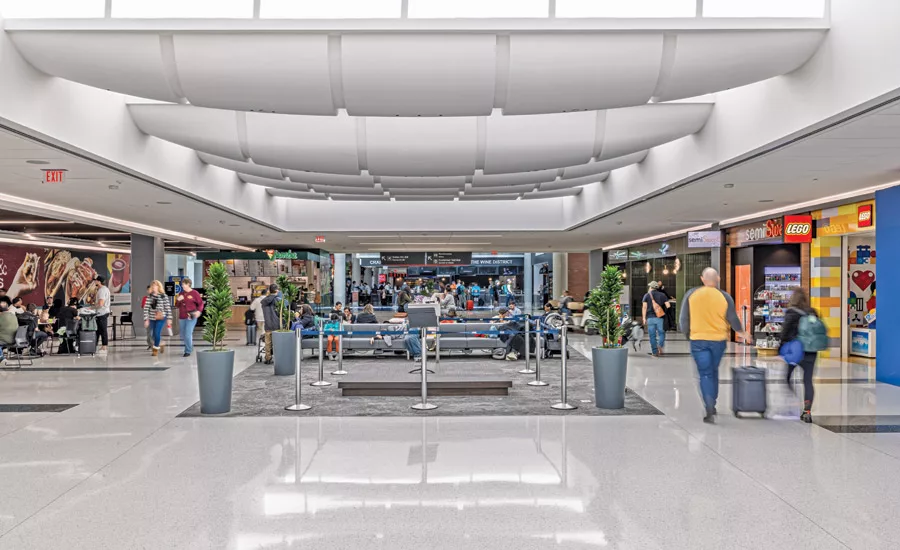
International flights moving in and out of Houston’s largest airport have a new centralized hub. The $364-million Mickey Leland International Terminal spans more than 400,000 sq ft and is designed to enhance passenger experience through operational efficiency and a commitment to sustainability.
This comprehensive modernization project replaced the existing Terminal C North domestic concourse and all of Terminal D with an expanded international concourse. Work was performed while George Bush Intercontinental Airport remained fully operational. In addition to constructing an international pier with six wide-body international gates, scope included renovations to 12 existing gates and hold rooms.
To prevent airport disruptions during construction, the contractor utilized a phased schedule and detailed logistical planning. Strategic communication also ensured aligned priorities and stakeholder engagement given the many groups involved in decision-making, from the city of Houston to the airlines, concessionaires and regulatory bodies, among others.
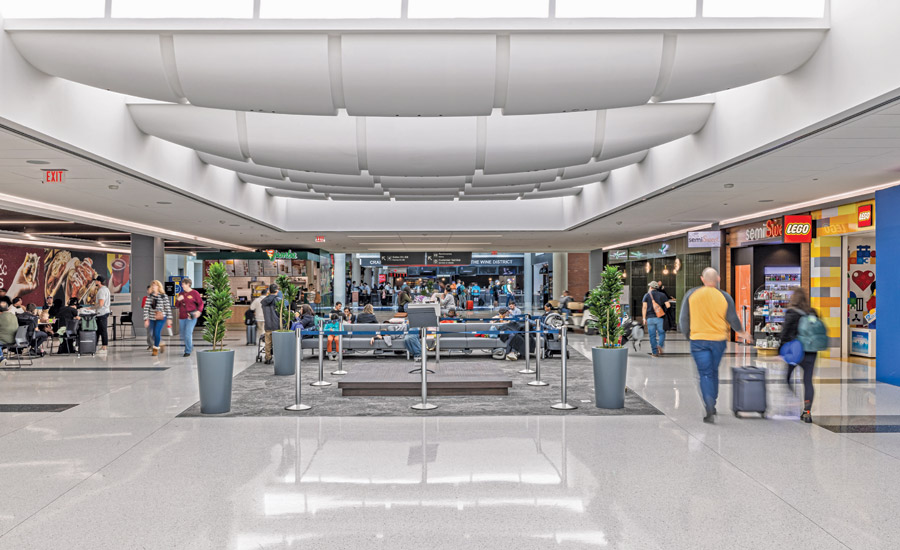
Photo by Cloyce Wall
Construction kicked off in 2018, and though interrupted by the pandemic, the decreased passenger traffic and modifications to flight mixes enabled a modified renovation process on the existing 12 gates and nine gatehouses. As a result, the team was able to limit gate closures to weeks rather than months, minimizing passenger traffic impacts. Just a single gate was closed at a time as well, rather than closing all eight, which further accelerated the schedule. Crews fabricated a 1,100-ft temporary sterile corridor in 11 segments off site, then trucked them across the airfield before being hoisted into place. This limited construction impacts on operating Terminal D gates.
Flexibility was an integral element in the terminal’s design. Four of its six gates can be reconfigured to accommodate either six wide-body or 10 narrow-body aircraft.
Environmental responsibility was another design consideration. Energy-efficient systems and sustainable materials were used throughout. Terminal D now meets LEED Silver requirements.
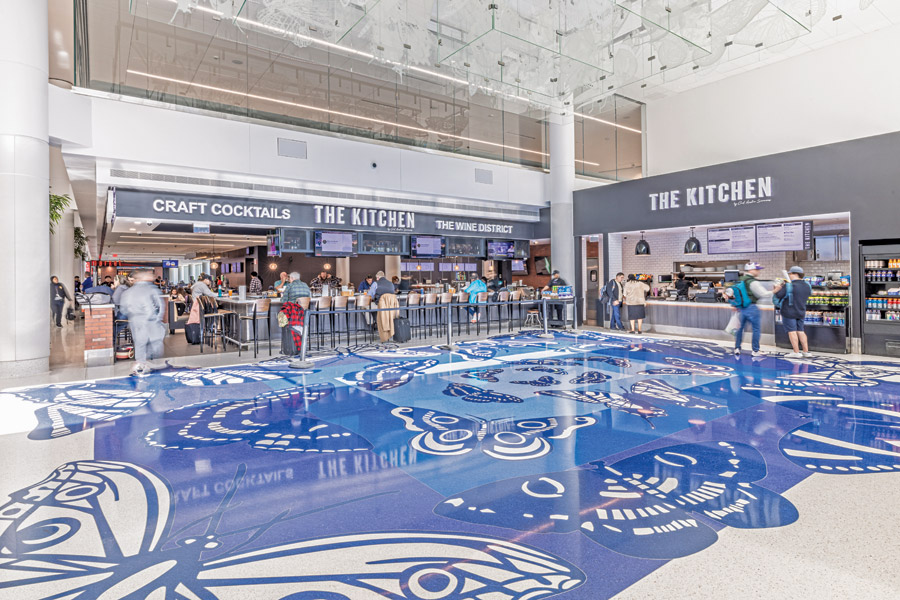
Photo by Cloyce Wall
A central clerestory and light-filtering screen run the length of the concourse, reducing glare and serving as a signature wayfinding element. Sunlight passing through copper-colored perforations and angled tabs creates dappled patterns reminiscent of a live oak’s shade. Meanwhile, the west-facing curtain wall frames exterior views while shielding interior seating and retail spaces from direct sun. Integrated linear LED fixtures along these openings are individually controlled, cycling through a 24-hour color sequence to support passenger circadian rhythms.
Across 1.7 million worker hours, the team only saw one recordable incident thanks to a comprehensive safety program that utilized the KPA Flex app, a real-time tool for managing safety compliance and communication. The app enabled logging and tracking of safety observations, audits and corrective actions, ensuring risks were identified and addressed. To further enhance oversight, the team implemented OccuCare’s case management system, which supported both prevention and recovery in the event of incidents.
After more than six years of construction, the team delivered IAH’s newest terminal on schedule in October 2024.