From Rapport to Robots, Innovations Rise at Pittsburgh Airport's $1.7B Overhaul
November 5, 2025
From Rapport to Robots, Innovations Rise at Pittsburgh Airport's $1.7B Overhaul
November 5, 2025The modernization of the Pittsburgh airport leans into its origin-and-destination role.


Approached by a headhunter in 2014 about possibly serving as CEO of the Allegheny County Airport Authority, Christina Cassotis recalls: “I’d only been to Pittsburgh once.” But the commercial aviation consultant was impressed by the agency’s board and community interest in turning around Pittsburgh International Airport after anchor tenant US Airways abandoned it in 2004.
She told her husband that they would only stay for about three years. A decade later, Cassotis and her teams are preparing this year to open the crown jewel of a $1.7-billion modernization program—an 811,000-sq-ft new terminal. “It was a bigger job than I thought,” she said of her CEO role. “And it turned out to be a better opportunity than I’d thought.”
That opportunity entailed creating a sustainable and cost-stable, origin-and-destination airport that reflects the community, offers a memorable experience for travelers and creates a positive environment for those working in it. The role also led to opportunities for innovation, both in procuring and collaborating with the design and construction teams, testing nascent technologies and going above and beyond in community engagement.
“It starts with an innovative mindset,” says Paul Hoback, who was airport authority chief development officer before recently becoming CEO of Sarasota, Fla.-based Bradenton International Airport. “The actual building is a physical manifestation of the work we put into our culture.”
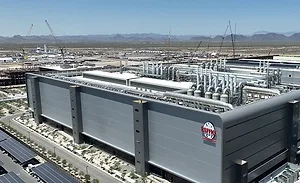
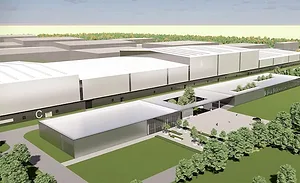
The project broke ground in 2021 and adds an 811,000-sq-ft terminal and 1.14-million-sq-ft parking structure adjacent to the existing airside complex. Modernization also included four miles of new access roads and a 1,300-ft dual-level bridge linking the facility to Interstate 376.
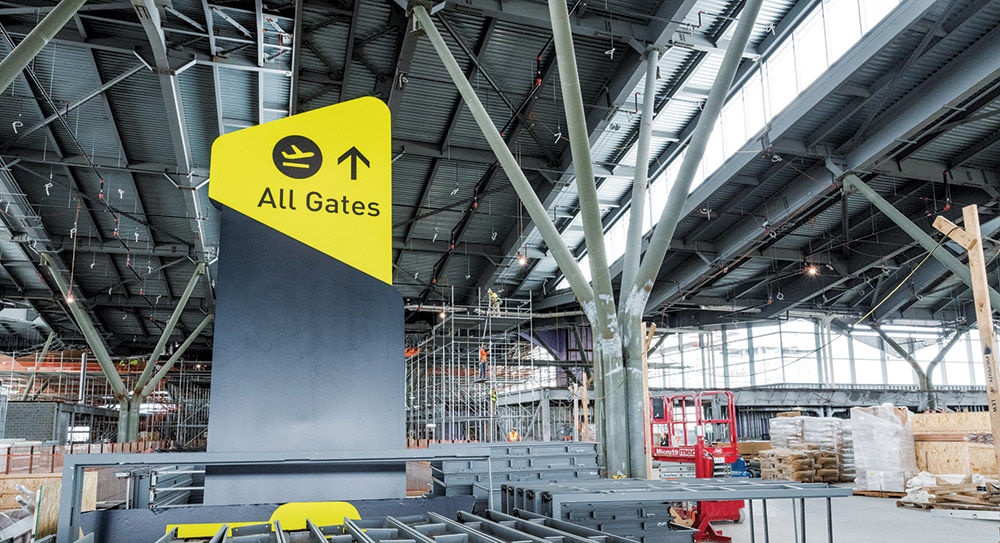
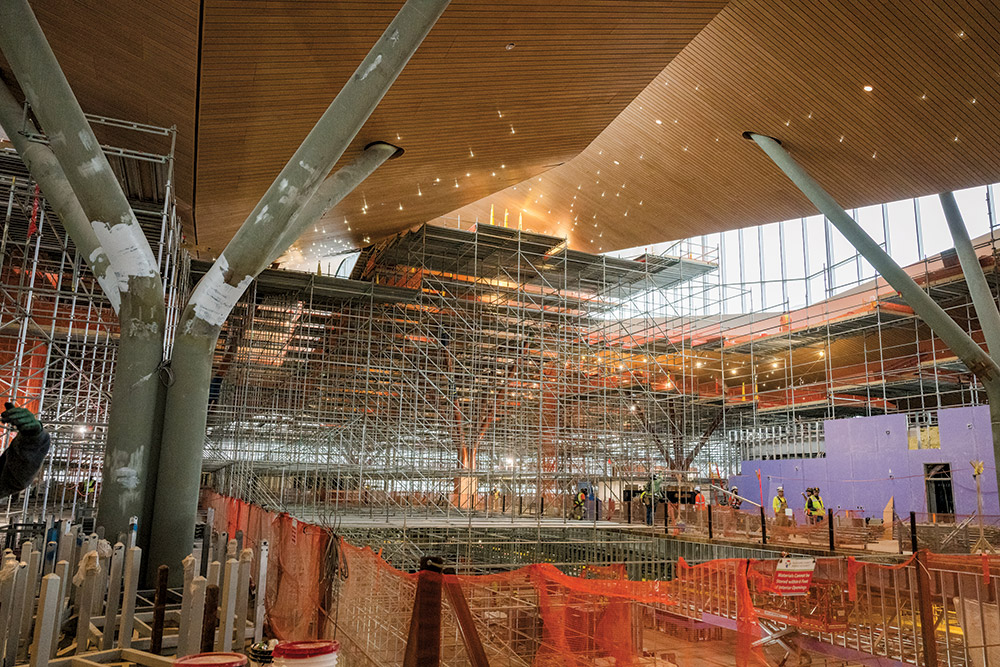
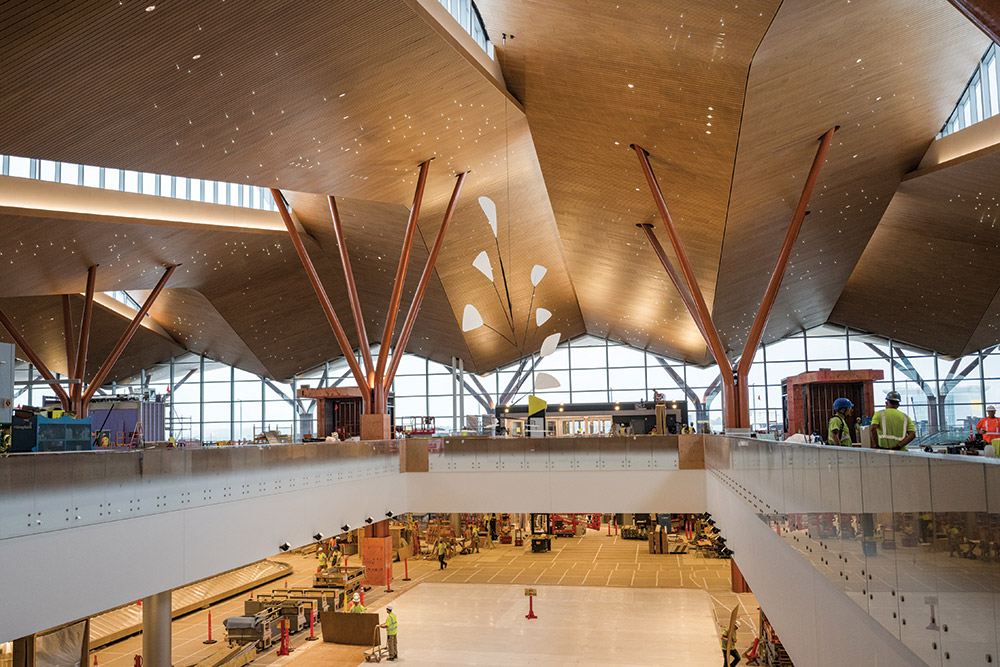
Design of the new terminal is informed by input from those set to work in it as well as by those flying through it.
Photos courtesy of ACAA
The authority brought in the Paslay Group with its executive program management model, which features a streamlined group of aviation veterans who integrate with the airport management. Perfecto Solis, who led the enterprise project management team, notes Pennsylvania’s Separations Act: “When you deliver a [construction plan], you had to do design-bid-build and you have to bid the work by trade. So we don’t have one prime contractor; we have 64. That translates into 284 subcontracts.” The EPM group also put together a team of construction managers.
A joint venture of PJ Dick and AECOM Hunt, along with Jacobs Solutions, serves as construction manager for the project, with Gensler, HDR and luis vidal + architects leading design. Contractor Fay, a subsidiary of S&B USA Construction, won the $154-million contract for the roads and bridges package, while Mascaro Construction held contracts worth about $102 million for the terminal foundation and slab-on-grade work, the structural steel and concrete decks package for the 1,143,868-sq-ft new parking garage and the terminal’s architectural enclosure.
Rycon Construction coordinated with other contractors on the $17-million baggage handling expansion and worked with Viking Erectors on the $163-million multimodal complex. Other major participants include Turner Construction, MBI International, Ricondo, Navarro & Wright, Connico and Buro Happold.
Looking for quick answers on construction and engineering topics?
Try Ask ENR, our new smart AI search tool.
Ask ENR →

William Peduzzi, HDR aviation leader, notes the novel consultant selection process. “We went through a rigorous, unique multistep process for qualifications and proposals,” he recalls. “There were lengthy interviews, evaluations by a behavioral psychologist on team chemistry and role-playing by committee members, challenging us to work together.” The process was introduced by Barry Weekes of U.K.-based Three Compasses Consulting, adds Hoback. “We were bringing in our personal beliefs and opinions, challenging each other. It was a self-awareness exercise ... to pick the right partners.”
The exercise paid off. “I’ve been working with [the airport authority] for seven years, from day one,” says Robert C. Bramblett, AECOM Hunt project executive. “That statement alone is one of the things that makes [it] a unique owner.”
Agency officials “acknowledged that this was going to be a complex project [and] brought on everybody early—the construction managers, the architects, even the [Operational, Readiness, Activation and Transition] team that’s going to turn everything on at the end of the project—to collaborate.” The authority “really pushed collaboration from day one to day now—not having silos, not having working groups, but being able to collaborate with everyone on the program on a continuous basis so that there are no surprises at the end of the job.”
But the biggest surprise actually came at the beginning—the pandemic.
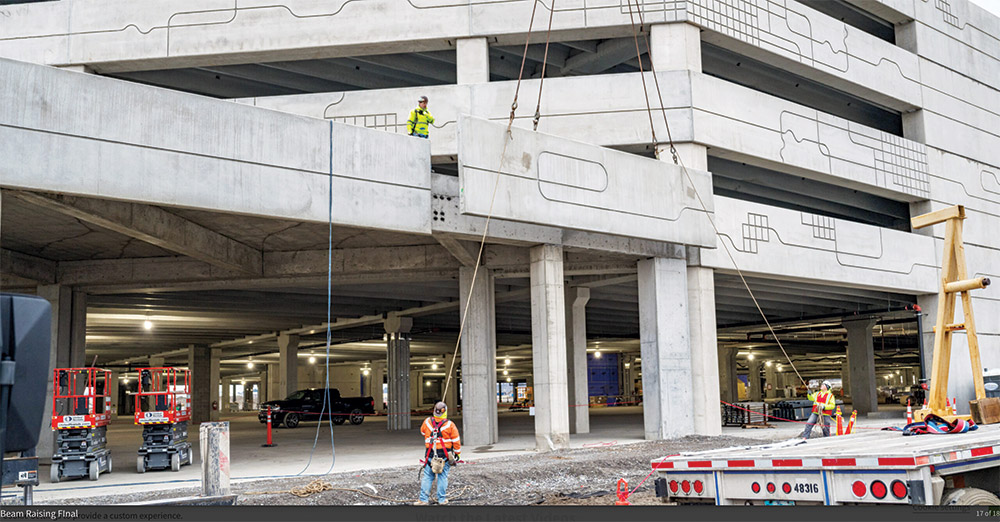
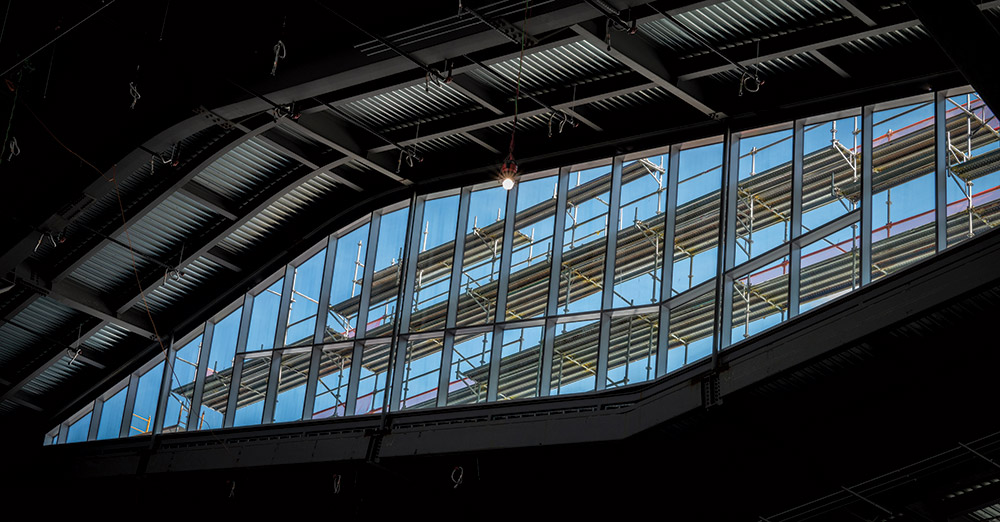
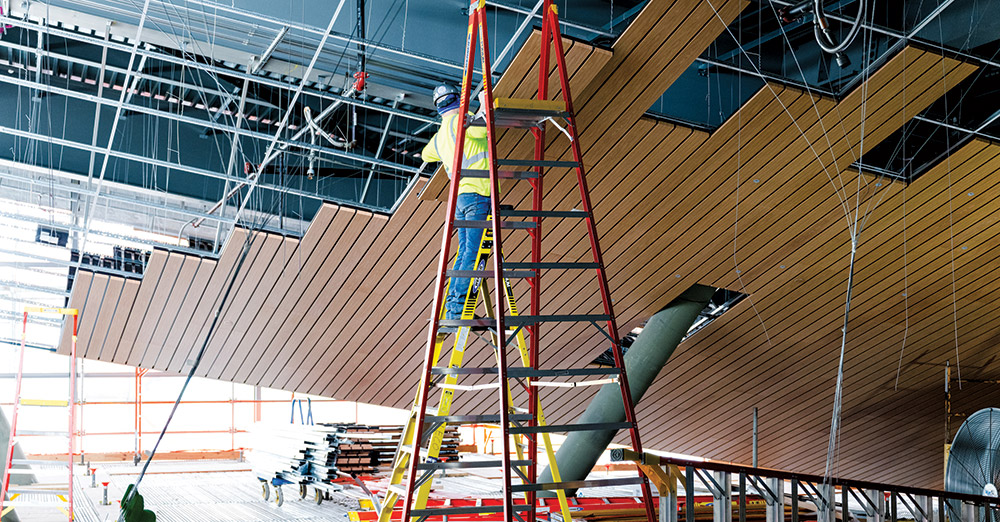
The terminal design utilizes natural light as much as possible, as well as a wood-like color.
Photos courtesy of ACAA
Collaborative Design
The pandemic in 2020 paused planned preparatory site work for more than one year. But the design team “never paused—totally the opposite,” says Luis Vidal, founder of the titular firm. “We revisited things, questioned things, reaffirmed things.”
Questions arose regarding construction phasing, new technology to address virus-related concerns and other design factors. “HDR’s healthcare design professionals, including communicable disease and nursing specialists, led an eight-week charrette to evaluate all aspects of the project,” says Peduzzi. Existing design aspects features such as open-air gardens and terraces provided an opportunity for fresh air, and fit the bill for spreading people out.
Stakeholder groups were consulted to discuss air quality, touchless surfaces, distancing and other factors, says Carolyn Sponza, a principal at Gensler, adding that even before then, “often we’ll design around the passenger experience. The authority wanted us to design for the employee experience as well.”
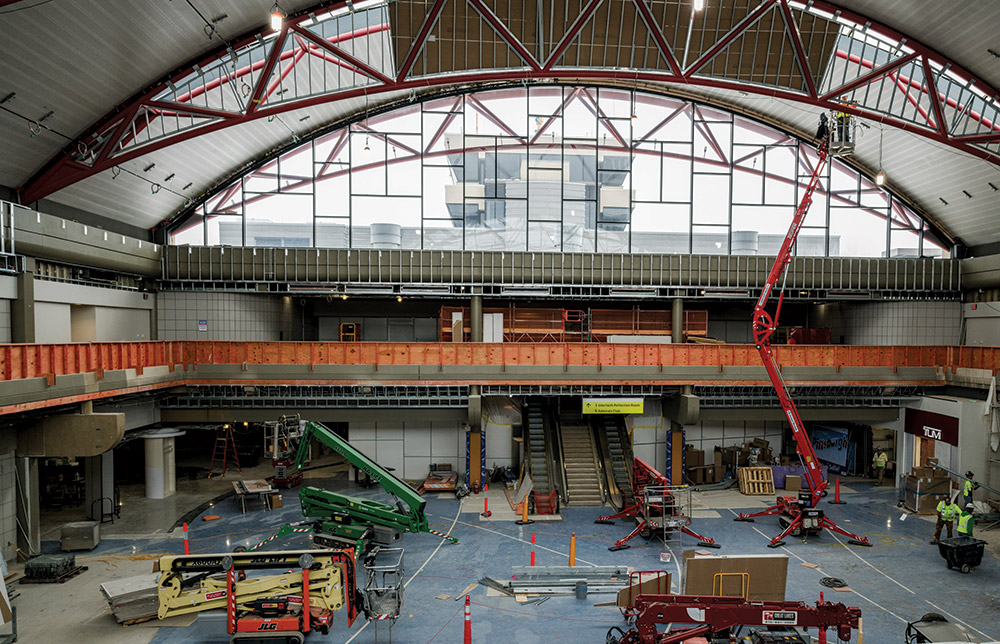
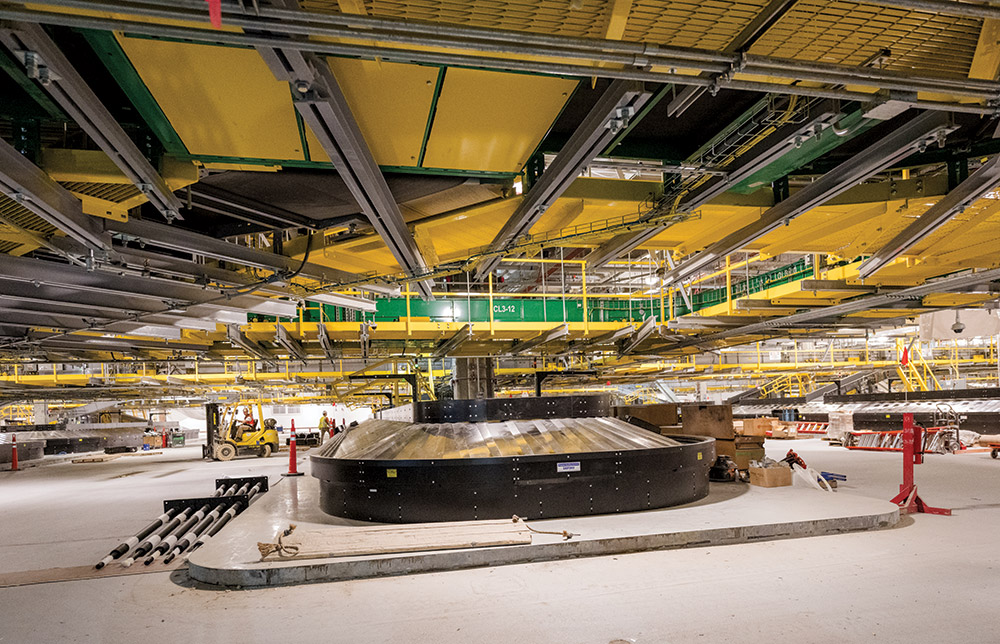
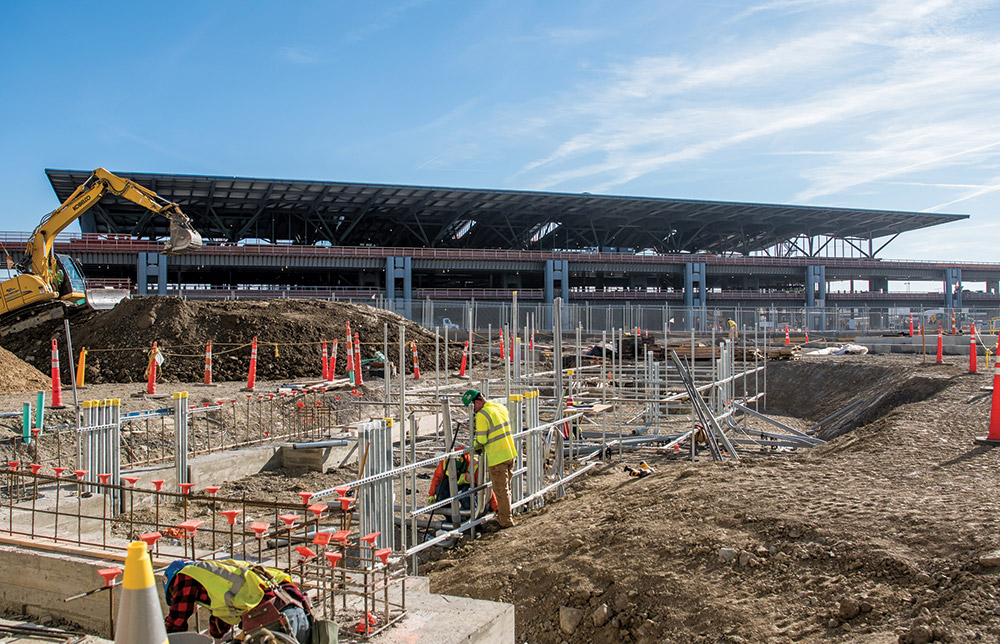
PIT land hosts a microgrid, additive manufacturing campus and aviation fuel farm.
Photos courtesy of ACAA
One outcome is use of autonomous floor scrubbers equipped with ultraviolet light to disinfect high-traffic areas. Developed by Carnegie Robotics, they debuted at the old airport in 2020.
Another pre-pandemic design tweak was to change the at-grade eight-lane roadway to a three-level roadway, Peduzzi says. “We had to bisect and cross two automated people-mover tunnels, a utility tunnel and a baggage tunnel. Once the old apron was removed, the top of the tunnels were at subgrade,” he adds. “We had to span all that with passengers while maintaining passenger, utilities,and baggage operations beneath.”
The new 1,300-ft-long bridge connecting to the new terminal at six locations had to be more rigid than a highway bridge, Peduzzi notes. “This is a terminus point. That changed the structure—it had to be very stiff and move with the building, but be light in terms of spanning the tunnels.”
The structure includes 21-ft floorplates, rigid columns and clearance for 14-ft emergency vehicles. Due to a slender profile, “it showcases the building behind it,” he says, adding that “one of our bridge architects was with us every step of the way.” The on-airport roadway’s geometry flow has no blind curves. “That way we could remove extra signage,” says Peduzzi. “Intuitive wayfinding is a theme throughout.”
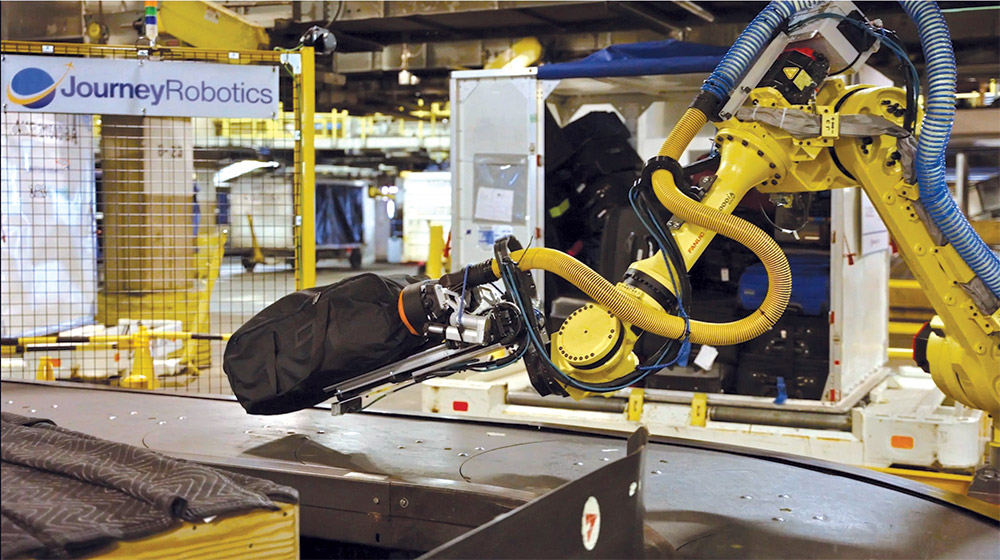
A robotic arm that can ease strain on human baggage handlers is one of many technologies tested at the airport.
Photo courtesy of Journey Robotics
The terminal consolidates ticketing, security and baggage operations under one roof, shortening passenger travel time from curb to gate by about 50% and cutting the route from international arrivals to curbside by 67%.
Inside, terrazzo floors with leaf motifs by artist Clayton Merrell, branching tree-column canopies and an undulating roofline inspired by Western Pennsylvania’s hills create a biophilic interior. More than 4,000 ceiling lights simulate a night-sky constellation visible throughout the terminal. Twelve security lanes feed into a spacious recompose area, while a new baggage-handling system shortens conveyor length from eight miles to three, speeding luggage delivery to eight expanded claim carousels.

Cassotis’s leadership fostered the airport’s turnaround and transformation.
Photo courtesy of ACAA
Universal-access amenities include inclusive restrooms, adult changing tables, quiet and nursing rooms, and Presley’s Place, a sensory-friendly suite for travelers with autism. These features reflect the Nature + Technology + Community ethos of the design, notes Vidal. “The way the natural light works in this building—it’s my favorite material,” he adds.
The terminal also reflects results of extensive community engagement, adds Solis. A “tremendous amount” of focus group time before design and construction informed such amenities as Presley’s Place. “Through design, we held workshops with stakeholders to make sure we hit the highlights we needed.”
The airport team this fall also conducted two test runs, asking the community to conduct basic trials for more than 40 different airport functions—from the parking setup to check-in counters. “Eighteen thousand people responded to the call for interest,” says Cassotis. There were 3,000 participants in “dress rehearsals,” offering feedback as crews subsequently tweaked wayfinding and signage.
Feedback also informed construction. “We were focused on making sure Pittsburghers would build this,” says Cassotis. Focusing on small, disadvantaged and local firms, “We held classes on doing work at the airport and on how to get bonded and insured. We held ‘meet the prime’ days.”
Airport officials have held 50 outreach events for disadvantaged contractors since 2018, and the project has met its 14% M/DBE goals. “The [authority], from the beginning, showed a commitment to make sure that diverse construction firms had a fair opportunity to participate in this project,” says Brian J. Merdian, vice president of construction at Waller Corp. “There were also job fairs [it] hosted periodically ... targeted for inner-city and at-risk youth to meet with contractors.”
The authority also offers technology providers opportunities to participate. Journey Robotics, a start-up firm developing autonomous baggage handling systems, is testing its robots. “The authority allowed us to install our prototype to refine it and test it in the real world,” says Reeg Allen, CEO and founder.
A robotic “arm” can handle five to six bags per minute, each up to 74 lb. “It allow humans not to wear out, and to do other things,” he says. “[The authority] has been extremely supportive and helped us show the world what can be done.”
The testing is part of the airport’s xBridge program, which invites companies such as Journey Robotics to test new technologies, processes and systems. The program has involved 33 new firms since 2022, says Cassotis. Gecko Robotics, involved in terminal construction, offered a technology that enables thorough building fire safety inspection—specifically, sensors to test the structure’s signature metal “tree” columns that support much of the structural steel, says the authority. Crawling robots attach to pillars and “scan concrete that fills the pillars for air bubbles,” says Cassotis.
Deepak Nayyar, the authority chief innovation officer, noted other technologies deployed: a waste digestor that processes around 400 lb of food waste a week into liquid fertilizer and AI models that monitor ramp operations through gate cameras to run analytics that measure timing for aircraft parking, baggage loading and passenger deplaning.
“We’re testing features like autonomous mobility vehicles that use AI and wayfinding to guide passengers to the closest restroom or restaurant,” he wrote in the ACAA’s news outlet, Blue Sky News. “Sensors will process video feeds to deliver real-time estimates for the checkpoint lines using predictive analytics that can forecast peak times and allow for optimal staffing,” Nayyar wrote. “AI-driven predictive maintenance proactively identifies potential issues, enabling optimized maintenance schedules and extending the lifespan of critical equipment.”
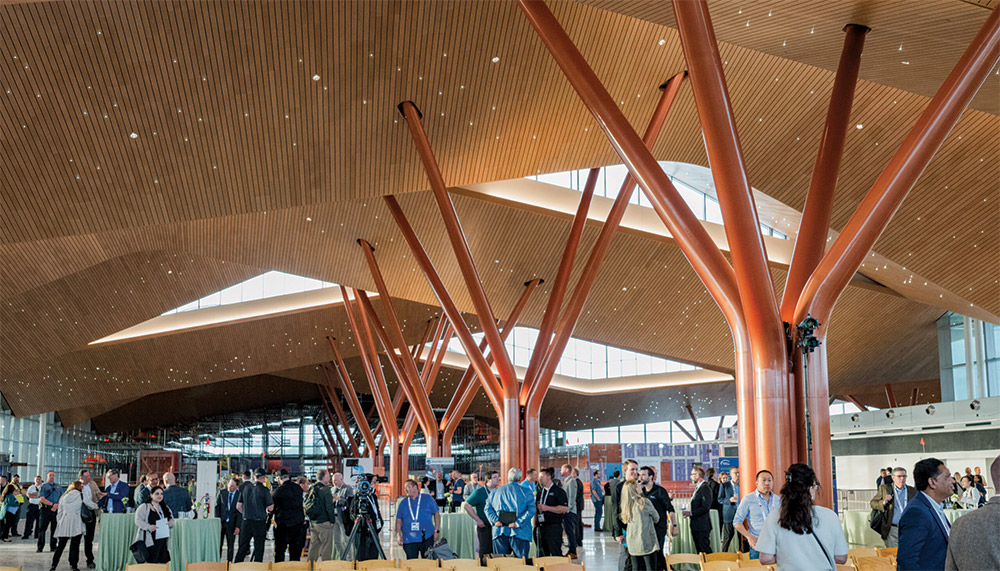
Terminal architecture aims to reflect Pittsburgh’s natural environment and industrial history.
Photo courtesy of ACAA
The authority also aims to develop a sustainable on-airport fuels farm in partnership with Avina Synthetic Aviation Fuel. it would be the first on-airport production facility using one of the first alcohol-to-jet pathways in the U.S., the firm said. The facility will use an alcohol-to-jet technology developed and owned by Swedish Biofuels AB and exclusively licensed globally by technology firm KBR. The facility would ultimately produce over 100 million gallons.
The airport authority has also designated 195 acres for Neighborhood 91, a first-of-its-kind dedicated campus for additive manufacturing such as 3D printing in metals, launched in 2022. The goal is to create a collaborative ecosystem to co-locate all additive manufacturing supply chain stages, Cassotis says. The first 13-acre phase is operational.
The airport, which in 2021 set up a 23-MW microgrid, also has plans to launch a solar project to more than double its existing array and generate an added 4.7 MW of power. Duquesne Light Co. and IMG Energy Solutions will install 11,216 solar panels adjacent to an existing 10,000-panel field. “If we have to shut down, somebody’s life is in jeopardy,” says Cassotis, noting aviation medical deliveries. “We have a duty to the public to remain open and operational.”
With Bryan Gottlieb and Jim Parsons


Bryan Gottlieb is the online editor at Engineering News-Record (ENR).
Gottlieb is a five-time Society of Professional Journalists Excellence in Journalism award winner with more than a decade of experience covering business, construction and community issues, including finance, law and real estate. He has reported for Adweek and the San Diego Daily Transcript and led a community newsroom in Santa Monica, Calif. He served as editor-in-chief of the Detroit Metro Times and as managing editor at Roofing Contractor, where he helped shape national industry coverage. At Engineering News-Record, Gottlieb covers breaking news, large-scale infrastructure and megaprojects, regulatory developments and business trends across the U.S. and global construction sectors.
email: gottliebb@enr.com | office: (248) 786-1591