Clean Energy Construction
Virginia's 2.6 GW Offshore Wind Megaproject to Hit Power-On Switch
$10.7B CVOW project off Virginia Beach will link first turbine energy to land-based grid in early 2026, Dominion Energy says
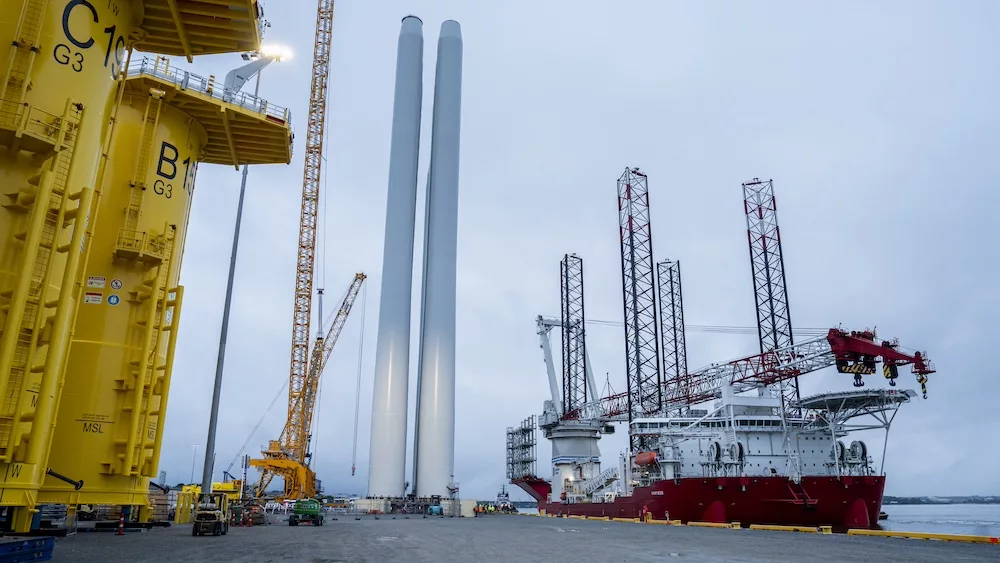
The $715-million Charybdis offshore wind installation vessel, on right, built at a Texas shipyard, has a 426-ft crane that can lift up to 2,200 tonnes. It is the first to comply with federal law that restricts non-US made vessels moving between American ports.
A quiet hurricane season and jobsite arrival of Charybdis, the first U.S.-built and federally approved offshore wind turbine installation vessel, enabled crews building the $10.7 billion, 2.6-GW Coastal Virginia Offshore Wind project to complete work to install its 176 turbine foundations by the end of September, when pile-driving ended for the season to protect migrating North Atlantic right whales.
Installation continues of the project's 14-MW Siemens Gamesa turbines and the second of three offshore substations, a spokesman for owner Dominion Energy told ENR. "We’ve completed installation of the deepwater offshore export cables, installed nearly 45% of near-shore export cables and also are installing inter-array cables that carry energy from turbines to offshore substations."
He said first power is set to generate in quarter one of next year, will full project finish by late 2026.
The $715-million, 472-ft-long Charybdis, built at the Seatrium AMFELS shipyard in Brownsville, Texas, exceeded its original budget by about $65 million. But it has a 426-ft- crane that can lift up to 2,200 tonnes and install four turbines with each trip, says the spokesman.
The ontime execution has not been affected so far by Trump administration sector attacks, which have included orders at other East Coast sites to halt project work and stop permitting. But the US. Transportation Dept. in September canceled a nearly $40 million grant for the Norfolk Offshore Wind Logistics plant that was set to support the project.
"Our project has enjoyed bipartisan support from the beginning,” the spokesman said, noting the backing of leading state Republicans, including Gov. Glenn Youngkin and U.S. Rep. Jen Kiggans, who called CVOW “important to Virginia,” as one of the largest U.S. data center hubs and military operations centers. According to Politico E&E News, House Speaker Mike Johnson (R), selayed Kiggans’ concerns directly to President Donald Trump. “I understand the priority for Virginians and we want to do right by them, so we’ll see,” Johnson said.
"The administration’s tactics against offshore wind have largely centered around trying to compel states to buy more natural gas," said sector analyst Philip Totaro, founder & CEO of IntelStor LLC. "Dominion Energy already supplies natural gas to some customers in South Carolina and is pursuing a new gas-powered power plant in Chesterfield County, Va., as a backup to offshore wind."
Looking for quick answers on construction and engineering topics?
Try Ask ENR, our new smart AI search tool.
Ask ENR →
But all are watching the outcome of the Nov. 4 election, with new contenders vieing to succeed the term-limited Youngkin as governor, and former House of Representatives Democrat Abigail Spanberger showing a strong lead.
Her victory could result in new clean energy legislative moves in Virginia such as the 2020 state Clean Economy Act, which could focus Trump rancor on CVOW. “If Spanberger is elected to office and attempts to implement more actions similar to the [law], Virginia could become a target for the federal government, and CVOW might take the brunt of [its] fury,” Totaro said.
Meanwhile, administration attacks on offshore wind and clean energy are set to complicate efforts for bipartisan permitting reform, said Sen. Sheldon Whitehouse (D-R.I.), ranking member of the U.S. Senate Environment and Public Works Committee on Oct.. 22.
"Why would we want to do bipartisan permitting reform during an administration that won’t faithfully execute [the] law, that can’t be trusted, with unrelenting and often illegal assaults on clean energy projects?," he said, stating that Interior Dept. Secretary Doug Burgum "declared that he had no interest" in including offshore wind in a permit reform proposal.
Burgum reiterated that position in Oct. 20 remarks to the American Petroleum Institute, a key trade group for the oil and gas industry. While group CEO Mike Sommers termed permit reform "a bipartisan issue,” the Interior Secretary again voiced no support for changing administration anti-renewable rhetoric to forge a permit deal with Democrats. "I hadn’t thought about the idea of trading something that makes sense for everybody in America for something that makes no sense — and that’s sort of how I view offshore wind,” Burgum told the institute.
Said Whitehouse: "Unless these illegal acts stop and unless offshore wind is included, there will be no permitting deal. End of story."