ENR Top Green Firms: Rewards Outgrow Risks
October 9, 2025
ENR Top Green Firms: Rewards Outgrow Risks
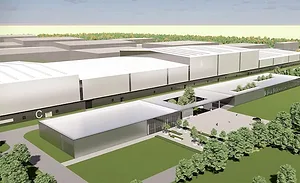
October 9, 2025Skidmore, Owings & Merrill is helping energy-storage firm Energy Vault further develop the modular EV0 gravity-based system, shown here.


Related Links:
ENR 2025 Top 100 Green Buildings Design Firms
ENR 2025 Top 100 Green Building Contractors
View complete 2025 list, with full market analysis
(Subscription Required)
ENR Top 200 Environmental Firms: Facing New Realities
Federal funding clawbacks targeting sustainability-minded programs are expected to stunt U.S. 2050 emissions goals by as much as 7 billion tonnes by 2030, experts warn. But despite those shifting political priorities, ENR’s Top 100 Green Design Firms and Contractors say an “inevitable” evolution is lurching the green building market forward.
The Trump administration has moved to majorly roll back federal environmental protection regulations and standards in favor of boosting fossil fuels production while slashing Biden-era investments in clean energy and sustainability baked into the Inflation Reduction Act and the Infrastructure Investment and Jobs Act.
Last month, the administration announced that it would open around 13 million acres of federal land across Wyoming, Montana, Utah and North Dakota for coal mining on the heels of President Donald Trump’s pledge to revive the heavily polluting energy source as an essential “national and economic security” tool to restore “American energy dominance.” In an April 8 executive order, Trump wrote, “We must encourage and support our Nation’s coal industry to increase our energy supply, lower electricity costs, stabilize our grid, create high-paying jobs, support burgeoning industries and assist our allies.”
___________________________________________________________________
RELATED
Don't miss updates on key construction sector issues and on billions in Los Angeles region infrastructure development at the ENR LA Infrastructure Forum, Nov. 3 in downtown LA. Click for details on who's speaking and how to register!____________________________________________________________________
Yet amid a global march toward an energy transition that intends to supplant fossil fuels for cleaner electrification, policy experts say America risks falling behind its competitors by doubling down on crude coal as clean energy takes off.

Keeping Up Green Momentum
Shifting political priorities are “no match for the momentum of the green building movement,” says Eric Corey Freed, director of sustainability at Cannon-Design. At the ranked No. 10 design firm, he says such momentum is reflected in the form of renewables on the utility grid.
“If you look at our utility grid, 95% of the additions to the grid last year were renewables,” says Freed. “[Jurisdiction] and codes are at the state level, and that’s where we are seeing the most action around sustainability.”
ZGF Architects, ranked No. 18 in design, says that despite federal rollbacks, its clients are mostly standing firm in their commitments to sustainability and greener design. However, the firm expects the rollbacks will make innovation around carbon reduction and improved air and water quality initiatives more challenging.
Looking for quick answers on construction and engineering topics?
Try Ask ENR, our new smart AI search tool.
Ask ENR →

“We are watching the changes in real time because the sustainable bulk buying power of the federal government has historically driven innovation and lowered the cost of new technology in the private sector,” says Principal Arathi Gowda. “These impacts will unfurl over time, while deeply impacting vulnerable populations in the near term.”
Although “progress will slow down without federal wind at our backs,” she adds “we will continue to hold the torch.”
For many private sector owners, high-performance buildings, sustainability and occupant wellness, have become inextricably tied to their operations and mission, says Susan Heinking, senior vice president for high performance and sustainable construction at Pepper Construction, ranked No. 21.
Such initiatives can be “a differentiator and source of pride for employees”—not easily untied by sliding federal support, Heinking says, adding that she expects green incentives at a local level will help fill some of the void.
Evolving Codes and Standards

“Electrification represents one of the most significant opportunities for the sustainable construction industry to accelerate decarbonization. ”
Susan Heinking, Senior Vice President, Pepper Construction
The rollback of federal laws such as the Clean Air Act, Clean Water Act and Waters of the United States (WOTUS) under the Trump administration has put the burden on the states to adjust their codes and standards to levels that will continue to minimize environmental impacts, says Theresa Lehman, director of sustainable services at Miron Construction Co. The contracting firm is ranked No. 88.
Lehman says such abrupt changes have also made it difficult for green building industry leaders to react.
“It’s costly to continuously change EHS [environmental, health and safety] standards, policies and procedures to comply with current regulations, much less train people,” she says.
Because regulations and codes often vary between regions, and between states and the federal government, inconsistency and confusion can in some cases add additional costs for compliance, adds Lehman.
“Without consistent policy or codes, voluntary third-party green building certifications are the only way to create a roadmap for creating an energy efficient and healthy green building,” says Lehman.
Although a decrease in federal funding and incentives may slow broader green building adoption, Luke Leung, principal and sustainable engineering practice leader at the ranked No. 22 Skidmore, Owings & Merrill, says he expects many Fortune 500 companies will continue to invest in green buildings because their sustainability commitments look “beyond national borders.”
Because the companies align with global standards—“such as science-based targets or international reporting frameworks”—Leung says their investments are often deeper than meeting “local codes or policies.”
He adds, “For them, incentives help accelerate their timelines, but their long-term strategies are driven by global obligations and competitiveness.”
Greener Numbers

“Without consistent policy or codes, third-party green building certifications are the only way to create a roadmap.”
Theresa Lehman, Director, Miron Construction
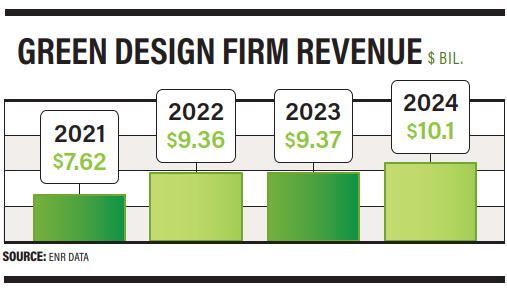
Green design revenue increased 7.8% between 2023 and 2024 for the Top 100 Green Design Firms, topping $10 billion for the first time. International green design revenue rose slightly, up to $1.82 billion from $1.79 billion.
However, not all firms saw revenue growth. Of the 89 design firms who filed surveys both this year and last, 62.9% reported an increase in green revenue. Median revenue actually fell 12.8% to $24.5 million in 2024, from $28.1 million in 2023. The top 10 firms accounted for 57.9% of the total revenue, up from 57% in 2023 and 53.7% in 2022. The share of total green design revenue earned by firms ranked sixth through tenth has increased every year from 2021-24, rising to 18.2% from 14.3%.
Green design revenue in the industrial-manufacturing market grew 84.1% between 2023-24, far and away the largest growth market. The health care (32.1%) and sports-civic-entertainment (21.6%) markets also saw significant growth. But airports fell 20% and multi-unit residential is down 13.3%.
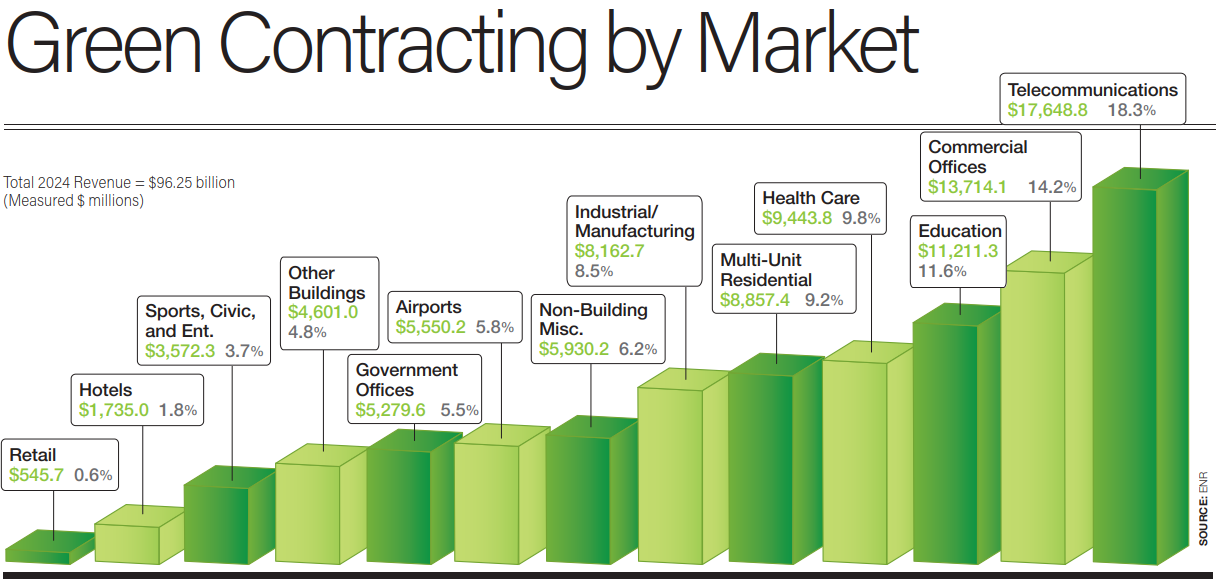
Revenue also rose 5.3% for the Top 100 Green Contractors, to $96.25 billion. Outside of that top line number, however, revenue mostly took a step back between 2023-24. Median revenue fell 7.7% to $318.83 million. International revenue also contracted 3.8% to $3.77 billion this year. Most interestingly, fewer than half of the 86 general contractors that filed this year and last year reported an increase in green revenue this year. The equivalent number reported on last year’s survey was 66.3%.
Green contracting revenue in the telecommunications market, which includes data centers, rose 64.8% between 2023-24. The airports (up 13.9%) and education (10.4%) markets also saw substantial increases. The hotels-hospitality market fell 23.1% between 2023 and 2024, and is down 37.5% since 2022. Commercial offices (down 19.2%), and multi-unit residential (11.0%) also saw significant drops.
Healthcare | By Jonathan Keller
Design-Build Team Tackles First All-electric US Hospital
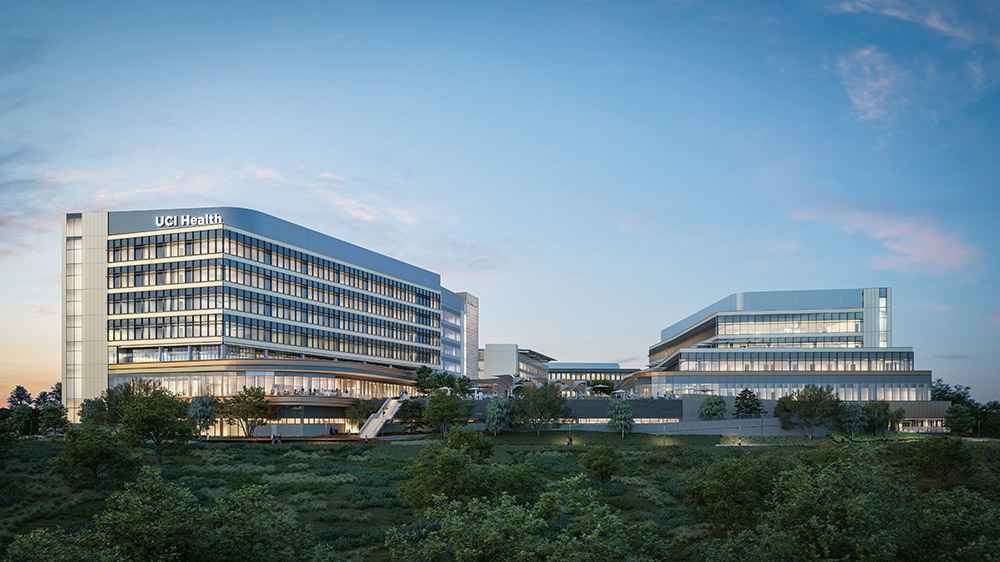
Rendering Courtesy of CO Architects
CO Architects (No. 36) and Hensel Phelps (No. 8) are the design-build team on the UCI Health-Irvine project in Irvine, Calif. The campus, which includes a 350,000-sq-ft hospital and 220,000-sq-ft ambulatory surgery center, will be the first in the U.S. to operate on an all-electric central utility plant, the team says. With the site adjacent to the San Joaquin Marsh nature preserve, the design features a turtle fence and frit shading to protect nearby endangered wildlife. The hospital is on track to be certified as LEED Platinum.
Behind the Numbers
Top 100 Design Firms and Contractors overwhelmingly named cost as a major barrier to entry when it came to investment in green building innovation. Firms say on many projects, cost was a matter of near-term and short-term challenges.
“The biggest near-term challenges in sustainable design and construction fall into three areas: materials, data and operations,” says Julianne Laue, environmental and sustainability director at JE Dunn, ranked No. 15 on the contractors list.
She adds that procurement of low-carbon materials, such as low carbon concrete, steel and aluminum alternatives at scale “remains difficult.” Adding to that, regional availability, specification clarity and buy-out timing often collide, “making it hard to secure the right products at the right time and volume,” says Laue.
On the data side, accurately capturing auditable data covering environmental product declarations around fuel use, energy and waste is also a challenge. “Contractors need systems that can capture and report this information reliably without overwhelming field teams,” explains Laue, adding that the energy transition and grid limitations will also demand new approaches to the construction sequence.
“From temporary power to commissioning, electrified sites and buildings demand new approaches, and the industry is still catching up,” she says.
Pepper’s Heinking sees the shift toward electrification as “one of the most significant opportunities for the sustainable construction industry to accelerate decarbonization.” Challenges also “open the door for innovation, collaboration and leadership.”
Parks & Recreation | By Jonathan Keller
LA Park Grows From Second Largest US Landfill
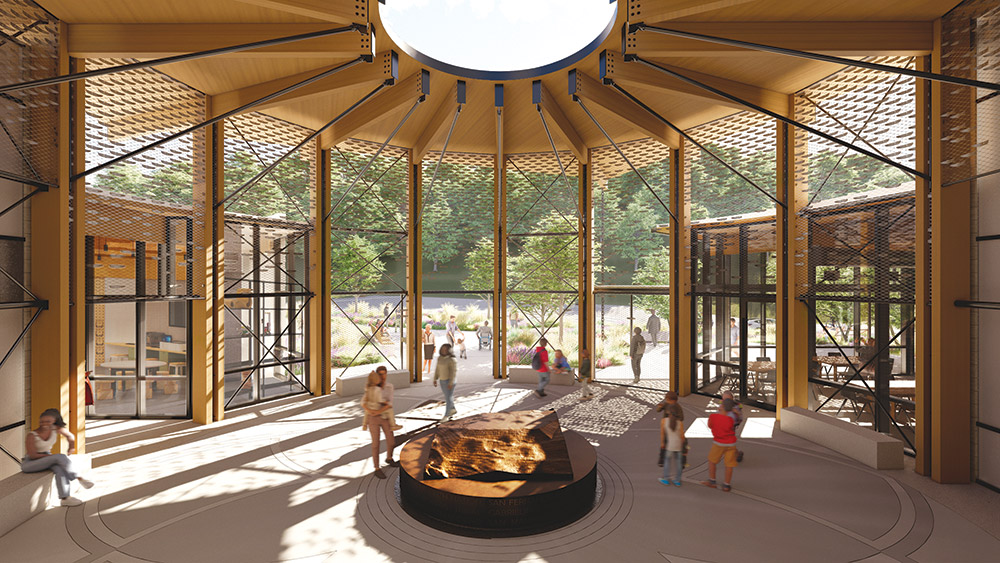
Rendering courtesy of HDR
HDR (No. 6) is providing architectural and engineering services, including solid waste engineering, on the Puente Hills Regional Park project, which will convert the second largest U.S. landfill into Los Angeles County’s first new park in 30 years. Phase one, which broke ground Sept. 9, will build the Hilda L. Solis Environmental Justice Center at the park’s entrance. It is designed to achieve net zero energy for operational carbon, and a 50% or more reduction in both embodied carbon and potable water consumption.
Greening the Grid
Amid grid limitations, Top 100 Design Firms and Contractors say some buildings, utilities, owners and codes are now including grid friendliness in their design to solve short-term limitations with load management, battery storage and thermal mass.
However, “the larger limitation is that utilities are financially disincentivized from investing in large-scale transmission and infrastructure that would lower the cost of energy in the U.S. and enable widespread electrification,” says Kjell Anderson, principal at LMN Architects, ranked No. 52. “Utility financial incentives need to be rethought to incentivize the rapid buildout of a robust, non-polluting electric grid.”
Amid increased power demand surges due to the proliferation of artificial intelligence adoption, Kraus-Anderson Sustainability Manager Kevin Bright says he foresees “more buildings electing to source their own power on site, limiting interruptions and providing additional energy security for projects.”
Patty Lloyd, sustainability director at Leopardo Construction, says she doesn’t see grid limitations as a hindrance to adoption of high-performance buildings or net-zero goals.
“Cost is the first and biggest hurdle. Longer term benefits like grid resilience or lifetime return on investment above and beyond the initial investment don’t seem to resonate—which is odd given that we know there will be strain on the grid, and we know that energy costs will only go up,” she says. “In fact, grid limitations and the deployment of renewables to reduce grid dependency and lower lifetime energy costs should be an impetus toward adoption of high performing, near zero and net zero projects.”
Bright says that he sees grid limitations and net-zero adoption as “complementary,” adding that “green building standards are moving in the right direction of focusing on the reduction of embodied carbon in construction materials.”
Balancing Health, Wellness and Resilience
At Affiliated Engineers Inc., “Many of our clients maintain a strong resolve to invest in sustainability measures,” says Brett McQuillan, building performance engineer at the ranked No. 44 firm. However, “changes in federal incentives have resulted in a reassessment and realignment of which technologies are most cost-effective,” he notes.

“Green building standards are moving in the right direction of focusing on the reduction of embodied carbon in construction materials. ”
Kevin Bright, Sustainability Manager, Kraus-Anderson
Joss Hurford, senior building performance project consultant at Affiliated Engineers, adds that climate risk modeling can be used to effectively support client decision-making around resilience investment.
“Common approaches to enhancing a building’s resilience include elevating critical program and supporting infrastructure, along with designing cooling systems for projected extreme heat events, such as space planning for future equipment expansion and installed distribution sized for increased capacity,” he says.
Webcor Senior Sustainability Director Sarah Rege says the ranked No. 28 general contractor is seeing a greater focus on health and wellness.
“We certified our Los Angeles and Alameda offices for Fitwel a couple years ago, and we’re recertifying them because we’re prioritizing the occupants of the building and their daily health,” she says. On projects, Rege adds that one feature the contractor is seeing is more filtration systems to address wildfire smoke.
“We’re hearing up front that building owners want their systems designed to either incorporate filtration or include filtration they can put in temporarily,” she says. “That way, in the event of a smoke-related incident, the building occupants will still have good indoor air quality.”
Weighing building occupant wellness, resilience and performance has become a balancing act for design firms and contractors to tailor building features to fit the owner’s needs amid increasing costs and climate demands.

“It’s not just about what we build but how we build it: rethinking logistics, retraining teams and coordinating across project teams.”
Kevin Montez, COO, Rycon Construction
“The perception of increased upfront costs, fragmented regulatory framework and inconsistent stakeholder alignment remain the biggest hurdles. However, these challenges can transform into long-term value for clients, especially as increasing extreme weather events underscore the urgency for sustainable development and infrastructure,” says Will Wilhelm, director of sustainability and resiliency consulting at Kimley Horn. He adds, “Lasting progress depends on engineering design and construction professionals shifting their mindsets to fully consider downstream risks—both temporal and spatial—so that decisions made about the built environment and infrastructure result in a 30–100-year lifespan and beyond.”
Overall, Arup’s Americas Climate and Sustainability Services Leader Ilana Judah says she believes the industry has been challenged by a slowdown in new projects as a result of inflation and higher interest rates.
“This can lead to tighter budgets and less flexibility for clients to invest in sustainability up front, as cost savings become a priority,” she says.
Costs also pose a barrier to retrofitting or reusing existing buildings, Judah adds, explaining, “on a positive note,” that tariff changes could increase local sourcing and reuse.

“Despite these obstacles, there is still a strong business case for building sustainably, particularly in terms of occupant health, energy and material efficiency, and resilience to climate events,” he adds.
A New LEED
Beyond the green building market’s challenges of consistent regulations and availability of low carbon materials, LEED standards have been a uniting force to bring contractors and design firms on the same page.
“While builders and designers can help owners achieve their decarbonization goals, each project and location requires a different set of knowledge, such as locally available low carbon materials, unique climate conditions and other factors that can be challenging to navigate,” says Ian Pope, sustainability director at McCarthy Holdings Inc.
With the release of LEED v5 in April, U.S. Green Building Council Senior Policy Counsel Elizabeth Beardsley says the group aimed to address decarbonization, quality of life and biological conservation and restoration.
“We did a huge number of listening sessions and researching and looking at what was working and what people wanted from this next iteration,” says Beardsley. She explains that every LEED project will have to have a climate risk assessment, applying to existing buildings as well as new ones. Also new is a human impact assessment, “basically looking at who’s involved in this project and taking into account the needs of the neighborhood, what the workforce looks like, and so on,” she says.
On the subject of federal rollbacks, Beardsley laments that the organization doesn’t have the same engagement with federal agencies and lawmakers it had in previous administrations. “It’s more of an opportunity loss in terms of how the federal government can advance important areas,” she says. But she adds that states are pushing forward with green standards that work best for their needs.

“I think what we’re seeing is continued resolve in many of the states to continue the work they’re doing, as well as cities and across the private sector, in a lot of the companies that we work with,” she says.
Kevin Montez, COO of Rycon Construction, adds that sustainable construction is no longer a future goal; “It’s a requirement on many of our projects, offering new challenges within an evolving market.”
“We’re being asked to deliver buildings that meet higher environmental and health standards while navigating shifting regulations, unfamiliar materials and tighter schedules. It’s not just about what we build but how we build it: rethinking logistics, retraining teams and coordinating across project teams and supply chains,” Montez points out.
The success of the green building design and contracting sector “will depend on how quickly we adapt, how effectively we train, and how committed we are to long-term performance over short-term convenience,” he says.
According to Myrrh Caplan, senior vice president of sustainability at Skanska USA Building, “As builders, we use our expertise to guide clients toward high-performing buildings, whether or not those efforts are publicly promoted.”
But to drive broader industry progress, she emphasizes that “we need more owners to speak openly about their sustainability commitments and inspire others to follow.”