Construction Technology
Bluebeam To Release Revu Max With AI Assistants, Geometry Capabilities in 2026
Software firm Nemetschek Group doubles down on document-centric workflows for design and construction

Georg Nemetschek, 91, founder of software firm Nemetschek Group, announces partnership with Stanford University Center for Integrated Facility Engineering at the Bluebeam Unbound Conference in Washington, DC Oct. 1.
When Nemetschek Group's construction document management platform Bluebeam acquired Firmus AI on Sept. 4, it signaled that the German-based software company had big plans for artificial intelligence in construction document-based worklfows.
The latest version of Bluebeam Revu Max sotware is set to come out in the first quarter of 2026 and integrate AI into submittals, RFIs and other processes for construction users of the PDF-based tool, Nemetschek said at Bluebeam's Unbound Conference in Washington, D.C., Sept. 30 to Oct.
It also said that a "stitching" function, binding together several sheets for large civil projects would be included using Firmus technology to connect several sections of such large projects—made up of potentially hundreds of sheets, together in one 2D, overhead view. B
Bluebeam also shared details of its Model Context Protocol, the file exchange protocol that enables interoperability between AI applications and data formats of widely used business tools. A new Procore integration with no separate logins and a Docusign integration that takes fewer clicks to sign and approve documents were also detailed at the event.
"Revu being AI ready is what the [Model Context Protocol] integration is all for," said Don Jacob, Bluebeam chief innovation officer at. It "is really the early horse in the race that seems to really be gaining traction. We want to support that core interoperability."
As a PDF-based tool, Bluebeam Revu has always held a unique place in construction workflows as the Adobe file format translates paper into digital deliverables and still retains the ability to sign, stamp and perform other aspects of paper-based processes that design and construction depend on for workflow and managing legal risk.
While companies such as Motif, Arcol and now, even Autodesk with Forma Building Design are betting on the future of browser-based design tools with AI agents assisting the design and construction process, Bluebeam is filling the space that paper documents once did and plans to add AI functionality to those workflows.
Looking for quick answers on construction and engineering topics?
Try Ask ENR, our new smart AI search tool.
Ask ENR →
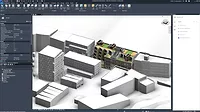
Bluebeam's Magic Wand is a tool that can can convert flat 2D geometry into volumes or quantities, or even duplicate geometry and offset it, with some surprisingly 3D design functionality built into a PDF platform. Bluebeam's Jacob and its head of product Luke Prescott said that adding AI to Revu Max will be done in a similar fashion.
"The civil, horizontal use cases and being able to do translations and conversions, absolutely are why having to manually calculate that, I think is where AI opens up potential for automating all of that," Jacob said. "Being able to see the overall project in Stitch is one example of that, being able to see different views of that PDF is that common language for a project. Over time, more and more data becomes available. I think that's definitely a direction we're going in, different ways to visualize project data."
The Procore integration will require only a login to Bluebeam Revu Max, which Jacob and Prescott said will work much like Bluebeam Revu's integration with Microsoft Sharepoint. It will be available in all subscription tiers at no extra cost. Magic Wand geometry capabilities will be included with Bluebeam Revu MAX, and will allow users to turn any markup with geometry into polygons, convert areas in a drawing to measurements of quantity or volume and duplicate areas. A new Revit plugin was created to allow users to create spaces across a Bluebeam PDF floorplan and match them with a Revit model in 3D.
At the conference Nemetschek announced a partnership between Stanford University's Center for Integrated Facility Engineering to accelerate AI-driven innovation across the built environment
"The purchase of Bluebeam in 2014 was one of the best decisions in our company's history," Georg Nemetschek, the company's 91-year-old founder, told attendees in announcing the Stanford partnership. "After the acquisition, [Richard] Lee, the founder of Bluebeam, asked me which of the many companies we had acquired I thought was the best. Today, I would say Bluebeam."

.webp?height=200&t=1780775005&width=200 "Bluebeam-Max-(2)")