Data Centers
Joule, Caterpillar Partner to Deliver Utah 4-GW Power and Hyperscale Computing Campus
The 4,000-acre project in rural Millard County would be the state's largest data center-power complex

The 4,000-acre project would combine Caterpillar G3520K generator sets with 1.1 GWh of grid-forming battery storage and a combined cooling, heat and power system that employs liquid cooling—an emerging necessity for high-density artificial intelligence workloads.
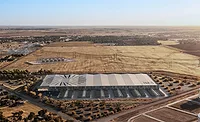
A collaboration led by Joule Capital Partners, Caterpillar Inc. and Wheeler Machinery Co. is advancing plans for what the developers describe as Utah’s largest data center campus paired with more than 4 GW of on-site power generation.
The 4,000-acre project in rural Millard County would combine Caterpillar G3520K generator sets with 1.1 GWh of grid-forming battery storage and a combined cooling, heat and power system that employs liquid cooling—an emerging necessity for high-density artificial intelligence workloads.
RELATED
Power Hungry: AI-Fueled Data Center Boom Sets Energy Delivery's New Course
While no cost estimate has been released, comparable U.S. mega-campuses point to multi-billion-dollar outlays. Microsoft is investing about $3.3 billion in its Mount Pleasant, Wis., campus, now under construction and expected to open in early 2026. Google’s Council Bluffs, Iowa, data center has operated since 2009 and has grown through successive expansions totaling more than $6.8 billion—including a $1-billion build-out now nearing completion.
The firms did not respond to ENR queries for additional comment on the status of site design and construction procurement before the story posting deadline.
RELATED
Project Team Pushes Limits on Abilene Data Center Job
The Utah partners describe an integrated prime-power platform designed to function as a quasi-microgrid that can operate independently of the regional utility grid if needed. Caterpillar emphasizes that prefabricated switchgear, controls and inverter systems that it will provide will shorten installation time.
Looking for quick answers on construction and engineering topics?
Try Ask ENR, our new smart AI search tool.
Ask ENR →
Melissa Busen, the equipment firm's senior vice president of electric power, called the project “a perfect example” of its power generation capabilities. Joule Capital Partners’ President David Gray said the project aligns with the company’s mission and Wheeler CEO Bryan Campbell called the alliance “world-class engineering, local expertise and visionary energy design.”
On Aug. 5, the Millard County Commission approved a zoning change for the parcel from agricultural to heavy industrial, clearing a key land-use hurdle. The companies said in a statement that an operational launch is targeted for 2026. A conditional use permit is required before construction can begin.
Transmission, Interconnection and Scale
Transmission and interconnection remain pivotal. Ryan Cross, senior practice manager for transmission engineering at Actalent, said in an email to ENR that if a data center uses all of its on-site generation, “the system can be set up to be shut off from the grid in times of disturbance—thereby drastically decreasing the challenges of grid interconnection.”
Cross, who is not affiliated with either Utah proposal but said he has 25 years of experience in the sector, also noted that “renewables require a large amount of real estate” and that EPC delivery “allows developers to start construction prior to completing design packages,” a benefit when long-lead equipment delays schedules.
Marty Puranik, CEO of Atlantic.Net, which operates data centers in the U.S. and overseas, added in an email that the Utah plans underscore a broader challenge. “What is unique is the attempt to build out this scale and get transmission and power at this scale to a single facility,” he said, noting that utilities often require large commitments up front for such loads. “Sometimes this build still ends up driving power costs for the rest of the rate payers.”
Separately in Millard County, Orem-based Fibernet MercuryDelta, LLC has proposed a “Delta Gigasite” outside the city of Delta, seeking to rezone roughly 1,200 acres for what KSL.com described as a 20-million-sq-ft campus that could ultimately host up to 10 GW of power generation, including solar, natural gas and tie-in to Intermountain Power Project transmission lines.
The Utah ventures, if realized at the gigawatt scale described, could eclipse both Microsoft and Google in terms of physical footprint and energy demand, underscoring the unprecedented scale developers are attempting in the Intermountain area.

Bryan Gottlieb is the online editor at Engineering News-Record (ENR).
Gottlieb is a five-time Society of Professional Journalists Excellence in Journalism award winner with more than a decade of experience covering business, construction and community issues, including finance, law and real estate. He has reported for Adweek and the San Diego Daily Transcript and led a community newsroom in Santa Monica, Calif. He served as editor-in-chief of the Detroit Metro Times and as managing editor at Roofing Contractor, where he helped shape national industry coverage. At Engineering News-Record, Gottlieb covers breaking news, large-scale infrastructure and megaprojects, regulatory developments and business trends across the U.S. and global construction sectors.
email: gottliebb@enr.com | office: (248) 786-1591

.webp?height=200&t=1770053544&width=200 "Stony-Brook-P3")