Construction History
Total Failure of St. Francis Dam Renewed Calls for Oversight
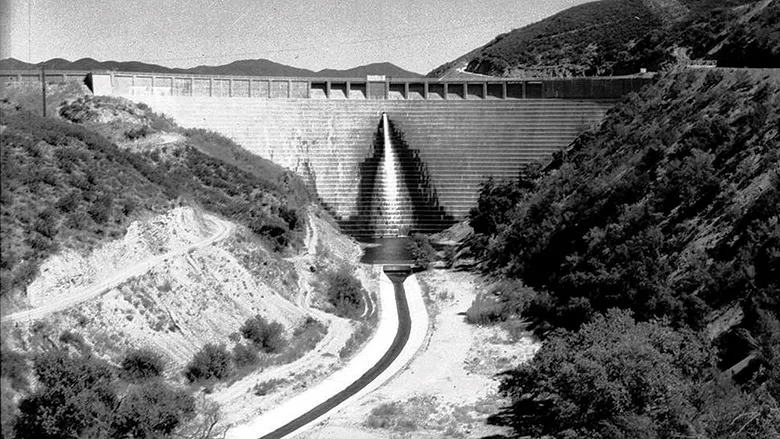
These before and after photographs of the 1928 collapse of the St. Francis Dam show, as ENR wrote at the time, “a single piece remained standing, while the rest slumped to the valley floor or was swept out.”
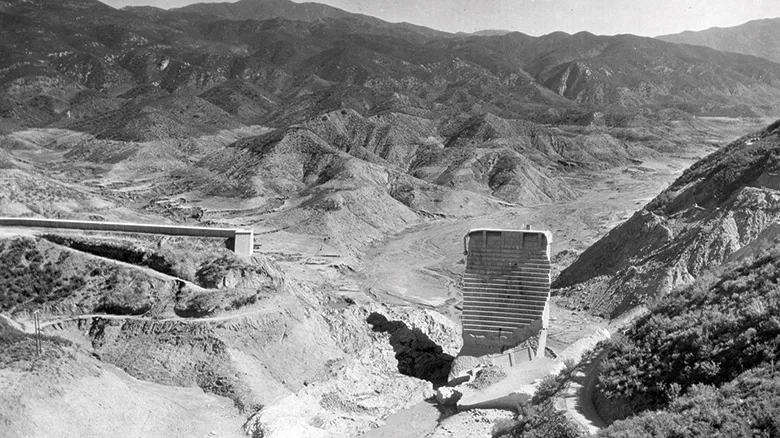
These before and after photographs of the 1928 collapse of the St. Francis Dam show, as ENR wrote at the time, “a single piece remained standing, while the rest slumped to the valley floor or was swept out.”

The second deadliest dam failure in U.S. history happened suddenly. The St. Francis Dam was a 205-ft-high concrete gravity arch dam located in San Francisquito Canyon, 30 miles north of Los Angeles. It was built to store water supplied by the city’s main water source, the Los Angeles Aqueduct, which brought water from the Owens Valley, 200 miles further north.
Shortly after the dam’s 1926 completion, moderate seepage was seen on the dam abutments, as well as two vertical contraction cracks on the dam face. William Mulholland, chief engineer of the Los Angeles Bureau of Water Works and Supply, along with his assistant chief engineer and general manager, Harvey Van Norman, inspected the cracks and judged them to be within expectation for a concrete dam of that size.
On March 12, 1928, shortly after the reservoir reached full capacity for the first time, the dam keeper, Tony Harnischfeger, who lived on site, spotted a new leak in the dam’s west abutment. He notified Mulholland and Van Norman, who spent two hours inspecting it, decided there was no danger, and left.
The dam collapsed just before midnight. “Without the slightest warning the great structure suddenly broke up: a single piece remained standing, while the rest slumped to the valley floor or was swept out," an ENR article, written by Pacific Coast Editor Nathan A. Bowers, stated. "Great blocks of the concrete mass, weighing many thousands of tons, were carried half a mile or more down the canyon.”
The full 38,000-acre-ft (12 billion gallons) of water formed a 140-ft-high wave that rampaged down the canyon for 11 miles, and then down the Santa Clara River westward for 50 miles to the ocean, descending 1,825 ft. It “swept the canyon sides clean for miles … washed away a concrete power house, buried great stretches of valley under silt, and extensively damaged bridges, highways and the Southern Pacific Railroad branch line.” The death toll is estimated at 431, with many bodies never recovered.
Sixty four of the victims were power house workers and their families. Eighty four casualties were Southern California Edison staffers living at a temporary construction camp on the riverbank.
Bowers, who was based in San Francisco, traveled to the disaster site quickly, studied the wreckage, interviewed the engineers who built the dam and other dam engineers, and telegraphed a 2,400-word article to ENR’s New York office within 36 hours of the failure. He brought strong credentials to his reporting, having earned a Ph.D. in civil engineering from Stanford University, for which his thesis was titled “Engineering Failures in the Water Power Field.”
His article outlined the dam’s foundation: “Excavation for the foundation extended 30-ft below stream bed at mid-channel and to lesser depths at higher elevations. Two kinds of rock occur in the foundation, meeting on a well-defined plane visible on the clean-swept side of the canyon. Under the stream bed and on the left [east] bank there is found a rock rated geologically as a schist, but known locally as graywacke shale. The right bank above the contact plane is usually referred to as red conglomerate. While some of this rock was not of the best quality, it was nevertheless accepted as a suitable foundation, and excavations of the rock of base and abutments were made deep enough to provide what was considered safe anchorage.”
Bowers pointed out that the dam lacked many features found on other dams. “No grouting of foundations was done, but … in the stream bottom holes were sunk 20 to 30 ft deep and … 4-in. pipes were brought out of these holes and led through a common drain outlet of the downstream face. There was no inspection tunnel, no concrete cutoff wall, and no reinforcement in the dam. The dam contained no vertical joints, as it is not the policy of the Los Angeles water bureau to make provision for contraction joints, but rather to allow contraction cracks to occur where they will and later close them as may be necessary. Contraction cracks occurred in the St. Francis Dam in approximately radial planes, but these were not of such nature as to effect the stability of the structure.”
Bowers described how the foundation rock was deeply eroded. “On the right bank the rock is now bare from stream bed to crest level. This portion of the canyon cross-section, now exposed, has been eroded considerably below the surface on which concrete was poured … it amounted to at least 15 ft in some places. Two distinct formations meet in a contact plane on this bank … along the contact is a band of serpentine of seamy formation so softened by water that here and there veins can be picked out with the fingers. Above the contact plane the formation has the appearance of red conglomerate, but typical samples submerged in water were found to soften in a short time.”
Looking for quick answers on construction and engineering topics?
Try Ask ENR, our new smart AI search tool.
Ask ENR →
Land along a 40-mile stretch of the Santa Clara Valley were denuded by the flood. Orchards and fertile farm fields were now “wind-swept stretches of bare silt and gravel deposits. Enormous quantities of debris had collected around trees, against buildings and in great piles.”
Some still-living orchard trees could be saved by removing debris. Repair and recovery efforts were robust. The L.A. City Council approved a $1 million allocation. The city formed a plan with the L.A. chapter of the Associated General Contractors of America whereby 1,300 workers went into the flood zone with tractors, trucks, power shovels and hoists to clear up debris, recover partly buried cars and aid in salvage work. AGC picked ten firms for the not-for-profit job.
A simple device that proved invaluable was the “stone boat,” a steel sled used to move large loads of debris to burn piles. They were made of sheet metal with two pieces of old rail welded on the underside as runners, and towed behind tractors.
The floodwaters' abnormal pressure caused three breaks in the aqueduct totaling 412 ft. Crews made repairs and restored the aqueduct to service 12 days after the disaster. During that time the city drew upon storage reservoirs at the lower end of the aqueduct.
Ralph Bennett, an engineer, visited the dam site the same day as Bowers, and contributed an article to ENR on his findings. He wrote: “The shales on which this dam stood will stand very high loadings when kept dry and in restraint. But when wet they become both soft and soapy. They are completely shattered and can be picked out in small pieces. They ravel freely where subjected to stream action. That the seams are not entirely tight is evidenced by the leakage back of and below the standing wall. With unrelieved under-seepage the dam must have had very considerable uplift. When this seepage began to produce full pressure at the lower toe the rocks must have raveled very readily and the originally minute passageways must have enlarged very rapidly into destructive channels which ate out under the arch at an accelerating rate until the structure fell into the hole so excavated.”
Two months later, Bowers wrote a lengthy article reviewing and excerpting the findings of the six investigating committees, each made up of engineers and geologists. Their conclusions on the causes of the failure were very much in agreement.
“The cementing material in the red conglomerate consists of clay, iron oxides and amorphous silica. The clay and silica soften in the presence of water, while the iron oxides dissolve. The percolation of the water into the conglomerate would soften the cementing material and would dissolve the gypsum which filled some of the fissures in the formation," said a report by the engineering committee of the L.A. City Council, chaired by Elwood Mead, chief of the U.S. Bureau of Reclamation. "The effect of softening or removing the binder would be to reduce at once the crushing strength of the mass and its ability to sustain the weight of the dam, and the effect of dissolving the slowly soluble gypsum which filled some of the fissures would be to open up these fissures and loosen the masses of material that are between them. If the water passing through these fissures carried with it gypsum in solution, the water would remain clear and would carry no evidence that it was washing away part of the foundation of the dam.”
The L.A. County district attorney’s technical commission report found “that the dam was constructed without a sufficiently thorough examination and understanding of the foundation materials upon which the dam was constructed; that failure of the dam was due to the incompetent geological formations upon which the dam was constructed; that the dam as designed should not have been constructed at this location.”
Perhaps the most damning error was that such a massive masonry structure was designed and built entirely in-house without any outside review. Mulholland, a self-taught engineer, had led the Bureau for over two decades, during which it had built 19 dams. State law exempted municipalities from needing state permits for dams.
The verdict of the coroner’s jury stated, “The construction of this dam, without having the design and foundation conditions passed upon by independent engineers and geologists, and without more thorough and systematic methods of design, supervision and inspection, involved an error in engineering judgment in determining the character of the foundations, and an error in fundamental policy relating to public safety. The responsibility for the error in engineering judgment rests upon the Bureau of Water Works and Supply and the chief engineer thereof.” At the coroner’s inquest, Mulholland accepted responsibility, stating, “Whether it is good or bad, don’t blame anyone else, you just fasten it on me. If there was an error in human judgment, I was the human, I won’t try to fasten it on anyone else.”
An ENR editorial right after the tragedy stated: “The present disaster contains no fact or happening that would justify restriction of dam construction. It points the need, however, for an effective check on individual judgement concerning foundations where many lives are at stake.” ENR had first pushed for oversight of all dams by state officials in 1889 after the Johnstown Dam disaster. California passed a law establishing state oversight of its dams in 1929.