Editorials
What to Do About Immigrant Construction Workers Under Siege
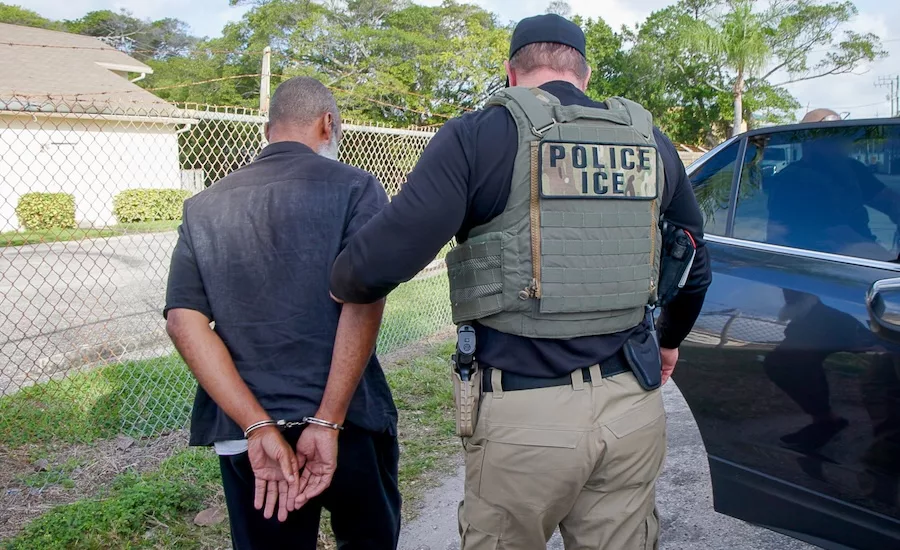
ICE officers perform enforcement operations in West Palm Beach, Fla. on Feb. 14.
In April, U.S. Treasury Secretary Scott Bessent described President Trump’s trade policy approach as an exercise in “strategic uncertainty.” Regarding the administration’s stepped-up undocumented worker raids, however, we remain unconvinced there is anything strategic about it. Instead, we see confusion, disruption and economic harm.
Rather than focusing on “the worst of the worst,” as promised during his campaign, the administration has increasingly treated the construction sector as a primary enforcement target. Since May, Immigration and Customs Enforcement has ramped up jobsite raids nationwide, with Florida, Alabama and Texas seeing heavy activity.
There is cause for worry. Construction spending has dropped 2.2% year-over-year by June, says the US Labor Dept—a decline more akin to a recession than an otherwise solid economy. The construction industry is short more than 430,000 workers, says the Associated Builders and Contractors, and America’s housing shortfall exceeds 4 million units. Yet ICE enforcement appears set on shrinking—not sustaining—the labor pool to meet that demand.
Undocumented immigrants make up at least 12% to 15% of the U.S. construction workforce, remitting more than $30 billion in payroll taxes annually—without receiving benefits. They are mainly Hispanic, highlighting disparities in enforcement. Unlike agriculture (with its H-2A visa program) or hospitality (with multiple seasonal visa channels), construction has no special work visa and remains legally exposed. In June, the administration briefly paused raids on farms and hotels before abruptly reversing course days later.
Construction was never mentioned, yet it generates 4.5% of U.S. GDP—five times agriculture’s slice and more than hospitality and agriculture combined. Construction workers are essentially being treated as collateral damage of deportation politics.
The U.S. needs more construction workers, and calls for increased workforce training are welcome. But that is a corrective to decades of encouraging Americans to pursue college educations. It will likely take a generation to right—assuming the U.S. population grows, which is not a given—and we can ill-afford to wait. ENR is not proposing amnesty. Instead, we seek a pragmatic solution aligned with the president’s stated goal of making America safer by removing burglars, drug dealers and murderers—not flatworkers, drywallers and roofers.
We have a message for trade organizations: make a full-throated call for a temporary visa system, grounded in labor demand and compliance oversight that will help stabilize the workforce, ease absenteeism and keep projects on track.
Currently, some jobsite managers spend mornings making sure “ICE must have a warrant” signs are visible from the road. Without reform, the president risks undercutting a centerpiece of his economic agenda. The construction industry is not seeking special treatment, but it must ask not to be sabotaged.
Looking for quick answers on construction and engineering topics?
Try Ask ENR, our new smart AI search tool.
Ask ENR →


