Immigration
ICE Raids Create Chilling Effect on Already Stretched Industry Workforce
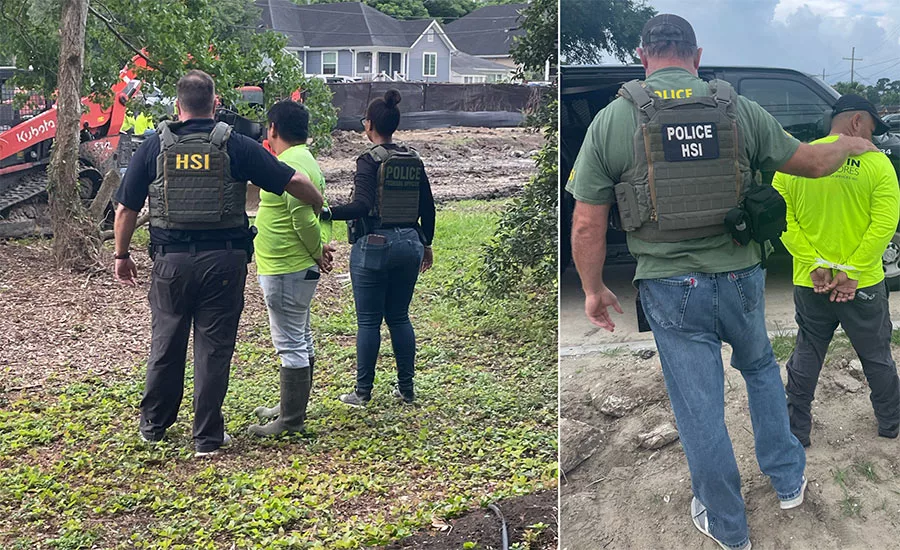
U.S. Immigration and Customs Enforcement agents targeted a federally-funded stormwater management construction project in New Orleans on May 29, arresting 15 undocumented workers, the agency announced.
Photo courtesy U.S. Immigration and Customs Enforcement
Trump administration mass deportation actions are taking a toll on the already stretched U.S. construction workforce, with some workers electing to leave jobsites or to not show up at all for fear of being targeted in U.S. Immigration and Customs Enforcement agency enforcement actions, say industry worker advocacy groups.
Both documented and undocumented workers are being arrested and detained as enforcement escalates across construction, as well as in agriculture, food service and hospitality sectors. In construction, public works projects as well as large commercial buildings—are among ICE targets, said one industry advocacy group, the Hispanic Construction Council.
“This is ridiculous. We need more transparency. We need more information” because the administration’s goal is unclear, council CEO George Carrillo told ENR.
Hispanics have been a key demographic helping to boost contractors' jobsite activity, with industry firms now employing more than 4 million, making up 33.8% of the workforce in 2023 that is set to rise to 35.2% this year and approach 50% by 2030, according to a survey by the council, which also reports about 95,000 Hispanic-owned construction firms.
“For generations, Hispanic workers have been the unsung heroes, the unwavering driving force behind the U.S. construction industry,” said Carrillo. But they also account for 27% of construction-related fatalities and earn 20% to 30% less than non-Hispanic counterparts, the group claims.
Construction in the Crosshairs
One early deportation action that drew national headlines was that of union sheet metal worker Kilmar Abrego Garcia, an El Salvadoran immigrant and 13-year Maryland resident who ICE mistakenly deported to a prison in that country. He was returned to the U.S. earlier this month amid public outcry, but he faces federal criminal charges.
More recently, media reports note ICE raids at construction sites across the U.S. One on June 24 at a Gulf Shores, Ala., high school site resulted in 37 arrests and a multiday shutdown of the $137-million repair project. Mayor Robert Craft said the raid would not affect work completion, set for next year, but he rebuffed a U.S. Dept. of Homeland Security official's claim that undocumented workers on site caused or contributed to poor project quality. “We are unaware of any evidence to support this,” he said in a statement, noting the project’s “rigorous oversight from … a team of architectural, engineering and construction experts.”
Auburn, Ala.-based Rabren General Contractors confirmed the project raid and said the company is “fully cooperating with all authorities,” but it had no other comment.
Raids in Texas last month included one at a warehouse project in Laredo resulting in about 24 arrests, with site employers not identified. Mayor Victor Trevino said the action “is currently under review” but noted “the city’s role is not to enforce immigration laws.” The Laredo Fire Dept. said its personnel were on site during the raid “only to provide medical standby support, which is standard for large-scale or potentially dangerous operations.” ICE also detained 27 workers after raiding a Texas A&M University fire damage repair project in Corpus Christi. Contractor Cotton Holdings Inc., Houston, noted the matter “involved a subcontractor, as we aim to abide by all applicable laws and have clear standards in place for our contractors.”
There were no arrests after a raid on a Los Angeles-area fire damage site, but such actions are “instilling fear in the workers trying to rebuild L.A.,” a property developer spokesman told the Los Angeles Times. A new report issued by the University of California-LA Anderson Forecast said enforcements would hurt efforts to reconstruct an estimated 13,000 homes destroyed in Altadena and Pacific Palisades, and further delay homebuilding statewide.
On May 27, ICE agents raided the Mirabeau Water Garden stormwater management project in New Orleans that is partly funded by a $30-million Federal Emergency Management Agency grant. According to an ICE release, agents arrested 15 workers suspected of being in the country illegally without proper documentation. Project contractor M.R. Pittman did not comment to local media on how arrests affected its workers or the project's completion. Two days later, agency teams arrested more than 100 workers at two sites in Tallahassee, Fla., with six charged.
Economic Impacts
The Bay Area Council, a San Francisco area business-civic group that includes 330 of the region's largest employers, said undocumented workers make up 26% of the regional craft force. Abby Raisz, its research director, predicts major impacts on project schedules and housing costs if there are mass deportations in the state. Those actions in all business sectors could cost the state GDP up to $275 billion, she noted.
Carrillo emphasized that his group supports the administration’s efforts to deport criminals. “We know there was a humanitarian crisis at the border ... and appreciate what the president has done,” he said. “But we don’t agree with … how the [enforcement] implementation is being rolled out.”
When Trump took office, "business owners believed hard-working, boots-on-the-ground immigrants working for them would be fine,” Carrillo said. “No one necessarily had a sense of urgency at the time,” he added, although one council member cautioned the group that the administration’s target group could widen by the summer with more outdoor work could widen. In March, ICE officials were given an administration quota to arrest at least 3,000 people per day.
“Early on when we started seeing the raids, we got reports from employers of team members not showing up for work—not because they lacked the documentation but for fear of not finding family members when they got back home,” Alejandra Spray, president and CEO of Denver-based Hispanic Contractors of Colorado, told ENR. The group's 200 members include large national suppliers of contracting and professional services such as Hensel Phelps, Mortenson, The Weitz Co. and Whiting-Turner, as well as specialty firms, she said.
About 60% of members identify as small, minority, women or veteran-owned enterprises, Spray added. While Denver and Colorado have been targeted for enforcement actions by ICE and Homeland Security Investigations, she said she has not yet witnessed any raids. But with smaller projects seen as “ideal targets," Spray said some member contractors “are avoiding attending public events due to growing concern of ICE presence.”
What Can Be Done?
The administration reportedly paused ICE enforcement actions in early June in some sectors, the result of intense lobbying by those highly reliant on the immigrant workforce, according to a Politico report, but it did not extend to construction.
According to the council's annual report, the construction sector today has more than 500,000 job openings and is expected to have 1 million by 2030.
Carrillo said the administration does not appear to understand the impact of Hispanics in construction. “There should be a pathway for people to be able to stay and be part of the workforce,” he said. “There are people here legally who have work permits, but we’re seeing … their visas being revoked,” he said. “What's the logic behind the way this enforcement [action] is being carried out?”
To that end, the council has developed the Building America Stronger Act, a policy proposal delivered to members of Congress this month that aims to create temporary legal status for undocumented workers. Eligibility requirements include a fine of $10,000 over five years for workers who must remain employed by industry. The program is expected to generate $50 billion in revenue that can be used for the American Workforce Development Fund, Carrillo said.
“We feel very confident from our conversations with Congress that [the proposal] is going to be sponsored with bipartisan support,” Carrillo said. He declined to name lawmakers who have expressed interest, saying that the project is in the early stages.
Other group actions include advocating for a major increase in the annual cap of the H-2B visa program, which allows employers in a variety of non-agricultural industries to temporarily hire foreign workers. The cap on these visas is now at 66,000, and only a small number of them are typically used for construction workers, Carrillo said.
Both the National Utility Contractors Association and the Associated General Contractors of America said they support an expanded H-2B visa program. AGC would prefer to see creation of a construction-specific temporary workforce visa for foreign-born workers, a spokesperson told ENR.
AGC is also concerned about administration enforcement actions but noted that aside from some high-profile cases, its members have not seen many. Even so, the group has been “warning our members about the possibility of increased enforcement, and we’re holding webinars on what to do to be ready,” the spokesperson said.