Government
Lawmakers Eye Cuts for Some Programs in Fiscal 2026 Spending Bills
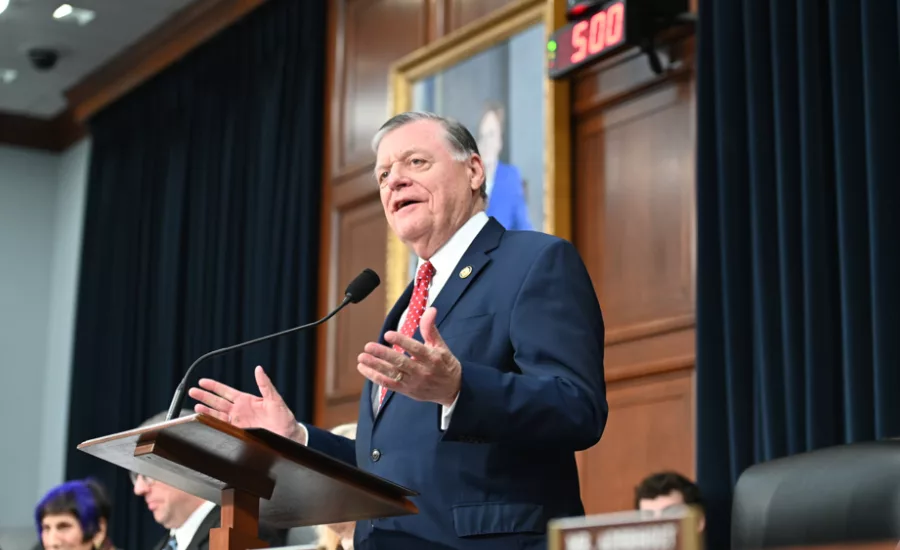
Rep. Tom Cole (R-Okla.), has so far steered seven of 12 appropriations bills through his committee.
Photo courtesy U.S. House of Representatives
Lawmakers in Congress are advancing spending bills for fiscal 2026, with mixed results for items related to construction. Overall, interim allocations from House Appropriations subcommittees total $1.6 trillion across the 12 bills, a reduction of $45 billion compared to 2025 enacted levels.
“Every bill is cut except for the vital areas the president requested be protected: our defense, veterans, and homeland security,” said Rep. Tom Cole (R-Okla.), House Appropriations Committee chair, in a statement.
So far, House lawmakers have passed two appropriations bills, advanced five through the full committee and three more through subcommittees. The Senate Committee on Appropriations has advanced four bills so far.
Deep Cuts at EPA
The Appropriations Interior, Environment, and Related Agencies Subcommittee approved a $37.9 billion spending bill for the U.S. Environmental Protection Agency, Dept. of the Interior and related agencies on July 9.
The bill reflects current administration priorities, with funding steered toward deregulation, particularly related to oil and gas leasing through Interior, and a drop in EPA’s overall budget by 23%—making deep cuts to the state revolving fund programs for drinking water and wastewater infrastructure projects.
Cole praised the subcommittee’s Republican leaders for “targeting resources where they are needed most” while reducing funding for “lower-priority programs.” Those considered lower priorities by subcommittee leaders included environmental justice initiatives and programs to implement diversity, equity and inclusion efforts.
As far as top-line numbers, the Interior bill would allocate $14.77 billion for the agency. which is $61 million below fiscal 2025 enacted levels; the EPA bill allocates $7 billion, which is $2.12 billion below the amount enacted in fiscal 2025. Although the bill slashes EPA’s budget significantly, it is still less than the 31% cut proposed by the Trump administration in March.
Looking for quick answers on construction and engineering topics?
Try Ask ENR, our new smart AI search tool.
Ask ENR →
The bill would allocate $490 million for drinking water infrastructure and $559 million for wastewater projects through EPA’s SRF loan programs, which would slash their funding by 26% and 20%, respectively.
The funding cuts are “counterproductive to building and repairing our nation's water and wastewater infrastructure,” said Zack Perconti, vice president of government affairs at the National Utility Contractors Association. “Congress has compounded the problem by earmarking nearly half the remaining funding. While helpful for individual communities, this effectively further cuts available SRF resources by removing dollars from the revolving loan pool and undermines the long-term health of critical infrastructure programs used by all 50 states, territories, tribal governments and District of Columbia for water projects."
In its most recent assessment, released in 2023, EPA pegged the 20-year need for drinking water infrastructure at about $625 billion, a 32% increase over the last report. The latest estimate for clean water estimates the 20-year need for wastewater infrastructure at more than $630 billion.
Redirected Transportation Funds
The Transportation, Housing and Urban Development and Related Agencies bill recommends a total non-defense discretionary allocation of $89.5 billion, down $4.5 billion or 4.7% from the 2025 enacted level. Of that, the U.S. Dept. of Transportation would see $22.1 billion, a $3.1 billion decrease from 2025 and $4.7 billion below the White House budget request for DOT.
The House appropriations committee advanced the measure by a 35-28 vote July 17.
Along with $83.3 billion from the highway and airport trust fund programs, the bill provides $105.1 billion for transportation projects. It authorizes $6 billion for airport facilities and equipment, $63.4 billion from the Highway Trust Fund for highway and highway safety construction programs, $924.9 million for Amtrak Northeast Corridor work and $1.4 billion for Amtrak projects elsewhere and $538 million for the Consolidated Rail Infrastructure Safety Improvement program.
But about $4.4 billion of the funding is being redirected from unobligated funds previously allocated to different programs under the 2021 Infrastructure Investment and Jobs Act such as the Federal-State Partnership for Intercity Passenger Rail. Rep. Steve Womack (R-Ark.) said during an Appropriations Committee hearing that the move would put money from lower priorities to “programs with a real return on investment.” He noted that while "some of these programs have been transformational in nature, there are too many programs in this bill that were there to curry political favors or overfunded relative to demand.”
But infrastructure law funds were a sticking point for Democrats on the committee, along with cuts to some items in both the transportation and HUD sections of the bill. Rep. James Clyburn (D-S.C.) said funding from infrastructure law programs was included in an attempt to make up for “a woefully inadequate allocation,” highlighted cuts to Amtrak, public transit and programs related to climate change.
“These transportation cuts are particularly shortsighted because they compound the housing and cost of living crisis,” Clyburn said. “Access to safe, reliable affordable transit is essential for connecting people to jobs, schools and health care.”
Rep. Rosa DeLauro (D-Conn.), ranking member on the House appropriations committee, read a statement from Connecticut Dept. of Transportation Commissioner Garrett Eucalitto on the Amtrak cuts.
“With over $10 billion in capital needs on the New Haven Line, which the state ... inherited from a private bankrupt railroad that failed to invest for decades, we cannot make these repairs on our own,” he said. “The majority proposal will not only stop progress on the Northeast Corridor, but also set us back on our heels just as we have started to see momentum.”
Energy and Water Development
The House appropriations committee also advanced the 2026 Energy and Water Development and Related Agencies Appropriations Bill by a 35-27 vote during the same marathon session. It provides a discretionary allocation of $57.3 billion, which is $766.4 million below the 2025 enacted level.
The bill cuts $1.4 billion from the Dept. of Energy compared to 2025 enacted levels, providing $48.8 billion for the department. Many programs saw cuts in funding. The bill provides $1.9 billion for Energy Efficiency and Renewable Energy, a cut of $1.6 billion compared to 2025; $350 million for Advanced Research Projects Agency-Energy (ARPA-E), $110 million less than 2025, and, with $35 million cut from grid deployment funding, it provides $25 million for those projects. "This is a fiscally responsible bill that will strengthen our national security and advance our energy independence,” said Rep. Chuck Fleishmann (R-Tenn.).
The bill provides $9.9 billion for U.S. Army Corps of Engineers civil works, including $3.5 billion for the Harbor Maintenance Trust Fund, $1.9 billion for flood and storm damage reduction projects and $396.8 million for inland waterway projects.
But the bill does not include any funding for the Corps’ Formerly Utilized Sites Remedial Action Program, which is focused on cleaning up sites contaminated during earlier defense nuclear activity. In the committee’s report on the bill, lawmakers wrote that they expect “the Corps to make expeditious progress within available funds from prior years.” The bill also cuts funding for Dept. of Energy nuclear cleanups by $779 million, but provides $7.7 billion.
“This bill turns its back on communities still living with the toxic legacy of America’s atomic past,” said Rep. Marcy Kaptur (D-Ohio).
For Interior, the bill provides $1.9 billion. Most would go to the Bureau of Reclamation’s Water and Related Resources account, including $126.8 million for rural water projects and $201 million for water storage projects.
Military Construction
The Senate Committee on Appropriations voted 26-3 on July 17 to advance its 2026 Military Construction, Veterans Affairs, and Related Agencies Appropriations Act with $153.5 billion in discretionary funding, an increase of $6 billion over the 2025 enacted level, plus about $300 billion in mandatory funding.
House lawmakers previously approved another version of the bill with a discretionary allocation of $152.1 billion.
The Senate version of the MilCon-VA bill provides funding for nearly 300 projects, including housing and child development centers, works to bolster U.S. military presence in the Pacific region and NATO facilities, said Sen. Patty Murray (D-Wash.), vice chair of the committee. That includes $2.4 billion for Army construction, $5.9 billion for Navy and Marine Corps construction, $4.1 billion for Air Force construction and $3.7 billion for Defense-wide construction. For family housing construction, the bill provides $228.6 million to the Army, $177.6 million to the Navy and Marine Corps and $274.2 million to the Air Force.
“These are incredibly important to our service members, our veterans and our national security,” Murray said.
The bill also includes $2.1 billion for Veterans Affairs construction.