Nuclear Energy
WSP, Kiewit, Hatch to Build Canada's $3.2B Spent Fuel Repository
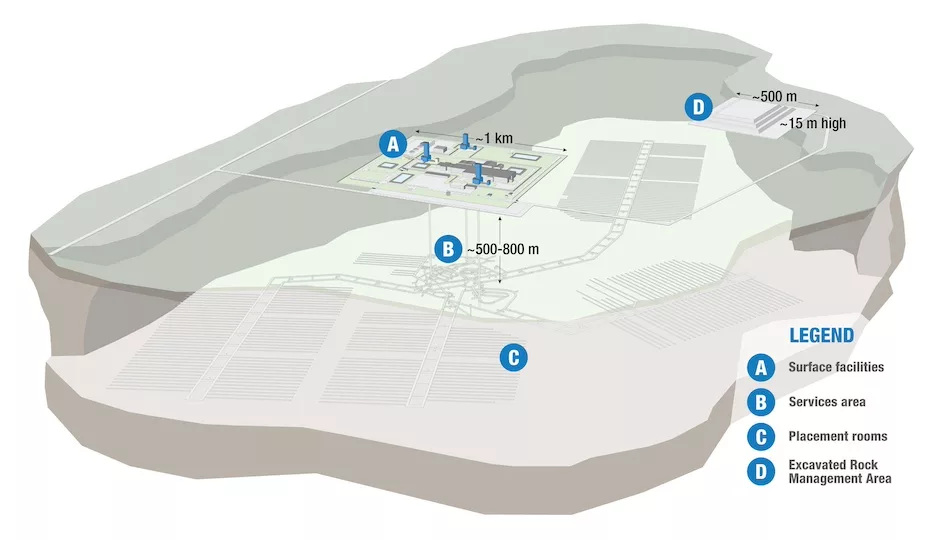
Image courtesy of Group/Nuclear Waste Management Organization
Canada’s Nuclear Waste Management Organization, the nonprofit responsible for long-term management of the country’s used nuclear power plant fuel, has selected companies to plan, design, build and manage a deep geological repository in northwestern Ontario, with an estimated initial $3.2-billion construction cost.
It will be the country's first such deep spent fuel storage site and only second in the world, with the other recently completed in Finland.
The team includes Montreal-based WSP for design and engineering; Kiewit's Canada unit for above-ground construction; Mississauga, Ontario-based Hatch Ltd. for underground mine and waste rock management and other work;Thyssen Mining Construction of Canada Ltd. in Saskatchewan to handle underground mine construction design and sinking of three shafts into the repository. and Toronto-based Kinectrics Inc. for nuclear operations management, oversight and quality assurance.
A total of 31 firms applied to be part of the project, with just half invited to take part in the Request For Proposal (RFP) process, said Craig MacBride, the non-profit's media relations manager. He declined to identify names of competitors to the winning firms.
The repository site on Wabigoon Lake Ojibway Nation land 200 kilometers northwest of Lake Superior was chosen last year after a nearly 15-year search. About 15% of Canada's power comes from nuclear energy, with Ontario generating more than 50% from that source
The team will use the integrated project delivery model, according to WSP. Design is set to complete by 2028, with construction to begin by 2033 after design and environmental impact reviews by Canadian and indigenous regulators, and operation startup set for 2045. The repository will be built to a depth of between 2,100 ft and 2,600 ft below ground with engineered and natural barriers to contain and isolate used fuel. The non-profit management organization last December had selected the site, which contains a crystalline rock formation known as the Revell batholith, to be a suitable repository host.
The non-profit management organization was set up by Canada nuclear power generators Hydro-Québec, Ontario Power Generation and New Brunswick Power to find a long term spent fuel repository site to replace its current temporary storage at reactor sites in Ontario, Quebec and New Brunswick, and at a Manitoba research site.
"This project will solve an environmental issue and supports Canada's climate change goals," said the non-profit's President and CEO Laurie Swami. “While this is a unique project in Canada, the core needs are well established, and the companies chosen have deep experience in mining, construction design and the handling of nuclear materials.”
Looking for quick answers on construction and engineering topics?
Try Ask ENR, our new smart AI search tool.
Ask ENR →