History
From the Archives: May 8, 1924
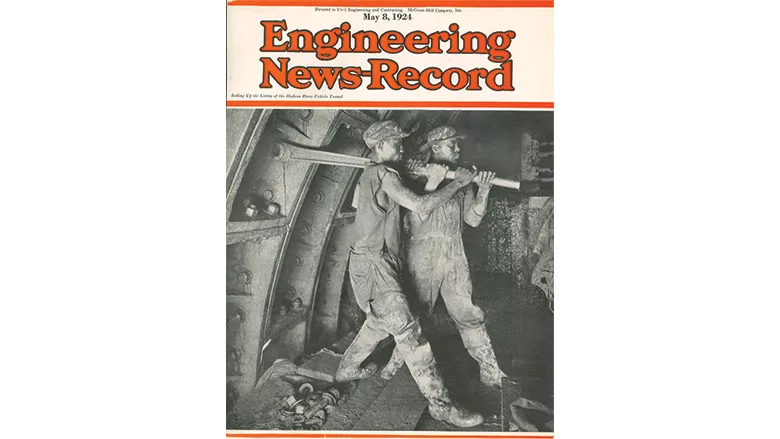

This 1924 cover image depicts two workers pulling on a 6-ft-long wrench to tighten bolts on sections of cast-iron tunnel lining.
The project is the Holland Tunnel, the first vehicular crossing beneath the Hudson River between New York and New Jersey, as well as the first vehicular tunnel in the U.S. The tunnel consists of twin tubes 29.5 ft in dia and 1.6 miles long.
The critical advance that made the tunnel possible was its mechanical ventilation system, needed to supply fresh air and remove car exhaust containing carbon monoxide.
The ventilation system was designed by engineer Ole Singstad. The tunnel faces were excavated by workers on a shield structure, who loaded the muck into carts set on a system of rails. The spoil consisted of sand, gravel, clay and silt.
The tunnel shafts were filled with compressed air to prevent water from seeping in, and workers had to undergo compression and decompression measures while entering and leaving.
The tunnel is named for Clifford Milburn Holland, the project’s chief engineer. It opened to traffic in 1927.
Looking for quick answers on construction and engineering topics?
Try Ask ENR, our new smart AI search tool.
Ask ENR →