Las Vegas Airport Expansion Makes Final Approach
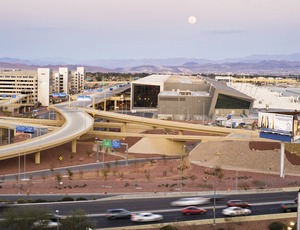
When McCarran International Airport's $2.4-billion third terminal complex opens on June 27, it will mark the beginning of long delays for new big projects in the region.
The three-level, 1.9-million-sq-ft building comes with a 5,954-space, 2.3-million-sq-ft, $121.7-million garage built by McCarthy Building Cos., an eight-mile elevated roadway system and a 900-ft-long automated connecting tram. It brings the four-runway, 2,800-acre McCarran to final build-out.
The five-year job employed 1,800 people working more than 9.5 million man-hours. "It's a bit of a letdown to see it done," says Sean Stewart, executive vice president, Associated General Contractors, Las Vegas chapter. "There aren't any billion-dollar projects on the horizon."
Bechtel Infrastructure Corp. was the program manager; Perini Building Co. was general contractor for the $1.2-billion terminal. Last year, McCarran was the world's 20th-busiest airport, with nearly 41.5 million passengers. Its international passengers are expected to quadruple to 30% from 7% in the next 15 years, says Director Randall H. Walker. The 14-gate terminal has seven international gates and a 60,000-sq-ft, 28-lane customs and border-protection area capable of processing 2,000 visitors an hour.
"The owner wanted to incorporate as much flexibility as possible into the building," says Bechtel's project manager, Don Wright. The parallelogram-shaped terminal, designed by PGAL, increases efficiency by 15% through extensive technology. There are self-baggage checks, self-boarding gates and automated aircraft docking with LED displays. The building uses 1.5-million linear ft of electrical wire and cable and can process 440,000 passengers a hour. It also has 16 in-line security scanners and eight miles of second-generation RFID baggage conveyors.
McCarran provided a nearby 53-acre property for construction storage, while a project labor agreement prevented any work stoppages. "We undertook a partnering approach to coordinate activity with the adjacent contracts," says Perini Vice President Michael Kerchner. "We held weekly open-door coordination sessions with other contractors and kept an open line of communication."
Looking for quick answers on construction and engineering topics?
Try Ask ENR, our new smart AI search tool.
Ask ENR →