Trade Policy
As Trump Signals End of US-Mexico-Canada Pact, Contractors See Little Immediate Impact
Industry groups say prolonged trade uncertainty is a bigger threat to future manufacturing investment and supply-chain planning
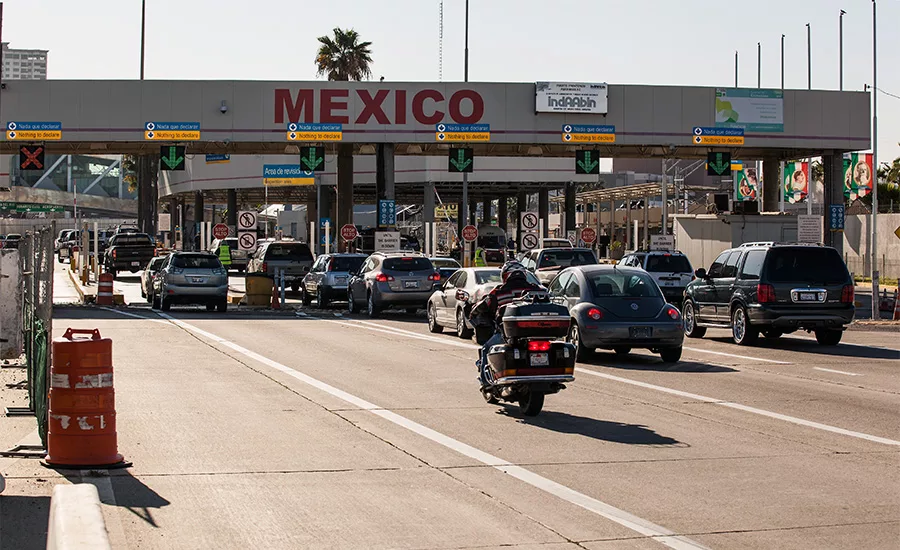
Cross-border traffic enters Mexico through port of entry. Construction industry groups say Trump administration's latest USMCA review action is unlikely to affect projects immediately, but prolonged trade uncertainty could influence future manufacturing investment and North American supply chains.
Construction groups see little immediate effect from President Donald Trump's latest move in the U.S.-Mexico-Canada Agreement (USMCA) review process, saying the greater risk is that prolonged uncertainty could weigh on future manufacturing investment and supply-chain planning.
Speaking with reporters at the White House on June 30, Trump said he was "not looking to renew" the trade agreement.
"Today's announcement probably doesn't change much in the immediate term since USMCA remains in effect while the review proceeds," Macrina Wilkins, director of market insights at Associated General Contractors of America, told ENR in an email. "The bigger issue for contractors is the uncertainty surrounding negotiations rather than any immediate policy change."
Read More
USMCA — Chapter 34
Final Provisions
Under the pact's review provisions, that decision begins annual reviews that could ultimately allow it to expire in 2036 if the U.S., Canada and Mexico fail to reach agreement. The treaty remains in force while the process continues.
Marcos Carias, North America economist at trade credit insurer Coface, said negotiations appear well behind schedule because of significant differences over issues including automotive rules of origin and domestic content requirements. He believes companies are taking a "wait-and-see" approach toward investment decisions.
"You look at foreign investment figures going into Mexico,” he said. “They've been on standstill ever since it became a plausible prospect that the president would win the 2024 election."
Carias said AI-driven data center development should remain relatively insulated because many critical inputs already receive tariff exemptions and the administration has generally sought to support AI investment.
Looking for quick answers on construction and engineering topics?
Try Ask ENR, our new smart AI search tool.
Ask ENR →
"Long story short, I think that the good news is that whatever happens with USMCA or otherwise, this particular side of the economy will remain relatively protected from the trade war,” he said when discussing AI data centers and energy projects.
Carias suggested contractors should continue to monitor for supply chain strains affecting transformers, electrical equipment and HVAC assemblies manufactured in Mexico. Automotive manufacturing remains the sector most exposed if negotiations ultimately produce stricter regional content requirements.
RELATED
2026 Forecast: Megaprojects, Data Centers Spur Growth Amid Shifting Policies
Associated Builders and Contractors reached a similar conclusion.
"This won't have too many short-term implications for construction," ABC Chief Economist Zack Fritz said in an email. "It's possible some very large, long-term projects will be scuttled because of uncertainty, but 10 years is a long time, especially with a new presidential administration just a few years away."
AGC's Wilkins said contractors, like all businesses, benefit from predictable trade policy because manufacturing, automotive, infrastructure and data center projects rely on integrated North American supply chains.
"Long-term construction projects depend on stable material costs and reliable supply chains to bid work and make investment decisions with confidence," she said.

Bryan Gottlieb is the online editor at Engineering News-Record (ENR).
Gottlieb is a five-time Society of Professional Journalists Excellence in Journalism award winner with more than a decade of experience covering business, construction and community issues, including finance, law and real estate. He has reported for Adweek and the San Diego Daily Transcript and led a community newsroom in Santa Monica, Calif. He served as editor-in-chief of the Detroit Metro Times and as managing editor at Roofing Contractor, where he helped shape national industry coverage. At Engineering News-Record, Gottlieb covers breaking news, large-scale infrastructure and megaprojects, regulatory developments and business trends across the U.S. and global construction sectors.
email: gottliebb@enr.com | office: (248) 786-1591