Technology First Read
AI in Construction: From More Work to Better Work
Artificial intelligence-enabled tools can help on the job site, but it's earlier on where they can have the greatest impact
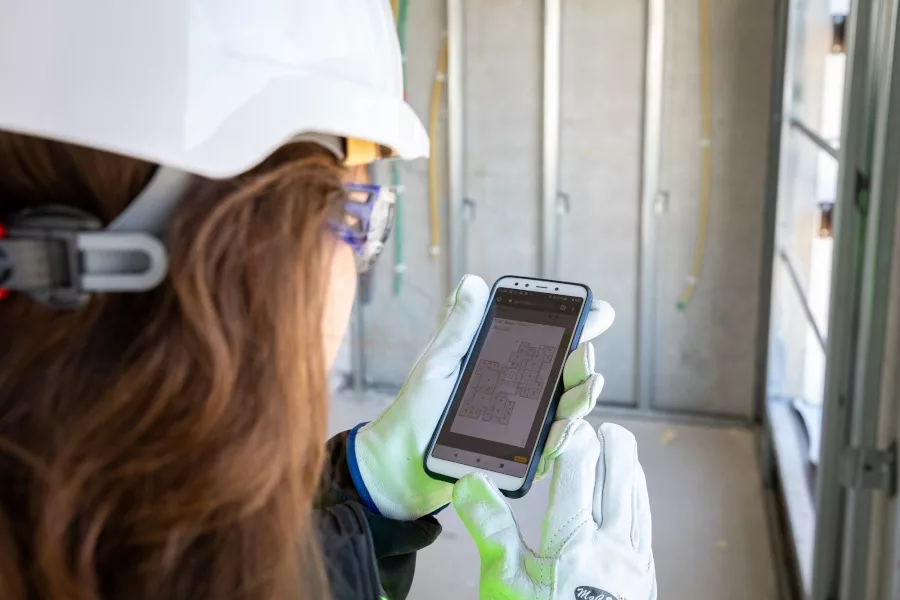
AI-based workflows such as using a language model to call up plans and specs can help in construction. but Saurabh Mishra writes that contractors must unlock efficiencies when design and estimation are already happening.
Large infrastructure projects rarely fail because there isn’t enough work to do. If anything, the opposite is true. Across energy, transportation, housing and digital infrastructure, demand is accelerating at a scale the industry has not seen in decades.
The challenge is delivering it.
Construction sits at the center of a roughly $13-trillion global industry, yet productivity has barely improved over time and in some advanced economies, it has declined. At the same time, nearly 40% of the skilled workforce is expected to retire this decade. What replaces them is not just a question of headcount, but of experience, judgment and coordination.
The problem is not whether there is enough opportunity. It is how to deliver projects with fewer experienced people, increasing complexity and tighter margins. That is where artificial intelligence is beginning to enter the conversation.
Much of the discussion around AI in construction focuses on the jobsite—automation, robotics, computer vision. Those applications are real and increasingly visible, but the larger economic impact sits earlier.
Where Risk Lies
Most of a project’s cost, risk and timeline is determined long before construction begins. Decisions made during planning, selection and design shape what happens in the field. By the time crews mobilize, many of the key outcomes are already locked in.
For many contractors, the issue is not access to projects, but choosing the right ones. Estimating teams are stretched, pipelines are noisy and time is often spent pursuing work that is misaligned, underpriced or structurally difficult to deliver.
Looking for quick answers on construction and engineering topics?
Try Ask ENR, our new smart AI search tool.
Ask ENR →
AI is starting to help shift that dynamic. By drawing on project pipelines, historical outcomes and market signals, it can help building teams focus on opportunities that align with their capabilities and risk tolerance—and avoid those where permitting, supply chains or owner expectations are already out of sync.
Better decisions at the front end lead to fewer bad bids and more consistent outcomes. In an industry where margins are often determined before ground is broken, that matters.
Cost estimation reflects a similar pattern. Estimates frequently fail not because they are careless, but because they cannot fully account for how projects evolve. AI can help bridge that gap by comparing bids to similar projects, identifying outliers in assumptions and surfacing risks that are not immediately visible — permitting delays, sequencing issues or supply chain constraints.
Estimation and Extension
This is not about replacing estimators. It is about extending their field of view. Experience remains critical, but it is no longer sufficient on its own. The ability to draw on patterns across many projects changes how decisions are made.
If there is a consistent source of underperformance in construction, it is not capital. It is coordination.
Projects rarely struggle because financing is unavailable. They struggle because different parts of the system operate with different assumptions — between design and execution, across trades, or between plans and site realities. The result is familiar: delays, rework and cost overruns.
AI’s role here is less about automating tasks and more about aligning information. Connecting design, schedule, procurement and field data into a shared view allows teams to identify inconsistencies earlier, when they are still manageable. By the time a coordination issue reaches the field, it is usually too late to fix cheaply.
The workforce challenge reinforces this. It is often described as a shortage, but it is more accurately a question of learning.
Construction has always depended on tacit knowledge, the superintendent who recognizes a problem before it appears in the drawings, or the engineer who anticipates how systems will interact in practice. That knowledge is built over years, often decades, and much of it is now at risk of being lost.
At the same time, younger workers are not entering the industry at the same rate, often choosing other sectors. Even when they do, the pace and complexity of projects make it harder to develop the same depth of experience through traditional apprenticeship alone.
AI offers a way to partially bridge that gap. It can capture project history, surface patterns from past performance and make lessons more accessible to newer teams. Used well, it can accelerate learning and help organizations retain institutional memory that would otherwise disappear.
Used poorly, it can have the opposite effect.
Using Automation the Right Way
There is growing evidence across industries that heavy reliance on automated systems can reduce attention and critical thinking, particularly under time pressure. In construction, where conditions are dynamic and often fall outside what has been modeled, that creates risk.
Safety illustrates this clearly.
Tools such as computer vision for personal protective equipment compliance or proximity alerts are increasingly common on job sites. They can reduce certain types of incidents. But most major failures—across construction, aviation and energy—are not purely technical. Research consistently shows that human factors contribute to roughly 70% to 90% of serious incidents.
In construction, those factors often include miscommunication, incomplete information, cognitive overload and decisions made under pressure. These are not problems that can be solved at the point of execution alone.
The larger safety gains come earlier—through better planning, clearer coordination and more consistent information. In that sense, the safest projects are often the ones that are best understood before they begin.
The impact of AI in construction is therefore unlikely to be defined by fully autonomous job sites in the near term. It will come from incremental improvements across the lifecycle: selecting better projects, estimating more realistically, coordinating more effectively and learning faster from experience.
Firms that adopt these capabilities well are likely to bid more selectively, price risk more accurately and avoid repeating known mistakes. Those that do not will still have access to work, but will operate with less visibility and over time, that difference compounds.
Construction will remain an execution-driven industry. But the source of advantage is shifting. It is no longer only about who can build, but increasingly about who understands the job early enough to build it right.
In that shift, AI is not just another tool. It is becoming part of the underlying infrastructure of how construction decisions are made.
Saurabh Mishra is the founder and CEO of Taiyō.AI. His career has spanned diverse roles, integrating research, teaching, AI policy, megaprojects, risk management, and decision-making.