Top 400 Contractors Hit Craft Ceiling as AI Boom Strains Skilled Labor Resources
May 20, 2026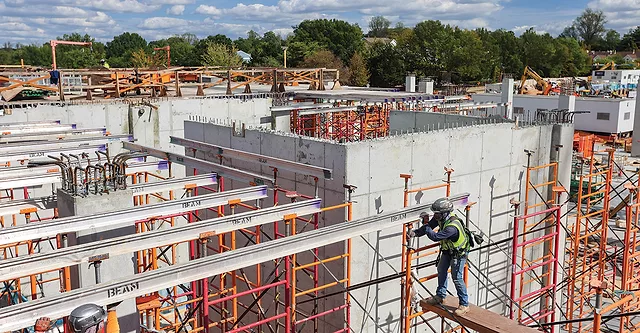
Top 400 Contractors Hit Craft Ceiling as AI Boom Strains Skilled Labor Resources
May 20, 2026A HITT Contracting crew erected 1,400 tons of steel, installed 2,400 tons of rebar and poured 30,000 cu yd of concrete during the core-and-shell construction of the firm's new headquarters in Washington, D.C. The 270,000-sq-ft facility is set for completion in late 2027.


Related Links:
ENR 2026 Top 400 Contractor Rankings
2026 Top 400 Contractors | Full PDF
(Subscription Required)
Top 400 Contractor revenue rose 11.8% to $671.4 billion in 2025, propelled by a surge of data center projects that have intensified power generation and infrastructure needs in their wake. With an estimated nearly $7 trillion that cloud service providers will spend to bring their artificial intelligence operations up to speed, contractors say the ongoing AI boom is a big opportunity for construction.
Turner Construction, ranked No. 1 on the Top 400 list for a sixth consecutive year, clinched record revenue in 2025, reporting a 40% rise to $29.2 billion and a 34% year-over-year increase to $44.3 billion for project backlog. In a March news release, company executives attributed much of that growth to an ability to shift resources and quickly respond to contracting demands tied to buildout of data center infrastructure.
“Our growth is being driven by increasingly large and complex projects in high-growth sectors and by the strength of our integrated services platform,” says President Abrar Sheriff. With a global head count of more than 17,000 employees, the contracting giant says it is directing its workforce capacity and reputational cachet toward community initiatives and partnership programs with schools and training providers, aimed at expanding access to careers in construction.
“The workforce challenge facing our industry is real, and it’s one we can help address,” said Senior Vice President Fuquan Collins in a May statement marking the 124th anniversary of the company’s founding.
In the short term, Top 400 contractors say today’s realities in workforce development and other construction arenas are intensifying, resulting in a growing disconnect between constructibility and tangible resources needed to shepherd projects to completion.
“There’s a lot of opportunity,” says Rob Blalock, CEO at Brasfield & Gorrie, ranked No. 24. “But when you layer in labor constraints, supply chain variability and faster timelines, it puts real pressure on execution.”
Shifting Challenges
For contracting firms with less capacity and labor resources, Ampirical CEO Matthew Saacks says the question becomes: “Can we continue to meet increasing annual hiring targets across the engineering spectrum necessary for capturing the market potential that exists?” For the company, which hit a record high backlog, “this is a time of unprecedented growth in the electric power space, but that growth is outpacing the supply of people required,” he adds.
Adding to that, Blalock says project complexity and owners’ needs are at times opposing forces. “Owners want more certainty around cost and schedule, while projects are getting more complex, especially in manufacturing and mission critical work,” he says. “For us, it comes back to discipline and people. The teams that can plan well, execute well and build strong relationships are the ones that will stand out in this environment.”
Looking for quick answers on construction and engineering topics?
Try Ask ENR, our new smart AI search tool.
Ask ENR →

Contractors have found that volatile material and labor costs can chip away at owner confidence, delaying approval of budget projections and lengthening preconstruction cycles on some projects. In effect, contractors say providing early, credible cost guidance is increasingly important to keep projects in play.
“This challenge mirrors what is happening across the AEC industry,” says David Callis, CEO of Swinerton, ranked No. 32. “At the moment, cost volatility, shifting economic conditions and uncertainty around pricing inputs like fuel and materials are not short-term disruptions; they represent the reality the industry is likely to face for the foreseeable future.”
Noting a reported spike in construction material prices in April, increasing 7% since last year, the Associated Builders and Contractors attributed much of that rise to the Iran conflict. The Associated General Contractors of America also warned this month how surging materials and energy costs are outpacing bid prices.
“Construction input costs continue to rise much faster than contractors’ bid prices, particularly for energy-intensive and metals-related materials,” said AGC Director of Market Insights Macrina Wilkins. “That gap is making it increasingly difficult for contractors to accurately price projects and raising the risk of delays, redesigns and deferred construction activity if cost volatility persists.”
Behind the rising costs, “labor shortages, heightened competition and consolidation among firms” are driving demand in some sectors and cooling others,” says Brian Daniel, president and CEO at Carroll Daniel, the No. 154-ranked contractor this year. “Industry indicators suggest that while demand persists, it is flattening in some sectors, increasing competition for the right projects,” he says. “In response, we are investing in workforce development, refining our pursuit strategies and adopting more efficient delivery methods to remain competitive.”
Owners still want projects finished at “accelerated rates,” says Rycon Construction CEO John Sabatos, adding that such demand “places extreme pressure on everyone at all levels in our industry to deliver.” The “human stress” is “significant,” he says. “The people that can’t, or aren’t willing to adapt to that will continue to leave the industry.”

Behind the Numbers
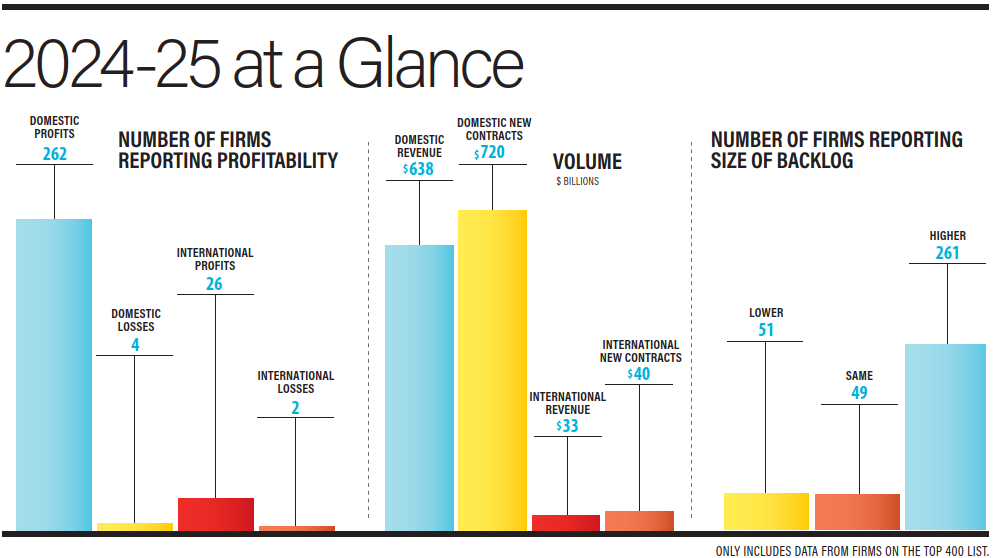
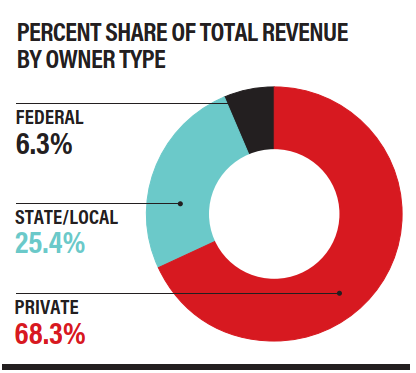
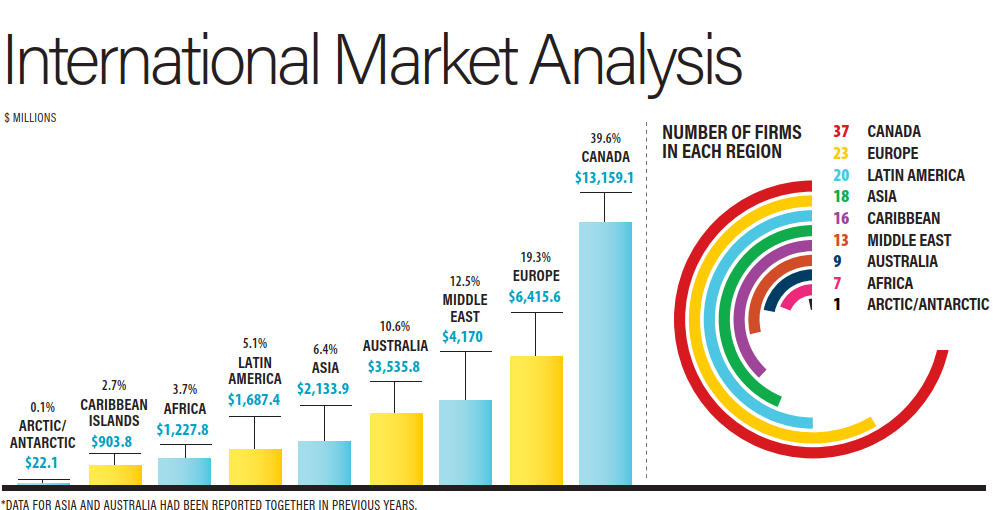
Overall, domestic projects propelled revenue growth for ENR’s Top 400 Contractors, accounting for $638.2 billion of this year’s list total, up from the 12.5% proportion of $567.1 billion in the prior year’s list. International revenue dipped slightly, down to $33.3 billion from $33.5 billion reported for 2024.
Among the 376 firms that filed both this year and last, 69.9% reported increased revenue on this year’s survey. That is up from 64.8% last year. After staying basically flat between 2023 and 2024, median revenue rose 5.9% to $672.28 million between 2024 and 2025. Just over 98% of firms report making a profit in 2025, but the number of firms reporting their profitability status on the survey dropped to 266 this year, from 307 on last year’s survey.
For Messer Construction, Chief Operating Officer Steven Bestard says the firm’s resilience is a “by-product of the diversity of customers we build for and sectors we build in.” The company, ranked No. 73, says it has seen consistent opportunities in the Midwest and Southeast.

“Cost volatility, shifting economic conditions and uncertainty around pricing inputs … are not short-term disruptions; they represent the reality the industry is likely to face for the foreseeable future.”
—David Callis, President and CEO, Swinerton
“We do not anticipate meaningful changes in those regions in the near term unless global challenges materially disrupt capital investment or supply chains,” says Bestard. “Specifically in the Carolinas, we are seeing a strong flow of opportunities in health care, manufacturing and higher education.”
Top 400 Contractors reported $760.1 billion in new contracts for 2025, up 22.4% from 2024. Median new contracts fell, however, dropping 18.5%. About one-third of firms reported a decrease in new contracts when comparing 2024 to 2025.
Notably, the share of revenue earned by the largest Top 400 firms showed an increase between last year’s survey and this year’s, after shrinking for a decade. The top 10 listed firms reported 23.3% of total Top 400 revenue this year, up from 21.2%. The top 100 firms account for 73.4% of revenue, up from 70.8%.
“Construction is always evolving and we are doing our best to lead from the front,” says MCL Construction Managing Principal Tony Fucinaro of sector ebbs and flows. “Our biggest success over the past year,” he notes, is using the firm’s industrialized construction department to prefabricate and construct building components in a warehouse on several projects. “This leads to cost and schedule saving and a safer jobsite,” he adds. The firm is ranked No. 348 this year.

Driving Growth
Of this year’s Top 400 survey participants, 72.3% of contractors reported higher backlog on this year’s survey, up substantially from 57.5% last year.
“In our markets, we are seeing more large-scale opportunities, and we are positioned well with our leadership group to have capacity,” says Shad S. James, president and CEO of Jaynes Corp., ranked No. 285. The Albuquerque, N.M., contractor specializes in commercial, hospitality and multifamily renovation and expansion construction. “I see good balance currently in our book of work,” James adds. “I do think over the next three to five years we will see some shifts in the makeup of our work, but now we are very optimistic about our future.”

“Construction is always evolving and we are doing our best to lead from the front.”
—Tony Fucinaro, Managing Principal, MCL Construction
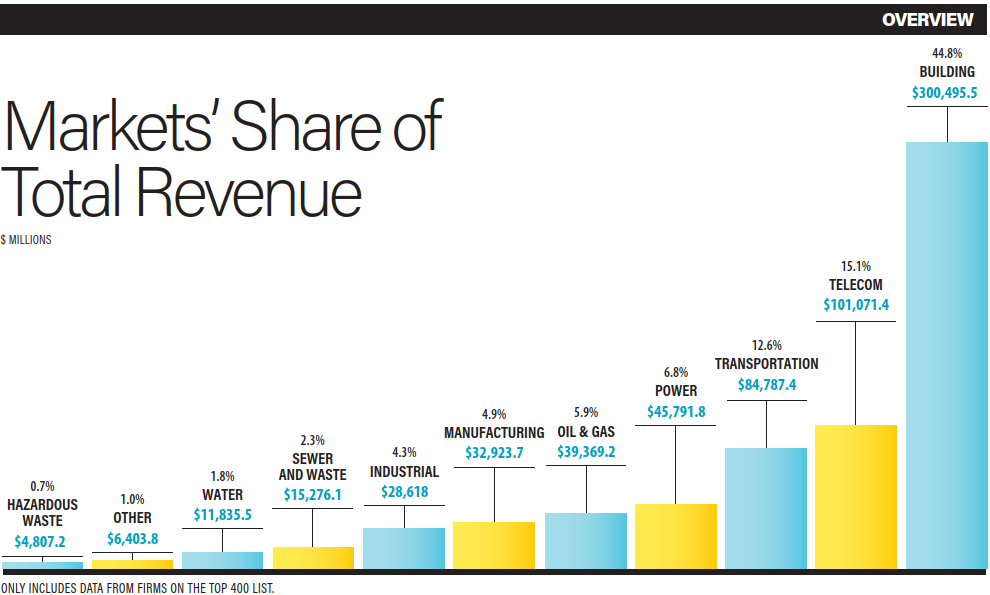
Among Top 400 market sectors, water supply and hazardous waste rose just over 21% between 2024 and 2025 for contractors, with double-digit hikes as well for sewer and waste (17.4%), power (14.2%) and industrial process (10.1%). Only manufacturing and oil and gas markets fell, dropping 28.5% and 4.8%, respectively.
As expected, the telecommunications market for Top 400 contractors continued its surge on the back of the ongoing data center buildout driven by hyperscalers such as Amazon, Alphabet, Apple, Meta and Microsoft. The market rose 86.4% between 2024 and 2025, topping $100 billion in revenue. In 2021, telecommunications made up 4.5% of total Top 400 revenue. In 2025, it rose to 15.1%.
On the ground, Top 400 contractors say the data center surge has also driven a shift in how they cultivate relationships with specialized subcontractors.
“Data centers are not currently a core market sector for KBE; however, we are seeing their impact across the region as they absorb a significant share of skilled labor, tightening the overall workforce available for other construction sectors,” says KBE Building Corp. President and CEO Mike Kolakowski. The contractor is ranked No. 340.
“To continue winning work, we focus on providing consistent, well-managed projects and strong relationships that make us an attractive choice for top trade contractors,” he says.
At Poettker Construction, Jeffrey Casey, data center and mission critical market leader, says the No. 334-ranked contractor engages with owners, designers, utilities and key trade partners early on in the project process to “confirm power availability, procurement strategies and realistic schedules before construction begins.” He adds that such a collaborative approach “reduces execution risk and enables us to deliver certainty in a market where speed and reliability drive selection decisions.”
Miami Gains Climate Resilient Cancer Center | By Jonathan Keller
_ENRready.jpg "Irma and Norman Braman Comprehensive Cancer Center")
Photo courtesy of Brasfield & Gorrie
Brasfield & Gorrie (No. 24) recently completed the $205-million Irma and Norman Braman Comprehensive Cancer Center project for Mount Sinai Medical Center in Miami Beach. Designed for resilience to extreme climate events, the facility’s finish floor elevation was raised more than 6 ft above the sea-wall elevation to mitigate flood risks, with the curtainwall system designed to accommodate deployable surge barriers. The center is also designed to withstand winds of up to 175 mph. The 234,000-sq-ft, five-floor building’s skin is made up of 464 precast panels that required use of 98 unique panel molds. Each panel ranges from 8,000-39,200 lb.
Cultivating Skills Stacking
Contractors noted that all markets have seemingly been, either directly or indirectly, affected by the billions of dollars pouring into developing data centers because of competition over labor resources and the economics of ensuring that connected investments in power and infrastructure succeed.
“AI infrastructure is now large-scale industrial infrastructure with complex integrated systems, power generation, cooling and water, designed and delivered as one,” says Brandon Statton, AI data center sector lead, manufacturing & technology, for Bechtel, which ranks No. 2. “The economic consequences of a six-month slip to the system can be critical to the business,” he says. “That reality changes every decision by the customer and EPC, [such as] design choices, procurement strategy, risk tolerance and the delivery model.”

“To continue winning work, we focus on providing consistent, well-managed projects and strong relationships.”
—Mike Kolakowski, President and CEO, KBE Building Corp.
Amid intensifying energy demands for data centers, the AI boom has also opened doors for a resurgence of nuclear power. Leaning into the opportunity, Bechtel announced a renewed partnership with North America’s Building Trades Unions to ensure craftworkers continue to receive skills training needed to work on nuclear projects at scale (see story, right).
With the large demand for data centers, Rycon Construction says it has also found a niche market in developing support facilities that include temporary housing, food service, security and transportation services for those in the workforce who spend days away in remote areas to build data center projects, says company CEO John Sabatos.
In a competitive market for top talent, many Top 400 contractors say they have found that offering a “clear career path” is a key driver for retaining workers they need to scale operations. “The companies that stand out will be the ones that offer a clear career path, the right training, a strong culture and steady, reliable work, not just a paycheck,” says Garney CEO David Burkhart. He says the contractor, ranked No. 58., balances competitive pay, ownership and benefits with profitability “by treating workforce development as a core operating strategy.”
According to Burkhart, “We invest in training, field leadership and structured growth paths because that reduces turnover, improves productivity, and strengthens project outcomes.” He adds that “the other piece is discipline. We are intentional about the work we pursue, how we plan it and how we staff it. Profitability and investing in our people go hand-in-hand; they’re both required for long-term growth.”
At McGough, ranked No. 71, Executive Vice President of Human Resources and Executive Services Cassie Nelson says she expects the workforce market to be “extremely competitive” within sectors that require complex mechanical and electrical systems.
“Like many other general contractors, we are recruiting for projects nationwide. We know that the talent out there has the pick of the litter,” she says. “We are differentiating ourselves by prioritizing safety and a culture where our employees and partners are treated with respect, have each other’s backs and have some fun as we work hard to deliver great outcomes.”

“AI infrastructure is now large-scale industrial infrastructure with complex integrated systems, power generation, cooling and water designed and delivered as one.”
—Brandon Statton, Sector Lead, Bechtel
Internally, Nelson says the company has increased communication about career paths and opportunities to work on meaningful projects while receiving competitive pay.
At the same time when data center megaprojects are hoping to pool labor resources to deliver projects, John De Lay, Evans General Contractors chief operating officer, says there is a larger workforce shift happening across the industry that has changed how and why people enter the skilled trades. The contractor, based in Alpharetta, Ga., is ranked No. 54.
De Lay believes competitive compensation is no longer the “sole differentiator” of what attracts and retains high-performing workers.
“In reality, many skilled trades today offer earning potential that meets or exceeds that of traditional college graduates,” he says. “Some of our mission-critical clients recognize this gap and are actively investing in trade development programs, which will be an important part of the long-term solution.
“Yet in reality, today’s workforce places equal value on stability, career progression, benefits and culture,” he adds. “Fewer individuals are entering the trades at the rate required to sustain long-term growth—as well as this huge increase in demand.”
De Lay says he believes a long-standing perception that a four-year college path is the “only route to success” is to blame. In response, he says the contractor is heavily investing in structured career development, particularly for field leadership roles, “while strengthening mentorship programs and onboarding processes to better integrate both entry-level and experienced hires into our organization.”
De Lay adds that “from an operational standpoint, we are also being very intentional in how we pursue and staff work. We align our backlog with our ability to properly support projects with the right people, rather than overextending resources and risking performance.”
Pennsylvania Bridge P3 is $1.5B Investment | By Jonathan Keller
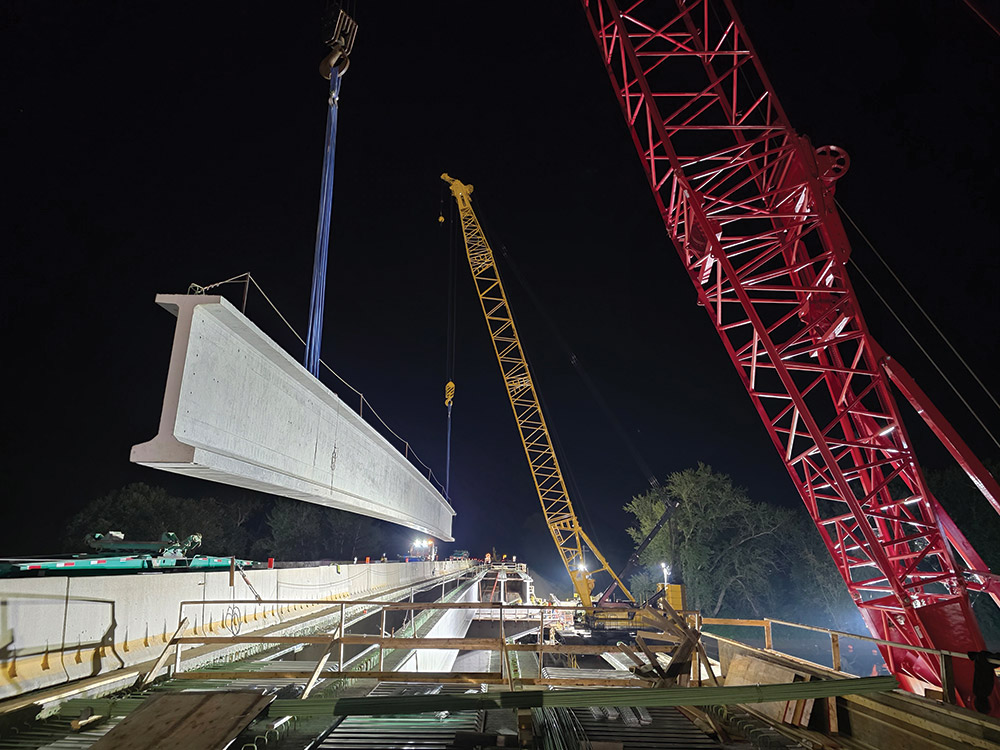
Photo courtesy of S&B USA Construction
Workers from Fay, S&B USA Construction (No. 205) place the final precast concrete beam for the southbound I-81 bridge over the Susquehanna River in northeastern Pennsylvania. It is part of the broader state DOT Major Bridge Public-Private Partnership (P3) Project, which will build 23 structures and more than 20 miles of roadway, including replacement and rehabilitation of six interstate bridges. The $1.5-billion project is being delivered under a progressive design-build-finance-maintain method. Work on the northbound bridge began this spring, with the full project expected to complete by summer 2028.
Adopting AI
In addition to competitive pay, benefits, mentorships and career path cultivation, Top 400 contractors say they are also taking decisive steps to integrate AI into their operations in ways that make the most sense for their company.
“There’s real enthusiasm around AI and automation, but enthusiasm without discipline can look like innovation theater and fail to deliver measurable outcomes,” says Chuck Binkowski, chief operating officer of Barton Malow, ranked No. 38. “We’ve learned to ask: Does this idea actually add value to the process, or does it just sound interesting? That question has made us more selective, but it’s also made us more effective.”
For some Top 400 contractors, AI’s biggest impact on operations has been speed—helping teams complete routine tasks more quickly.
“We are taking a deliberate, phased approach to AI adoption, starting with foundational tools and progressively expanding into more sophisticated capabilities,” says Gray Construction President and CEO Rebekah Gray. Across the No. 30-ranked company, she says that widely used personal productivity tools are already powered by AI, helping teams work smarter.
“Beyond individual productivity, select teams are going deeper—leveraging advanced AI platforms for software engineering, writing assistance, design audits and intelligent agents that enhance both personal and departmental workflows,” she explains. Throughout this, Gray says the company’s governance framework around data security remains central to how it operates.
As contractors dig deeper into AI tools, many find human capital is still the most critical component when it comes to safely moving operations and projects forward.
“My thinking on it has evolved, but my fundamental concern has not changed; AI cannot replace the need for our people to know how to build buildings,” says Kaufman Lynn Construction President and CEO Chris Long. The No. 282-ranked contractor is making “meaningful investments” in AI across all department, he adds, but “if someone doesn’t understand construction, he or she won’t know when the software is wrong, and it will be wrong. That judgment only comes from experience in the field.”
Bechtel, Unions Ink Nuclear Labor Pact | By Emell D. Adolphus
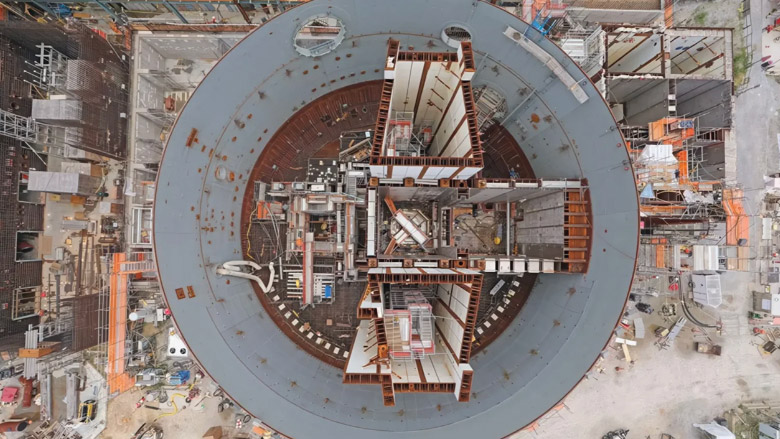
Photo courtesy Bechtel
Bechtel (No. 2) has signed a memorandum of understanding with North America’s Building Trades Unions to advance and modernize apprenticeship programs to develop tens of thousands of craftworkers needed to deliver new and advanced nuclear power projects at scale.
Amid a global resurgence of nuclear power fueled by decarbonization goals and data center power demands, the contractor says it will work with the union group to identify “specialized craft capabilities” to streamline nuclear construction, collaborate with union training centers on curriculum and expand “pathways into high-skill careers” building large projects and small modular reactors (SMRs). Company CEO Brendan Bechtel said the agreement ensures apprenticeship programs continue to develop craft professionals “needed to supply this growing market.”
Bechtel partnered with unions to assemble more than 9,000 workers to deliver in 2023 the 4.5-GW Plant Vogtle nuclear plant in Waynesboro, Ga., (pictured above). It also is engineering, procurement and construction contractor for developer TerraPower’s $4-billion advanced nuclear power plant in Wyoming, signing a project labor agreement for the plant last year. The 345-MW project will be the first utility-scale advanced reactor plant built in the U.S. when completed in about 2031.
Union group President Sean McGarvey said, “Workforce availability is not a constraint, and projects can be delivered safely, efficiently and with certainty.”
Economic Outlook
As contractors contend with the rippling effects of an expedited AI infrastructure buildout, Brad Kollar, executive vice president for industrial and strategic markets at Uprite Construction, calls for the industry to learn from previous mistakes, specifically growing at a rate too fast for skill levels to catch up.
“As an industry, we’ve had to be honest with ourselves,” he says. “Over the past few years, a lot of firms, including ours, have grown quickly to keep up with demand. In some cases, growth has outpaced availability of truly experienced talent. That can create strain on teams. If not addressed, it can impact performance.”
At Uprite, Kollar says there have been some “candid conversations internally and with clients, and we’ve taken those lessons seriously.”
For some contractors, it’s a matter of weighing all risks before jumping head first into opportunities connected to the ongoing AI boom.

“Select teams are going deeper — leveraging advanced AI platforms for software engineering, writing assistance, design audits, and intelligent agents.”
—Rebekah Gray, President & CEO, Gray Construction
“The scope of major infrastructure projects continues to grow, but inflation and cost escalation are creating real pressure on budgets and delivery timelines, making it more difficult than ever to move projects from preconstruction into construction,” says Clayton Gilliland, president of Stacy Witbeck, ranked No. 251.
Although 2025 was a slower year for Knutson Construction’s core markets such as health care, education, science, technology and power, company Chief Financial Officer Steve Ellis says the contractor is seeing strong demand “that we believe will translate into quality backlog growth moving into 2027.” The firm is ranked No. 208.
In recent weeks, tech companies Meta, Amazon and Cisco have made headlines in announcing thousands of company-wide layoffs while still pumping billions into data center capital expenditure plans. At a construction level, ABC Chief Economist Anirban Basu says such a market mostly benefits the big players.
“While backlog surged to a 10-month high in April, the industry’s recent momentum is highly concentrated among a subset of contractors,” said Basu in an announcement examining the milestone registered by ABC’s Backlog Indicator. “Booming data center construction has almost exclusively benefited the largest ABC members; 42% of contractors with more than $100 million in annual revenue are under contract to work on data center projects.”
Shifting Directions
Construction “has always been cyclical,” says Michael Bryant, president of Pace Contracting LLC, an LPX Group Co., ranked No. 336. “Historically, when private work slows down, public funding tends to increase, and vice versa,” he adds.
More than ever, some Top 400 contractors say federal policy can play a role to move the economy in a direction that alleviates challenges linked to regional conflicts, high interest rates and shifting regulations.
“Global conflict has the potential to drive inflation, which could make the Federal Reserve less likely to reduce interest rates,” says Harkins Builders Inc. President and CEO Ben Nichols. “If that happens, it becomes more difficult for privately financed projects to move forward.”
Changes in permitting and environmental rules also continue to impact project timelines, notes Warfel Construction. Ranked No. 354, the firm says the “goal line” can shift amid those changes, adding a layer of uncertainty and challenges for project stakeholders. “What we’re seeing, and where projects are most successful, is in strong, thoughtful planning from the start,” says Warfel. “When teams take the time to build a solid, well-aligned plan and bring the right partners together early, they can reduce rework and avoid the ‘one step forward, two steps back’ that often happens during approvals.”
As regulations continue to shift and be modified, Manhattan Construction Group President Larry Rooney says he remains “optimistic that all agencies, both federal and local, will continue working to improve the efficiency of the review and approval process.” The contractor is ranked No. 64.
Despite challenges, there is “real opportunity in this moment,” says George Pfeffer, CEO of DPR Construction, ranked No. 7. “As AI continues to reshape other industries, more people will look for career paths that offer stability and long-term growth. Construction is well positioned to be part of that solution.” He says contracting work “is tangible, requires human skill and problem-solving, and creates opportunities to build a meaningful career over time.”
For the industry, “the focus must remain on how we bring people in, how we help them develop skills and how we create environments where they want to stay,” Pfeffer says. “That is what will ultimately define our ability to deliver the work and move the industry forward.”