News Analysis
Life Science Building Boom Gives Way to a More Selective Market
Contractors, market analysts say demand is moving toward larger, infrastructure-heavy pharmaceutical manufacturing and owner-driven R&D projects
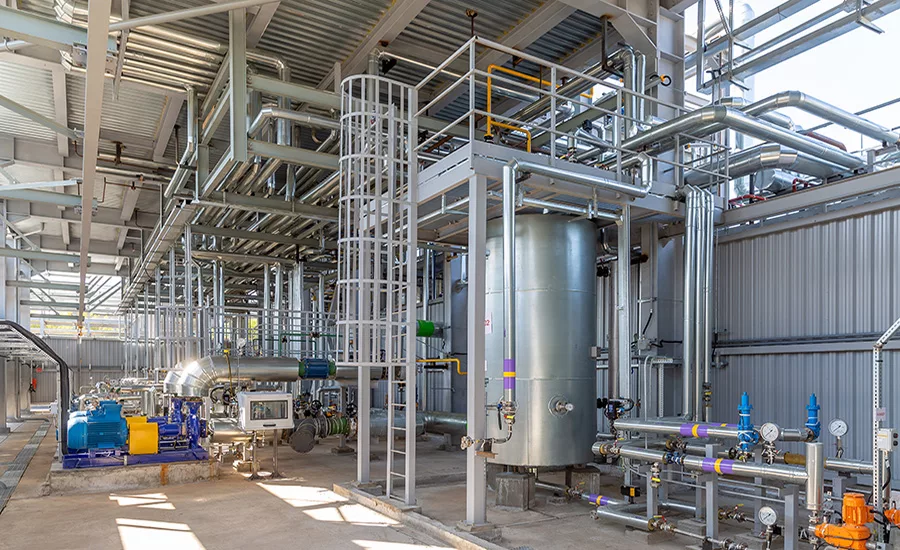
Stainless process piping, utility systems and specialized equipment increasingly characterize large pharmaceutical manufacturing projects, a growing area of life-science construction as speculative laboratory development slows.
After years of rapid expansion during and following the COVID-19 pandemic, the U.S. life science buildings market is recalibrating. Across major U.S. hubs, developers are working through elevated vacancies, tighter capital conditions and slower tenant demand even as pharmaceutical manufacturing and specialized research projects continue advancing.
Several recent market analyses suggest the sector's rapid expansion cycle ultimately outpaced demand in some markets.
A first-quarter 2026 U.S. life-sciences analysis by commercial real estate services firm Newmark said development has “all but shut down,” with much of the remaining pipeline expected to deliver within the next year, while biomanufacturing has emerged as one of the sector's strongest growth categories.
The current slowdown may reflect more than a temporary pullback.
“While the retrenchment in life science development is cyclical, there appears to be a more structural shift away from exposure to life science assets among owners and developers,” Elizabeth Berthelette, Newmark managing director of research, told ENR.
“Those that jumped into life science development at height of this cycle's growth period are shifting back to more core assets,” she added.
Boston's Fenway Center may offer an early example of that transition.
Looking for quick answers on construction and engineering topics?
Try Ask ENR, our new smart AI search tool.
Ask ENR →
Last December, developers completed one of the city's more technically complex air-rights platforms above Interstate 90 and an active commuter rail before pausing planned life-science towers amid weaker market conditions and financing uncertainty. Meanwhile, projects tied to specific operational needs continue moving.
In January, Genentech announced plans to more than double its investment in a Holly Springs, N.C., biomanufacturing campus to roughly $2 billion. Two months later, Procter & Gamble announced plans for a nearly $1-billion Gillette research and innovation headquarters in Boston centered on a 335,000-sq-ft laboratory and research building.
According to Peter Walters, a fellow for advanced therapies at CRB, an engineering, architecture and construction firm focused on life sciences, project pipelines increasingly look different from only a few years ago.
“The industry is experiencing a notable rise in the number of large or mega-scale projects—greater than $1 billion construction cost—for large scale API and proteins manufacturing, which demand far more complex and infrastructure-heavy buildouts than traditional projects,” he said.
Those projects often require extensive process piping, stainless systems, utility redundancy and clean-room infrastructure that differ substantially from speculative laboratory buildings.
DPR Construction sees the transition as more nuanced.
“DPR’s life science portfolio remains balanced between manufacturing and R&D opportunities,” Dennis Kirkpatrick, DPR Construction life sciences core market leader, told ENR. “The U.S. continues to see a shift toward manufacturing investment by biopharmaceutical companies, but the R&D market remains a crucial piece of their capital portfolio.”
RELATED
Procter & Gamble Plans $1B Gillette R&D Headquarters at Boston Waterfront Site
Oversupply Meets a Market Reset
Instead, contractors describe a market becoming more selective and increasingly concentrated around projects with clearer operational purpose.

Vacancy across the five largest U.S. life-science markets climbed from roughly 7% in early 2021 to 30% in first-quarter 2026, reflecting the sector's post-boom supply reset.
Source: Newmark
The development cycle prompted by the COVID-19 pandemic produced unprecedented laboratory inventory. International real estate services firm Savills reported nearly 60 million sq ft of life-sciences space delivered across major U.S. hubs between 2020 and 2025.
Greater Boston illustrates the pressure. Colliers reported vacancy exceeded 34% entering 2026, with approximately 19.7 million sq ft available. Commercial real estate advisory firm Cresa described conditions as a “supply-driven reset” as projects launched during the 2021-2023 cycle continue delivering into a market where speculative development has largely paused.
Disruptions in research funding and investment patterns also appear to be reshaping demand. Newmark cited more than 5,800 National Institutes of Health grants terminated or frozen during 2025, creating questions around future research activity and expansion plans in some of the country's largest life-science hubs.
At the same time, the firm’s report noted pharmaceutical companies committed upwards of $500 billion toward U.S.-based manufacturing and research infrastructure during the past year.
Kirkpatrick said manufacturing remains the industry's anchor and that large manufacturing projects announced in 2025 are now moving into execution.
“We continue to see large project kickoffs for manufacturing in 2026 across the southeastern and northeastern U.S.,” he said. “The amount of activity is generating movement into emerging geographies from Georgia westward to Alabama and Texas.”
Walters said technology also may be changing laboratory requirements: “With the support of AI and molecule modeling, companies seem to be able to do more with the footprint they have.”

Bryan Gottlieb is the online editor at Engineering News-Record (ENR).
Gottlieb is a five-time Society of Professional Journalists Excellence in Journalism award winner with more than a decade of experience covering business, construction and community issues, including finance, law and real estate. He has reported for Adweek and the San Diego Daily Transcript and led a community newsroom in Santa Monica, Calif. He served as editor-in-chief of the Detroit Metro Times and as managing editor at Roofing Contractor, where he helped shape national industry coverage. At Engineering News-Record, Gottlieb covers breaking news, large-scale infrastructure and megaprojects, regulatory developments and business trends across the U.S. and global construction sectors.
email: gottliebb@enr.com | office: (248) 786-1591