Sustainability
Structural Engineering Code Review Team Readies Carbon Reduction Report

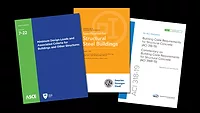
The scope of the committee's work is focused on three primary documents: ASCE 7, ACI 318 and the AISC Steel Manual.
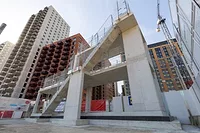
Image courtesy MKA
An independent group of practicing civil and structural engineers and academics, nicknamed CURE (Code Updates for Reduction of Embodied Carbon), will release a report in June to announce topics selected during their first 12 months of work to identify and prioritize provisions in current U.S. building codes and standards that, if appropriately modified, will result in a substantial reduction in embodied carbon.
The team is working with the American Institute of Steel Construction, among others, to update and expand standards in the organization's existing embodied carbon codes.
Led by University of Colorado structural engineering professor Abbie Liel and Ian McFarlane of Magnusson Klemencic Associates (MKA), CURE is tasked with looking at the three primary sets of U.S. structural codes—the American Society of Civil Engineers 7, the American Concrete Institute's 318 and the AISC Steel Manual— to identify and prioritize code changes that impact the greatest number of buildings and building materials.
The first phase of the committee’s work, launched at the Structural Engineering Institute’s 2025 conference held on the University of Colorado’s Boulder campus last June, has focused on laying out a roadmap for future research.
Liel says that the committee began with a brainstorming phase, ultimately identifying more than 80 potential topics. “Then we shortened the list by ranking the ideas by their potential for impact in terms of embodied carbon on both an individual building scale type and a broad scale for provisions that affect lots of buildings. We also thought about feasibility – how much research it involves as well as our perception of the appetite for codes and standards committees to be willing to consider adopting these ideas,” she explains.
The group presented a snapshot of its work at SEI’s 2026 Structures Congress, held in Boston April 29-May 1. A full report, to be released in June, will announce the committee’s recommendation of priority topics as well as what changes should be made to each of them. This priority list includes recommendations to:
- Reevaluate live loads
- Develop reliability framework for gravity loads
- Reformulate serviceability and deflection criteria
- Improve accounting for steel overstrength
- Improve fireproofing requirements
- Revamp concrete mix design proportioning and curability
- Refine concrete slab minimum strength drives (PT stressing, column puddling)
- Reevaluate seismic performance factors
The next 12-month phase of the committee’s work will entail identifying specific research needs and potential funding sources. “Members of our team as well as other people will begin to dive deeper into these topics to identify the appropriate research team and assemble funding to support the work and move forward on each of these topics,” says MKA Chairman and CEO Ron Klemencic, who conceived the initiative and helped raise $200,000 to support the first phase of the committee’s work.
“While the initiative is motivated by sustainability and embodied carbon reduction, inherently, to get there you must use less material, and by doing that many of these provisions are going to allow for reduced construction costs,” McFarlane explained when the initiative was launched in 2025. “There’s really a win-win opportunity here that makes it palatable to more people.”
Looking for quick answers on construction and engineering topics?
Try Ask ENR, our new smart AI search tool.
Ask ENR →
The Charles Pankow Foundation is the primary funder of the CURE initiative and is directing the $200,000 grant with partners MKA Foundation, ASCI, AISC, National Council of Structural Engineers Associations, ACI and CU Boulder.
Since launching the initiative through CU Boulder last year, Klemencic says the Pankow Foundation has also sponsored parallel efforts in Europe and China to look closely at the building codes for carbon reduction opportunities. “A group led by a faculty member at the University of Bath is leading an effort in the UK focused on the euro code and the British standard. More recently an effort has been launched at Tongji University in Shanghai, doing something similar with the Chinese codes,” he says.
Klemencic adds that Liel, McFarland and their team members are “out in front of the [international work] sharing amongst each other their efforts so that they are complementary and build off of one another.”
“There are obviously some big differences in details between the different codes and standards across the world,” Liel says, “but in terms of the topics we’ve identified as being ripe for reexamination in an embodied carbon context, there are a lot of similarities in the topics we’ve seen so far.”