Federal Procurement
White House Ballroom Contractor Wins $17.4M 'Sole-Source' Park Contract
National Park Service bypassed competition for Lafayette Park work as Trump and allies cite Washington Hilton shooting to press stalled ballroom project

Rendering shows proposed restoration of ornamental fountains in Lafayette Square across from the White House, part of a National Park Service project awarded to Clark Construction under a no-bid contract.
The National Park Service awarded Clark Construction Group a sole-source contract worth $17.4 million in January to restore two ornamental fountains in Lafayette Park—directly across Pennsylvania Avenue from the White House—invoking a rarely used urgency exemption and bypassing open competitive bidding.
The award, first reported as "no bid" on April 25 by The New York Times, ties the same contractor to both the park work and the privately funded White House ballroom project on the site of the former White House East Wing, less than 500 ft away.
News of the award drew immediate scrutiny, landing one day before a gunman breached a security checkpoint at the Washington Hilton hotel during the annual White House Correspondents’ Association dinner. President Donald Trump and his allies used the incident to accelerate pressure on ballroom opponents.
Clark, ranked No. 19 on the 2025 ENR Top 400 Contractors list with $7.2 billion in revenue, provided a statement to ENR through a company spokesperson, saying: "For more than 80 years, Clark has taken pride in delivering complex projects for the federal government. Our track record reflects the quality of our work and our commitment to integrity. We bid on work we are qualified to deliver and we follow prescribed procurement processes."
RELATED
Appeals Court Stays Injunction, Lets White House Ballroom Construction Continue Into June
A Contract Five Times the Prior Estimate
The two ornamental fountains in Lafayette Park, both dating to the 1960s, had been inoperative for nearly a decade due to aging equipment. A cost estimate the Biden administration developed in 2022 put the repair at a reported $3.3 million.
In January, the Park Service awarded Clark an $11.9 million contract for the initial scope; it was later expanded to $17.4 million as additional tasks were added, the Times first reported, citing government documents.
Looking for quick answers on construction and engineering topics?
Try Ask ENR, our new smart AI search tool.
Ask ENR →
A search of SAM.gov conducted by ENR on April 26 found no contract award notice or sole-source Justification and Approval document for the Lafayette Park fountain work.
The agency justified bypassing federal procurement rules requiring competitive bidding by invoking an urgency exemption—a provision typically reserved for natural disasters or wartime emergencies—citing the need to have the fountains operational ahead of America's semiquincentennial celebrations this summer.
The exemption falls under the Federal Acquisition Regulation’s “unusual and compelling urgency” provision, which allows agencies to bypass full competition only when delay would cause serious harm to government operations or public safety.
Under NPS procurement rules, sole-source awards on urgency grounds are permitted only when the urgency of the requirement would not permit a competitive delay—a standard the agency's own guidance describes as narrow and exceptional.
The U.S. Interior Dept., responding to questions from ENR, defended the procurement, saying the contract award was “above board” and citing the need to complete the Lafayette Park work ahead of the nation’s 250th anniversary.
In a statement, a department spokesperson added that the project is “well overdue” and said the administration is prioritizing improvements to “an iconic space” as part of broader efforts to enhance conditions around the White House.
Trent Cotney, head of Adams & Reese LLP’s construction practice group and general counsel for the National Roofing Contractors Association, with a firm practice that includes federal procurement advisory work, said that, regardless of the contract vehicle used, the urgency standard permitting agencies to limit competition is intended to be applied sparingly.
“A no-bid federal contract should be the exception and not routine,” he said. “It is generally permitted only when the agency can justify why competition is infeasible or would harm the government’s interest. Emergencies such as war or natural disasters are common examples, but they are not the only examples. A sole-source award can also be justified when only one contractor can meet the requirement, when national security is implicated, when Congress has authorized it, or when there is an unusual and compelling urgency.”
The Park Service internal memo argued that because Clark already had personnel and equipment positioned on the adjacent ballroom site, only that firm could move fast enough to meet the deadline.
A source familiar with the procurement process, who was not authorized to discuss the matter publicly, told ENR that Clark was among contractors already active under an existing Park Service indefinite-delivery, indefinite-quantity contract at the location and was invited to submit a proposal in November 2025.
The source said Clark's proposal incorporated competitive bids from specialty subcontractors. The project scope, the source added, extends beyond fountain repairs to include additional infrastructure improvements within the park.
An agency Record of Determination signed Jan. 17, by its Liaison to the White House John Stanwich confirmed that the Lafayette Park restoration—encompassing fountain repairs, new pumping systems and fountain vaults, irrigation infrastructure, tree replacement, hardscape installation, new park benches and turf—began Jan. 19 in coordination with the East Wing Modernization Project.
The scope documented in the determination extends beyond the fountain repairs that formed the basis of the Biden administration's 2022 cost estimate, encompassing broader park infrastructure improvements that a source familiar with the procurement told ENR were included in Clark's proposal.
The combined construction activity has closed most of Lafayette Park and the White House sidewalk; the closure remains in effect through the end of May, per that determination.
On April 24, ahead of the Times’ story, Trump posted on Truth Social that it was his "Great Honor to have funded this project." After the story appeared, he responded at length, writing that he "made a multimillion contribution to the effort" but "was not in charge of handing out the contract," adding that the Park Service "gave it to the largest and most respected Construction Firm, for many years, in D.C., Clark Construction."
RELATED
White House East Wing Razed for $300M Ballroom
The Ballroom is the Connection
Clark Construction was selected as general contractor for the East Wing Modernization Project last summer, a choice Trump has publicly praised on multiple occasions, including expressing interest in using the firm for additional Washington renovation work.
The ballroom plan—which grew from an initial $200 million to an estimated $400 million—encompasses approximately 90,000 sq ft and is privately funded, as the White House has asserted numerous times.
The project, which received design approval from the Commission of Fine Arts and the National Capital Planning Commission, has been tangled in litigation since shortly after demolition of the former East Wing, with vertical start halted twice before an appeals court stayed an injunction preventing above-grade construction until at least June.
RELATED
Private Funding May Deliver Trump’s White House Ballroom—but What Pays for the Rest?
Shooting at the Correspondents' Dinner Intensifies Ballroom Pressure
The procurement story broke one day before the security incident that put both projects at the center of a national debate.
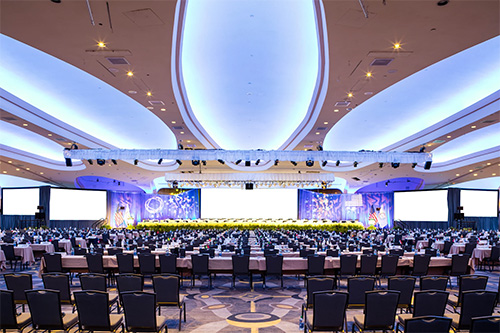
The International Ballroom at the Washington Hilton, longtime venue for the White House Correspondents’ Association dinner, was the site of a security breach April 25 that has since intensified calls for a secure event space on White House grounds.
Photo courtesy of Hilton
The suspect, 31-year-old Cole Tomas Allen, allegedly charged a security screening checkpoint at the Washington Hilton while roughly 2,600 guests—including Donald Trump, Vice President JD Vance and much of the Cabinet—were seated in the main ballroom for its first association dinner.
Allen was reportedly armed with a shotgun, a handgun and multiple knives and was subdued before reaching the ballroom. One Secret Service agent was struck but was protected by a bulletproof vest and was expected to recover fully.
Addressing reporters at the White House after the incident, still in black tie, Trump launched into a pitch for the ballroom project.
Characterizing the Washington Hilton, he said it was "not a particularly secure building" and added: "I didn't want to say this, but this is why we have to have the ballroom"—describing the East Wing project as drone-proof and equipped with bulletproof glass.
"That's why Secret Service, that's why the military are demanding it,” the president said. “They've wanted the ballroom for 150 years for lots of different reasons. But today's a little bit different because today we need levels of security that probably nobody's ever seen before.”
The following day, the president called the National Trust for Historic Preservation's lawsuit "ridiculous"—describing it as brought by "a woman walking her dog, who has absolutely No Standing"—and demanded the litigation be dropped immediately, noting construction remained on budget and substantially ahead of schedule.
The administration formally escalated that pressure on Sunday when Assistant Attorney General Brett Shumate wrote to an attorney for the National Trust, arguing that the organization's lawsuit "puts the lives of the President, his family, and his staff at grave risk." A source familiar with the National Trust's plans told CNN the organization does not intend to drop the case.
RELATED
Injunction Stops White House Ballroom at Start of Vertical Construction
Congress, a Potential Linchpin, Finally Speaks Out
"Unless and until Congress blesses this project through statutory authorization, construction has to stop!"
That instruction came from U.S. District Judge Richard Leon, whose 35-page opinion earlier this month found that the administration had proceeded with above-grade construction without the congressional authorization federal law requires for permanent alterations to the White House complex—a legal deficiency no amount of private funding, executive action or appellate maneuvering has been able to cure.
The D.C. Circuit stayed Leon's injunction, allowing limited work to continue, but the underlying authorization gap remains unresolved and the appeals court has scheduled a full hearing for June.
After more than a year of litigation in which Congress remained entirely silent, the April 26 shooting finally drew legislators into the fight directly.
Sen. Tim Sheehy (R-Mont.) said April 26 he would introduce legislation this week seeking unanimous Senate consent to provide express congressional authorization for the ballroom.
"It is an embarrassment to the strongest nation on earth that we cannot host gatherings in our nation's capital, including ones attended by our President, without the threat of violence and attempted assassinations," Sheehy wrote on X. "A President of any party should be able to host events in a secure area without attendees worrying about their safety."
Sen. Lindsey Graham (R-S.C.) went further, telling NBC News he would introduce a bill Monday that would both authorize the ballroom and provide public funds to pay for it—a potential departure from the administration's position, which ENR has previously reported, that the roughly $400 million cost would be financed entirely through private donations, with no cost to taxpayers.
"Some people saw it as a vanity project," Graham said. "I don't think that's true anymore. I just talked to the president and the first thing out of his mouth was, 'We've got to get that ballroom, not for me but for future presidents.'"
The incident's most notable bipartisan development came from Sen. John Fetterman, D-Pa., who attended the dinner with his wife, Gisele. In a post on X, Fetterman wrote, "That venue wasn't built to accommodate an event with the line of succession for the U.S. government."
Lost in the bellicosity is that the association dinner is a private function—not a White House event—and the Washington Hilton has been its near-exclusive venue since 1968, when the hotel opened.
Ned Price, a U.S. State Dept. spokesman under former President Joe Biden, told NBC News the post-shooting ballroom case was "a manufactured argument that is cynically taking advantage of this moment."
The hotel was famously where President Ronald Reagan was shot outside after leaving an AFL-CIO building trades speech in a March 1981 assassination attempt.
Following that targeting, the Secret Service required the Washington Hilton to construct a dedicated, secured presidential entrance—a covered, shielded corridor between the motorcade and the building—that has been used for presidential visits ever since.
Saturday's breach occurred despite that infrastructure being in place. Allen, according to published reports, had checked into the hotel as a registered guest ahead of the dinner, entering through normal hotel channels before rushing the security checkpoint.
The timing of the contract award and the security incident has placed two separate construction efforts — one publicly funded, one privately financed — into a single, intensifying debate over how security demands are shaping federal construction and procurement decisions.

Bryan Gottlieb is the online editor at Engineering News-Record (ENR).
Gottlieb is a five-time Society of Professional Journalists Excellence in Journalism award winner with more than a decade of experience covering business, construction and community issues, including finance, law and real estate. He has reported for Adweek and the San Diego Daily Transcript and led a community newsroom in Santa Monica, Calif. He served as editor-in-chief of the Detroit Metro Times and as managing editor at Roofing Contractor, where he helped shape national industry coverage. At Engineering News-Record, Gottlieb covers breaking news, large-scale infrastructure and megaprojects, regulatory developments and business trends across the U.S. and global construction sectors.
email: gottliebb@enr.com | office: (248) 786-1591