Workforce
How Plans for Safety Week 2026 Came Together
A talk with Adam R. Jelen, CEO of Gilbane Building Co., about Construction Safety Week, May 4-8
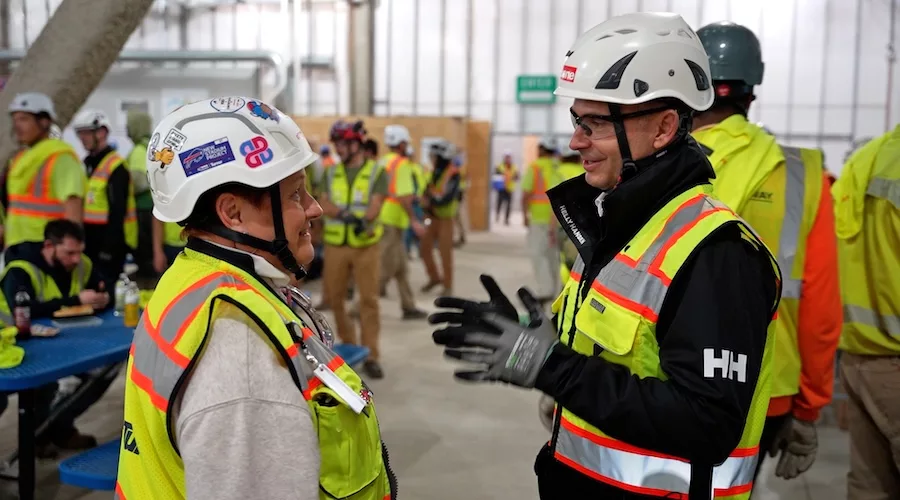
Adam R. Jelen, (right), CEO of Gilbane Building Co. and executive committee chair of Construction Safety Week 2026, says the theme for this year's events crystalized around the link between high energy and serious injuries and fatalities.

As executive committee chair of the 2026 National Construction Safety Week events May 4-8, Adam R. Jelen, CEO of Gilbane Building Co., has been deeply involved in planning this year’s program. A more than 33-year construction industry veteran, he began his career with hands-on field experience followed by 19 years at Gilbane before taking over as its chief executive in January 2024. ENR Correspondent Elaine Silver queried him about the inner workings of the Safety Week operation, how the event's annual themes are chosen and the evolution of construction safety as a key industry priority. The conversation has been edited.
ENR: Tell us about the inner workings of the Safety Week deciders. How is the event theme created, and what is the consensus process?
After wrapping up 10 years as an executive committee in 2025, we rallied around the biggest opportunities and challenges in health and safety to create a strategic plan for the next five years. We conducted a worldwide survey, with feedback that told us we need to better educate the workforce on the hazards, the stuff that could kill you, known as STCKY . It also told us that we need to align as an industry on the basic terminology. With this feedback, we decided to tackle high-energy hazards and STCKY to prevent serious injuries and fatalities in 2026 under this headline: All In Together and a focus theme of Recognize, Respond and Respect. It was so cool when we did come together, we realized that we’re all saying the same thing.
Tell us about Safety Week's technical advisors.
The survey told us that we need to educate on the hazards, and Safety Week's technical safety was born. The technical advisors and members of committees are all volunteers—which really reflects the energy and passion in the industry behind this. There are so many people raising their hands and putting a shoulder into this, and that’s what we found as we asked for help on the technical committees.
The new element of this year’s Safety Week is the bulletins. How are they created?
All different facets of the industry and experts in all different spaces, from owners to safety leadership to technology to regulatory players, created a technical bulletin to educate on each one of these [different] topics. We then bring that into the daily topics and that provides more depth throughout the week.
With your long experience in construction, where do you place the High Energy Wheel concept and related ideas about refocusing on serious injuries and fatalities, not just on Total Recordable Incident Rates?
There’s nothing more important than life, a human life. There’s nothing more important than making sure our teammates go home better than when they came. The high energy wheel concept, or high energy, high hazard activities, is a proven concept. It’s a proven model to identify the hazards and then to minimize their impact or eliminate the hazards altogether. So, to me, it’s about saving lives. Do our project schedules and our critical path schedules integrate the critical path of health and safety? That includes high energy hazards, planned in with direct controls to save lives. The bar that should be red is safety. It’s making of its critical importance, that it is the most important thing.
What is the best way to communicate these ideas to the industry so that they sink in? What is the best way for prime contractors to have subcontractors embrace them?
This is really around integrating the recognition, the response and the respect all the way into the project lifecycle with all stakeholders throughout the entire cycle. Safety Week focuses on the front lines, with the skilled craft workers who are ultimately doing the work. It’s integrating this into the fabric of what we do—and that’s from buyout to planning and to execution.
Is there a measuring tool Safety Week recommends for evaluating new safety protocols using the Energy Wheel?
We’re not prescribing one tool. But it is a call to action on the alignment of approach terminology, and the implementation of recognize, respond and respect for high-energy high hazards and STCKY. When tools like the energy wheel are used, recognition rates improve by 30%, significantly enhancing on-site safety awareness. Research at the Construction Safety Research Alliance has shown that without tools like these, workers often miss 55% of the hazards. We need to know the hazards in order to plan for them in our work.
If you had to recommend one action to a company to begin using the new understandings about high-energy hazards and STCKY, what would that be?
Be a leader and lead by example. Make sure that no work commences until hazards are recognized, responded to and respected. Know the hazards, plan for the hazards, respect the hazards, and that will ultimately save lives and definitely move the needle.
Looking for quick answers on construction and engineering topics?
Try Ask ENR, our new smart AI search tool.
Ask ENR →