Each of us has a role to play and a responsibility to recognize, respond to and respect high energy and high hazard work to prevent Serious Injuries and Fatalities (SIFs). Join us for Construction Safety Week 2026 as we work to transform safety and the future of our industry. All In Together.


Respond | The Hierarchy of Energy Control: The Cornerstone of Direct Controls in Construction


Photo provided by: Gilbane Building

Photo provided by: Granite
A Message From the Safety Week Executive Committee
All In Together | A Vision to Transform Health and Safety
Construction Safety Week is a celebration of our industry’s commitment to health and safety—a commitment that has driven remarkable progress and saved countless lives. This year’s theme, All In Together: Recognize, Respond, Respect, invites us to reflect on the achievements we’ve made and to unite in advancing our shared mission to prevent Serious Injuries and Fatalities (SIFs).
Our journey is built on the foundation of hard work, innovation and collaboration. The technical bulletins we share are shaped by the expertise and dedication of industry leaders, safety professionals and skilled craft workers who have continually raised the bar for safety excellence. Together, we have established strong practices for recognizing hazards and protecting our teams. Our first technical bulletin focused on establishing aligned terminology, shared awareness and standardized approaches for recognizing high energy, high hazard activities.
This second bulletin is a continuation of our efforts, shifting from recognition to response. Responding to recognized hazards by putting in place direct controls during the planning and scheduling phase is the key to the prevention and elimination of hazards. The Hierarchy of Energy Control is a proven response model that prioritizes elimination, engineering controls and worker engagement. We elevate health and safety when prevention is built into the plan and where the effectiveness of those controls is assessed.
When we respond together, we move from awareness to action, from identifying hazards to eliminating them. Every step we take in planning and prevention strengthens our teams and saves lives.
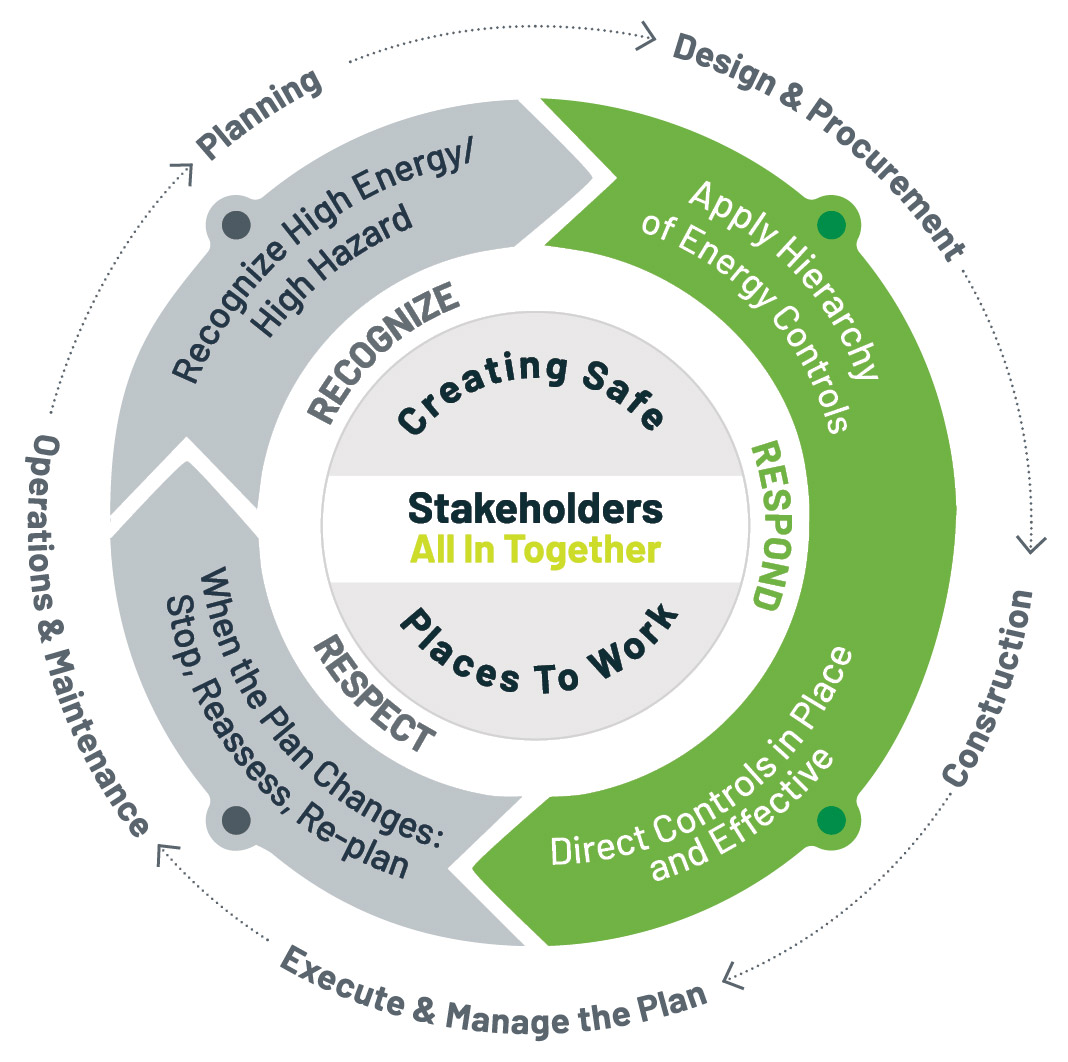
All In Together | Recognize, Respond, Respect
Construction plays a vital role in shaping our world, and with the right safety measures, it can be a secure and thriving industry. While progress has been made, challenges remain: the U.S. Bureau of Labor Statistics reports that construction fatalities accounted for nearly 20% of all workplace deaths in recent data. Globally, the International Labor Organization estimates that over 60,000 construction workers die annually due to workplace accidents. Despite widespread awareness and regulatory frameworks, the frequency and severity of Serious Injuries and Fatalities (SIFs) persist, highlighting the need for more robust and systematic approaches to hazard control. The hierarchy of energy control offers a proven framework for addressing these risks at their source, fundamentally altering how hazards are managed on construction sites.
Global Safety Elevated: The Hierarchy of Controls
In the United States, regulatory bodies such as OSHA have incorporated the principles of the hierarchy of controls into standards for lockout/tagout, fall protection and machine safety. Construction firms have adopted the hierarchy as the foundation for energy control programs, resulting in measurable reductions in incident rates. Internationally, the hierarchy of controls is echoed in standards set by organizations such as the International Organization for Standardization (ISO 45001) and the International Labor Organization. It has also been adopted as an American National Standard. Multinational construction companies report that harmonizing energy control practices across borders improves safety performance, compliance and worker engagement.

From Standards to Action: Addressing High Energy Hazards
Responding by putting direct controls in place
Hazard identification is a cornerstone of safety management in the construction industry, where dynamic environments and high-risk activities demand robust risk control strategies. Selecting the right hazard identification model is crucial for recognizing threats and implementing controls that effectively prevent Serious Injuries and Fatalities (SIFs).
There is strong agreement across the industry that selecting effective risk controls is critical. Building on this shared commitment, the next step is achieving alignment around common standards that can effectively prevent SIF-type incidents. Some organizations opt to follow basic compliance-based programs, while others have followed a more sophisticated, risk-based approach grounded in principles such as the hierarchy of energy control.
Achieving industry-wide standardization of risk control plans and procedures is an ambitious goal; and one that can drive consistency and elevate health and safety practices across sectors. While many organizations have tailored in-house procedures to fit their specific trades, aligning these within an established, industry-recognized model, such as the Hierarchy of Energy Control, offers a practical and universally applicable path forward. This approach not only validates existing plans but also provides a strong foundation for creating new ones, fostering collaboration and continuous improvement across the industry.

Definitions
Common terminology is an important aspect when considering a unified approach at the industry level. The energy control model specifies two main risk control mechanisms: Direct Controls and Alternative Controls.
The Hierarchy of Energy Controls
The Hierarchy of Energy Controls is a structured methodology for managing high energy hazards such as electrical, mechanical, chemical and gravitational forces that can cause serious harm in the workplace. It ranks controls application from most to least effective, prioritizing the elimination, reduction and isolation of hazards over alternative controls such as administration, procedures or personal protective equipment (PPE).

What Qualifies a Direct Control?
- It targets the specific high energy hazard (e.g., gravity from working at height)
- It effectively mitigates the exposure to the high energy when installed, verified and used properly
- It targets and isolates the high energy hazards with safeguards that work even if a behavioral error occurs
Types of Direct Controls


Elimination in Practice
Connecting health and safety constraints to other data streams within an organization is critical for reducing serious injuries and fatalities (SIFs) during the planning and execution phases. Leveraging data-driven insights helps identify potential risks and implement proactive measures before work begins and incidents take place. Through AI-powered portfolio analytics, teams can create safer jobsites and improve overall project outcomes.
-Tim Gattie, P.E., 25-year industry veteran and Senior Director of Industry Data Analytics for Oracle

Scope of Direct Control Response
Systems Thinking: Embedding Controls Across Every Phase of a Project
Robust direct controls are not one-time fixes. They must be embedded into the system:

This systems approach ensures that safety is not dependent on behavior alone, but on design and engineering.

Best Practices
Direct controls are most effective when they are developed and applied early in the project, particularly through design, procurement and preconstruction stages. Leveraging best practices alongside advanced tools and technologies ensures controls are optimized and their effectiveness continuously assessed. To maintain industry-leading safety performance, these practices should align with recognized voluntary consensus standards, including ANSI/ASSP Z244.1 (Control of Hazardous Energy) and ANSI/ASSP A10.44 (Control of Hazardous Energy for Construction and Demolition). Key strategies and tools are outlined below.
Safety in Design
Development of design standards for specific design products, created with built-in prevention controls that protect construction workers as well as maintenance and operational workers. These are provided to design teams during the design brief.
Design Risk Assessments
Used by integrated project teams, including stakeholders from across every phase of a project, to evaluate and assess early direct control response strategies.
Preconstruction Risk Assessments
Used by project management teams to identify specific SIF precursor exposures during early project planning to inform direct control response strategies that form part of the jobsite safety plan.
Scheduling Tools
High energy hazards can act as planning constraints until direct controls are fully developed and verified. Treating them as constraints in scheduling aligns well with proactive risk management because it forces planners to respond by integrating direct controls into the logic of the schedule rather than treating it as an afterthought. By embedding high energy hazard constraints early, planners can anticipate resource needs for direct control implementation (e.g., engineering reviews, isolation plans, etc.) and avoid last-minute delays. Being able to recognize and respond early is critical.
Field-based Tools
- Use pre-task planning tools that incorporate the hierarchy of energy control.
- Leverage technology (e.g., Building Information Modeling) to identify and address hazardous energies during design.
- Establish clear roles and responsibilities for energy control at all organizational levels.
- Use the Hierarchy of Energy Control model to develop robust direct controls that underpin the development of task-specific control plans, followed by a multi-layered application across every phase of a project. This not only provides a powerful response to SIF exposures or precursors, but it also creates a culture of respect for all.
Inspections Focused on High Energy, High Hazard Activities
Inspections often fail by being too general, missing the highest risk activities. They should instead target high energy/high hazard activities occurring each day, checking whether direct controls are present and properly applied. When high energy hazards have been identified in planning, teams must ensure that direct controls are implemented. Project teams should ask: What are today’s highest‑risk activities? Which involve hazards that could cause serious injury or fatality? Focused inspection data drives better planning, daily communication and training, while also recognizing safe execution. Identified exposures create opportunities for coaching and continuous improvement.
A Unified Call to Action
The Hierarchy of Energy Control stands as the most effective method for developing robust direct controls that prevent and mitigate Serious Injuries and Fatalities in the construction industry. Its systematic approach prioritizes reliable, engineering-based solutions over less effective measures, yielding proven results in both the U.S. and global contexts. By fully embracing the hierarchy during early project phases, industry leaders and policymakers can drive transformative change, saving lives and strengthening the culture of safety in construction.
A Special Thanks to Contributors to This Technical Bulletin
Executive Committee
Chair, Adam Jelen, President & CEO, Gilbane Building | Co-Chair, Kyle Larkin, President & CEO, Granite
Russell Becker, President & CEO, API Group, Inc. | Mike Choutka, CEO, Hensel Phelps | Rebekah Gray, President & CEO, Gray Construction | Jason Hendricks, CEO, Performance Contracting | Chris Beck, SVP, Managing Director, Turner Construction Company
Technical Committee
Heidi DeBenedetti, Chief Operating Officer, Gilbane Building | Steven Carter, Global Health & Safety Director, Gilbane Building | Michael Sharpe, Safety Director, Gilbane Building | Jesse Torres, Corporate Compliance Safety Director, Granite | Wendy Warner, Safety Systems & Compliance Manager, Granite | Clint Coberly, Vice President, Global Safety & Risk Management, APi Group, Inc. | Tim Gattie, Senior Director Industry Data Analytics, Oracle | Billy Naylor, Senior Vice President of Safety, McCarthy | Sean Blakemore, Regional Safety Director, McCarthy | Doug LaPlante, Vice President Operations Safety Executive, Turner | Camille Ford, Principal Consultant, JMJ | Tim Fisher, Chief Technical Officer for Safety, Health & Well-Being, American Society for Safety Professionals (ASSP) | Brian Connearney, Technical Coordinator, Carpenters International Training Fund | Jeff Leeper, President, World Wide Professional Solutions | Dan Smolik, Vice President, Risk Management, Garney | Eyal Nafrin, Global EHS - Construction, Intel | Ben Wilson, CEO & Founder, HSE Global | Chris Doyle, Chief Operating Officer, HSE Global | Brock Myers, Chief Operating Officer, Allan Myers | Emma Matlage, Safety Manager, The Weitz Company, LLC
Learn More at ConstructionSafetyWeek.com