ENR 2025 Top 25 Newsmakers
James Perry: Executive Focuses on Scaling an Innovative Water-saving Firm to New Heights
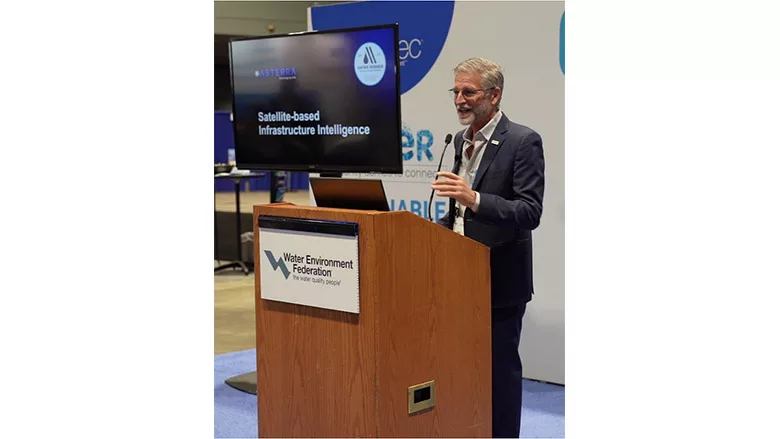
Perry has been a strong advocate for ASTERRA’s technologies, speaking at industry water-sector events such as the Water Environment Federation’s annual WEFTEC conference.

Related Article:
ASTERRA to Use Satellites, AI to Help New Mexico Water Systems Find Leaks
Back to:
25 Top Newsmakers
James Perry, the San Diego-based CEO of Israeli water consultant ASTERRA, has long been fascinated by disruptive technologies. He began his career as a “data analytics geek,” he says, and 30 years later, still considers himself a fan of promoting innovation using information and data.
Perry spent most of his career focused on scaling startups, much of that during the 16 years he worked at Fortune 50 company HP. While there, he encountered several companies in Israel at the forefront of disruptive technologies, particularly related to water infrastructure and sustainability.
One of them was a fledgling firm called Utilis, which rebranded itself as ASTERRA in 2021. The firm uses satellite imagery and a proprietary artificial intelligence algorithm to identify the location and types of water present underground at depths of up to 10 feet.
ASTERRA was founded in 2013 by Israeli geophysicist Lauren Guy, who recognized that the technology developed by the National Aeronautics and Space Administration in the U.S. to find water under the ground’s surface on Mars could also apply to earth. ASTERRA uses L-Band synthetic aperture radar to detect moisture in soil, which can pinpoint leaks in infrastructure as well as the characteristics of the water.
Since 2016, the firm says it has verified 100,000 leaks around the globe, saving more than 368 billion gal of drinkable water and 920,000 MW hours of energy annually. Perry was hooked and joined the team. “I could have just walked off into the sunset at HP, but I really was truly motivated by what we’re doing here, from an earth observation play, from a sustainability play. We’re really working to support current infrastructure around the world with this amazing technology.”
Since 2016, Perry helped drive growth at the firm as chief development officer, then into higher leadership, succeeding former CEO Elly Perets in January 2025.
Perry has been a strong advocate for the firm’s services, speaking at water-sector events such as the Water Environment Federation’s annual WEFTEC conference. In 2021 ASTERRA won the American Water Works Association Innovation Award.
Looking for quick answers on construction and engineering topics?
Try Ask ENR, our new smart AI search tool.
Ask ENR →
This year, ASTERRA signed a $1 million contract with the state of New Mexico to help small community water systems identify leaks in drinking water infrastructure contributing to the state’s water shortage. Under the contract, the company will work with different small water systems across the state annually over the next four years to identify leaks.
The firm formalized the contract in November following successfully completing a pilot program with state Environment Dept., field inspectors, consulting firm McKim & Creed and five local municipal water systems. The pilot initiative saved an estimated 345,000 gallons of water per day over the first half of 2025, according to ASTERRA. Once leaks are identified via the long-wave satellite imagery, they are verified by on-the-ground inspectors.
Upon completion, every small water system in the state will have a detailed report of where water leaks are, “and then we’re working on associated programs to provide support for the actual fixing of the leaks,” says Andrew Hautzinger, special projects coordinator for the state Dept. of Environment.
Perry describes the project as a “gamechanger” for the firm. Although ASTERRA had become well-established with water utilities across the U.S., it had not worked as extensively with state agencies.
“We’ve moved well beyond being a startup and a startup mentality, where you’re chasing every single application and any revenue at all to drive and fund a business,” Perry says. “We’ve done a great job of establishing ourselves at a water utility level, and that was sort of our direct business model, particularly in the U.S.” But the firm did not focus much on state agencies.
Going forward, Perry says he hopes to home in on the top 2,000 to 3,000 of the 55,000 water utilities in the U.S., as well as state and “ultimately federal programs to help us scale in the U.S. market.”