2025 East Best Projects
Project of the Year Finalist and Best Residential/Hospitality: Stratos, Poplar House, and Alula
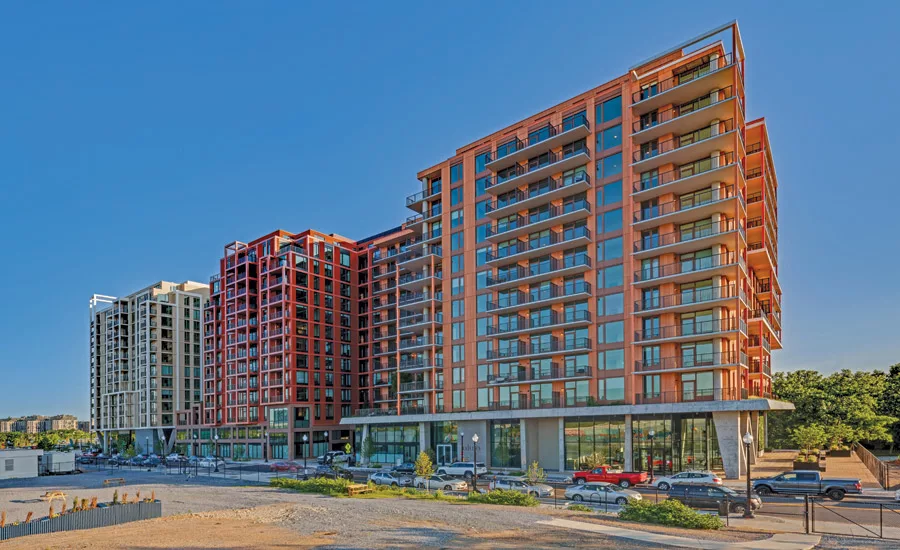
Stratos, Poplar House, and Alula
Washington, D.C.
Project of the Year Finalist and Best Residential/Hospitality
Submitted by HITT Contracting
Owner: Redbrick LMD
Lead Design Firm: ZGF
General Contractor: HITT Contracting
Civil Engineer: Wiles Mensch
Structural Engineer: SK&A
MEP: Introba
Interior Designer: Cecconi Simone Inc.
Landscape Architect: Lemon Brooke
Subcontractors: Arban & Carosi; Consolidated Waterproofing; Del Ray; Diverse Masonry; Dennis Stubbs Plumbing; Geostructures; MAGNA; Power Design; Schuster Concrete
Showcasing how innovation, environmental stewardship and luxury living converge, Phase 1 of the Bridge District in Southeast Washington, D.C., is on track to become the largest zero carbon-certified mixed-use multifamily project in the world. The towers—known as Stratos, Poplar House and Alula—anchor the Bridge District and aim to serve as a model for how responsible private development can foster community connections, support healthy living for residents and mitigate the impacts of climate change, all while delivering financial returns.
Totaling 958,000 sq ft, the towers include 757 high-end and affordable housing units. Additionally, the development houses 42,000 sq ft of mixed-use space, including a brewery, wine bar, coffee shop, two full-service restaurants and a marketplace, as well as two levels of below-grade parking. High-end amenity spaces also include a rooftop infinity pool, demo/test kitchen, pet spa, four expansive outdoor courtyards with grill stations, state-of-the-art fitness center with yoga studios, bike garage with a tune-up station, dedicated coworking spaces and a children’s playroom for tenants.

Photo by A.E.Landes Photography, courtesy of HITT Contracting
Christopher Somma, associate principal at ZGF, says his team was guided by a shared commitment to resilient, human-centered design. “ZGF is proud to have partnered with Redbrick LMD and HITT Contracting to realize the vision for Washington, D.C.’s most sustainable neighborhood,” he says. “Through this collaborative effort, the Stratos, Poplar House and Alula development redefines the benchmark for multifamily design.”
The all-electric buildings are powered entirely by renewable energy generated via a rooftop solar array and off-site sources. Much of the energy efficiencies gained by the building were achieved through the highly efficient use of operational heat loads shed by independent building systems, requiring a complex mechanical plant and control system. The project’s energy efficiencies aligns with the District’s goal of electrifying all new homes and commercial buildings by 2032. Captured rainwater helps reduce potable water use of each building’s cooling tower by more than 70 percent, saving 1.5 million gallons of water annually. Exterior glazing was carefully tuned to maximize views while minimizing heat transfer.

Photo by A.E.Landes Photography, courtesy of HITT Contracting
The design team worked with concrete suppliers to reduce carbon emissions, using advanced software tools to calculate and compare the carbon impacts of proposed mixes, and measure whole-building emissions. The design firm’s open-source Concrete LCA tool helped calculate and compare the carbon impacts of proposed concrete mixes for the building’s structure, while EC3 helped the team measure the whole building emissions.
During construction, more than 90% of waste was diverted from landfills through recycling and five other material streams. The project aligns with the District’s goal of electrifying all new homes and commercial buildings by 2032. The project is targeting LEED Platinum.
Given that the project involved the management of nearly one million square feet, the team adopted a lengthwise construction strategy. To maintain momentum, the project team commenced activities ahead of the original project timeline. Crews initiated framing while the re-shore posts were still in place,
facilitating the early installation of the corridor and demising walls. At peak, the project had a workforce of 800.
An on-site batch plant optimized concrete pouring process. Façade construction was organized in vertical sequences, enabling the team to implement 47 swings around the building and advance different tasks in a coordinated manner. The building employs two types of glass. To the north and east, there are fewer balcony overhangs, and a lower SHGC glazing is used to allow more natural daylight to penetrate the interior and reduce the reliance on electric lighting. On the west and south, the combination of high SGHC glazing and balcony overhang reduces solar heat gain in the units.

Photo by A.E.Landes Photography, courtesy of HITT Contracting
The design and construction team worked collectively with the developer to establish and cultivate a relationship with Cedar Tree Academy, a public charter elementary school across the street from the project. Construction updates were provided regularly to the school community through the school’s executive leadership team. This also created an avenue for the school to share concerns and questions in real time with our team. Based on the feedback, the team made adjustments to the operations that ensure school activities, such as drop off and pick up, were not compromised by construction activities.
With a focus on health and wellness, the towers prioritize connection to nature. The building is located adjacent to a trail network and an expansive park. To capitalize on the site’s expansive views, the towers’ form is sculpted to maximize the number of units with monument and river views and to optimize natural daylighting. The building includes terraces on 85% of units. Calming biophilic design elements are woven throughout the building, including living walls and warm natural materials, which promote wellness and foster a deeper connection to nature.
The overall project was completed at budget and two months ahead of schedule, achieving early turnover of additional square footage two weeks in advance.
“ZGF and HITT Contracting worked together along with teams to ensure the client’s vision of a truly sustainable neighborhood was met,” Somma says. “The design team, contracting team and commissioning agents, all came together to overcome the hurdles of attempting something unprecedented at this scale, while remaining on budget and delivering, not only on time, but ahead of schedule thanks to everyone’s commitment.”