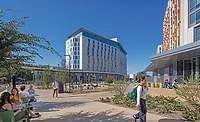
2025 West Best Projects
Project of the Year Finalist, Best Residential/Hospitality: Pepper Canyon West Living and Learning Neighborhood at the University of California, San Diego
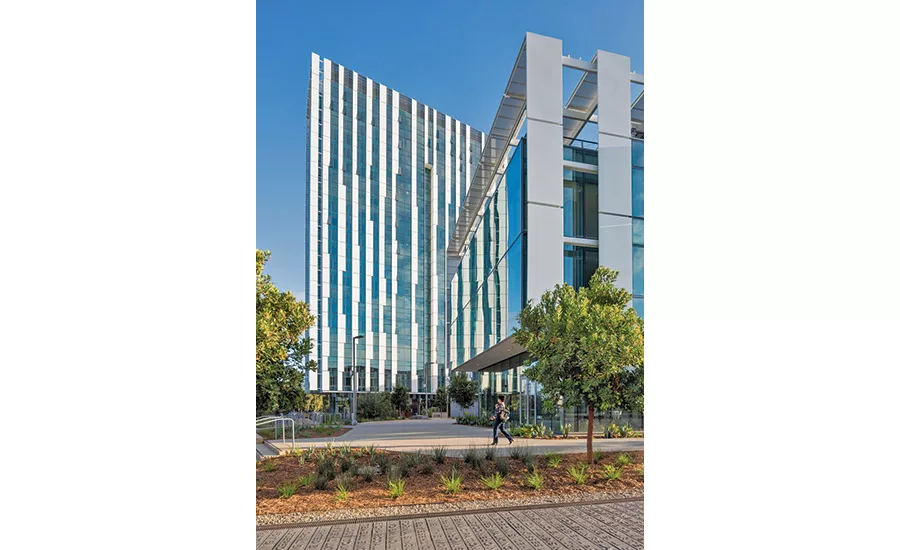
Pepper Canyon West Living and Learning Neighborhood at the University of California, San Diego
LaJolla, Calif.
PROJECT OF THE YEAR FINALIST and BEST PROJECT, RESIDENTIAL/HOSPITALITY
Submitted by Clark Construction Group LLC
Owner University of California, San Diego
Lead Design Firm Perkins & Will
General Contractor Clark Construction
When the University of California San Diego set out to expand affordable student housing in the crowded La Jolla market, Clark Construction faced a formidable challenge: deliver twin high-rise towers totaling 580,000 sq ft on a geotechnically complex site within an active campus in less than 26 months.
The $356-million Pepper Canyon West Living and Learning Neighborhood, completed in September 2024, adds 1,300 beds for upper-division and transfer students and anchors UC San Diego’s transit-oriented master plan. Built under a progressive design-build contract with Perkins & Will, the project transformed a former artillery range into a dense, all-electric residential community that connects directly to the Central Campus Blue Line trolley station.
Initially awarded in 2018, the job was suspended during the COVID-19 pandemic and restarted in 2022 after the team re-scoped and trimmed costs to $321 million from $347 million. Despite the pause, Clark delivered the project on budget and on schedule for fall 2024 occupancy.
The schedule demanded overlapping phases of excavation, structure and prefabrication. Clark organized dual-crew sequencing—two trades operating simultaneously on separate floors—while a third crew advanced finishes on the companion tower. That lean strategy maintained continuous workflow through the 22-story and 23-story buildings.
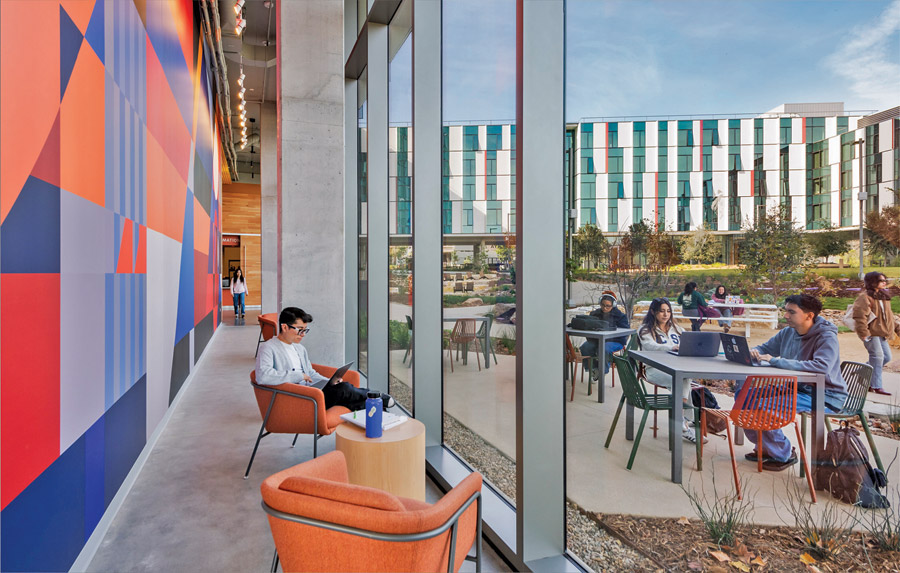
Photo by Anton Grassl
Excavation revealed contaminated soils from the site’s World War-era military use, requiring Level 4 hazardous-material disposal.
The Scripps Formation bedrock lay deeper than expected, prompting a rapid redesign of the mat foundations. Working with structural and civil engineers, Clark limited what could have been a three-month delay to just six weeks through cement-treated soil improvements and resequenced pours.
Prefabrication defined the project’s execution strategy. In collaboration with KHS&S West, Clark standardized four bathroom and two kitchen types for offsite fabrication. Each of the 835 modules carried a QR-code identifier linking design data, quality checks and delivery tracking. Units were hoisted by crane in a custom basket, temporarily braced to the building exterior, and rolled directly onto the floor slab—a lift sequence modeled in 3D to confirm clearances and load paths. The approach cut waste, reduced labor congestion and improved finish quality across both towers.
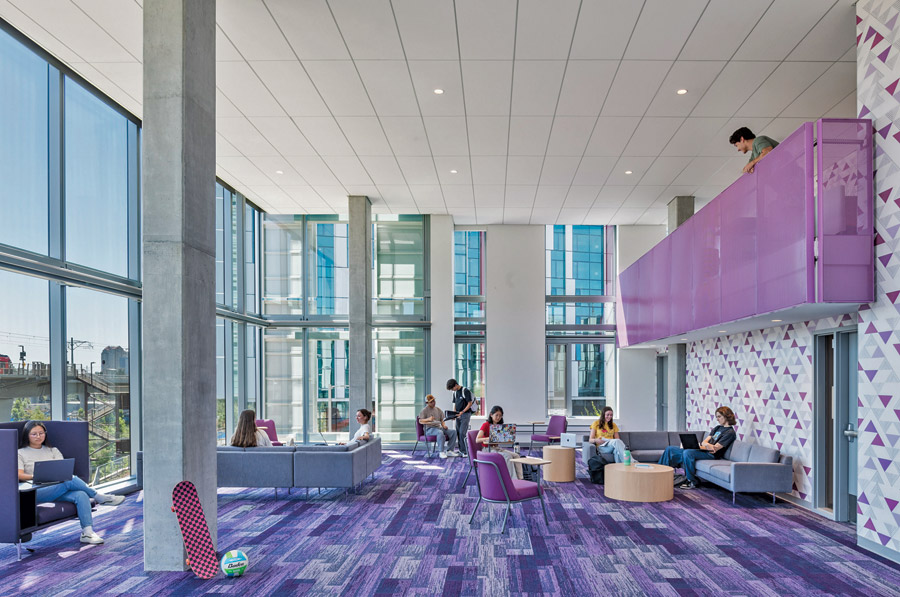
Photo by Anton Grassl
To maintain quality throughout storage and installation, Clark used SensorPush environmental monitors to track humidity and temperature, ensuring consistent finishes and minimal punch-list items. The prefabrication program also eased parking constraints, lowered emissions from commuting trades and freed skilled labor for fabrication shops across Southern California.
The project’s all-electric infrastructure advanced UC San Diego’s goal of achieving carbon neutrality.
Across more than 1.22 million work hours, the project logged an OSHA recordable rate of 0.65 with zero lost-time incidents. Clark enforced the use of helmets and chin straps for all trades to prevent fall-related head injuries and distributed gear to subcontractors who lacked it. Safety managers and engineers jointly reviewed each lift plan to verify slab-edge capacities and ensure 100% fall protection during modular placement.