2025 Midwest Best Projects
Project of the Year Finalist, Best Water/Environment: Upstream Approach Walls at Soo Locks, Phase 2
Upstream Approach Walls at Soo Locks, Phase 2
Sault Ste. Marie, Mich.
PROJECT OF THE YEAR FINALIST and BEST PROJECT, WATER/ENVIRONMENT
Submitted by Kokosing Alberici LLC
Owner, Lead Design Firm U.S. Army Corps of Engineers, Detroit District
General Contractor Kokosing Alberici LLC
Perched on the U.S.-Canada border between Lake Superior and Lake Huron, the Soo Locks Complex is one of North America’s most critical transportation links. Each year, more than 7,000 vessels pass through the locks, carrying 75 million tons of cargo—including the advanced high-strength steel vital to America’s auto and appliance industries. But with only one operational lock large enough to handle today’s modern freighters, the 19th-century facility represented a potential single point of failure for Great Lakes shipping.
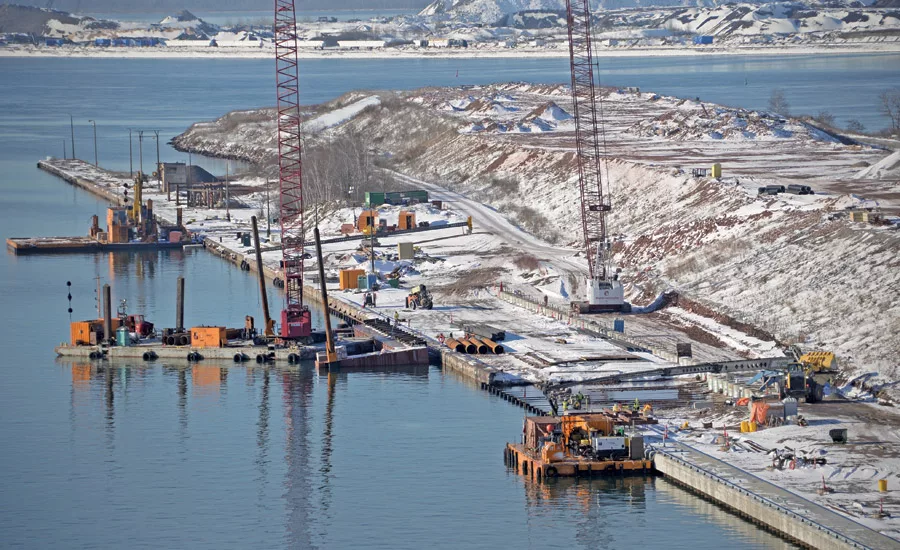
To strengthen this essential corridor, the U.S. Army Corps of Engineers is constructing a new 1,200-ft-long lock. Before that third and final phase could begin, Kokosing Alberici completed the complex’s second phase—an effort that included constructing and rehabilitating over a mile of approach walls in a deepened channel reaching depths of 30 ft.
The project site, located on an island in Michigan’s Upper Peninsula, is inaccessible by vehicle for most of the year. All equipment, materials and labor had to be barged or shipped by lake freighter.
“To address this challenge, the Kokosing Alberici team constructed an offsite storage dock and a dedicated temporary terminal to support efficient water-based deliveries and staging,” says Austin Dernberger, project manager for Kokosing Alberici. “Materials were transferred from the dock to the island as needed, and deliveries were carefully sequenced in collaboration with the U.S. Coast Guard and U.S. Army Corps of Engineers to avoid disruptions to commercial and recreational traffic.”

Photo by Kokosing Alberici LLC
Another unusual constraint came from the Canadian National Railway bridge that bisected the site. With trains running nightly, the contractor’s engagement with the railway was key.
“The Kokosing Alberici team maintained continuous communication with CN to ensure that all work—especially electrical activities that could impact their operations—was carefully planned and communicated to avoid interference with their schedule,” Dernberger says.
And then there was the weather. The area sees an average of 10 ft of snow each year, and frigid lake winds often halt water work from November through April. To adapt, the team planned construction around seasonal shutdowns, ensuring that each spring, crews could resume work without delay.
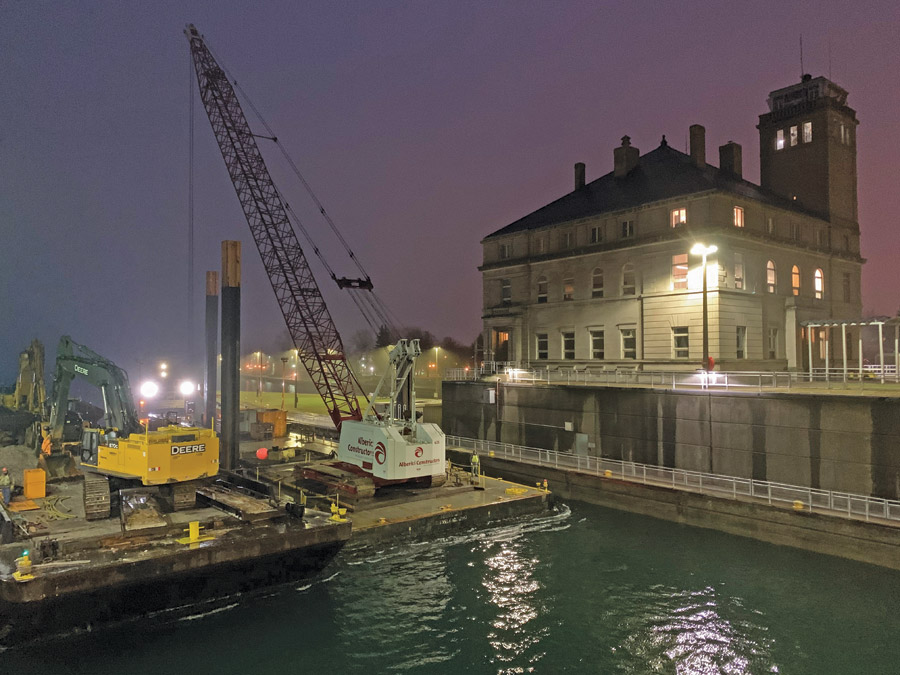
Photo by Kokosing Alberici LLC
Even the onsite concrete batch plant had to be carefully shielded from snow and moisture to maintain mix quality.
Safety was a top priority in these extreme conditions. The Kokosing Alberici team logged more than 400,000 work hours without a recordable incident—a major accomplishment given the hazards associated with heavy marine construction.
Daily meetings focused on job risks, from diving and crane operations to fall protection and confined-space entry. Divers completed 961 dives over 2,800 hours.
The project is a point of pride for the Kokosing Alberici team and the community.
“In addition to providing good-paying jobs and training for skilled workers, we made improvements to local facilities that will make the surrounding community a better place to live and work long after the project is complete,” Dernberger says.