Companies
ENR Top 600 Specialty Contractors: Data Surge Juices Market Rise
October 22, 2025
Companies
ENR Top 600 Specialty Contractors: Data Surge Juices Market Rise
October 22, 2025A crew from O'Connell Electric dismantles an existing transmission tower near Batavia, N.Y., as workers build two 140-ft structures and tie into 345kV lines from a new substation as part of the project.


Related Link:
ENR 2025 Top Specialty Contractors Rankings
View Complete List with Revenue and Market Data (PDF)
(Subscription Required)
The economic fallout from the Trump administration’s tariff war has already breached jobsites through acute materials cost increases and accelerated project timelines, say ENR’s Top 600 Specialty Contractors.
Yet added pressures are also boosting innovation in a market where data demands are rapidly transforming how contractors work together, executives say.
This year marked the fourth consecutive annual revenue growth for the Top 600, with the 2025 total for the prior year up 11.8% to $239.9 billion. Also, 97.3% of ranked specialty contractors that reported profit status said it rose in 2024—up from 95.8% previously. While 68.5% of Top 600 specialty contractors reported higher revenue this year, that percentage is down from 73.3% last year and 79.4% two years ago.
Beyond the numbers, specialty contractors say establishing the right relationships is still key in driving projects and profitability forward amid intensifying industry challenges and increasing costs.
“Construction is a relationship business,” says Alterman Inc. President and CEO Greg Padalecki. “As a subcontractor, we network with other subs and hear the stories. A [general contractor’s] ability to manage a project greatly affects a subcontractor’s profitability.” The firm is ranked No. 93 on this year’s Top 600 list.
Padalecki adds, “It is our responsibility to diligently investigate before we jump in on a subcontract.”
Shifting Labor Resources
According Top 600 specialty contracting data, such diligence has also helped reduce challenges posed by a limited labor pool. Overall, 57.3% of firms still report being short of workers, an improvement from 64.3% last year and part of a downward trend with this year’s number, the lowest percentage reported since 55.5% did in 2015. Additionally, less than 50% of Top 600 firms that list concrete as a primary specialty say they have a shortage. That percentage has been shrinking since the 2022 survey, when the equivalent number was 83.9%. Last year, 72.7% of utility firms reported worker shortages, which dropped to 62.9% on this year’s survey.
“We’ve learned that cross-training our operational teams across the different scopes of services we offer is key to staying agile in an ever-changing construction market,” says Isaiah Wayne, president at the No. 199-ranked Wayne Brothers Cos. in Davidson, N.C. “This flexibility allows us to pivot to one sector when another slows down, helping keep revenue targets consistent. It also builds stronger teams and reduces the silos that can develop within separate operating groups.”
Looking for quick answers on construction and engineering topics?
Try Ask ENR, our new smart AI search tool.
Ask ENR →
Balancing Cost Flow
In order to skillfully meet labor demands amid limited pools, Top 600 firms say workers must be treated as a limited resource to be carefully used, enabling better cost control.
For U.S. Engineering Holdings, ranked No. 86, President Brandon Wikoff says “pressure on procurement” feeds into labor as a “major driver” of increased construction costs, “both from wage growth and from investment required to attract and retain talent at the pace our work requires.” He adds that the other “industry reality is cash management.”
Top 600 firms report that 25.5% of their receivables are past due, down slightly from 25.9% on last year’s survey and 26.7% noted two years ago.
Widening gaps between receivables and subcontractor payment can create unbalanced cash flow for many firms, which Wikoff says his company manages with “disciplined billing” and “rigorous project controls.”
Next year, “our goals are clear,” says the executive. They include expanding the firm‘s offsite capacity and shoring up its field leadership with “structured training [and] succession planning.” To reduce field labor, he says the firm intends to “standardize prefab workflows across all business units so model-to-manufacturing-to-installation runs on a single playbook.”
Sunland Asphalt & Construction LLC CEO Matt Johnson applauds a trend the firm is seeing in which individuals from non-adjacent industries are beginning to explore careers in the skilled trades. “This shift presents an opportunity, as construction offers a viable path to financial stability and the ability to support families better,” says Johnson, explaining that a “critical challenge” for the No. 123 listed firm is in helping newcomers in the skilled trades “navigate the first 60–90 days.” He adds, “The work is physically demanding, and acclimating to the environment and expectations requires targeted support and guidance.”

Driving Industry Change
The Associated Builders and Contractors estimates that the construction industry needs to hire more than 400,000 new workers this year to keep up with demand. “With the rising costs of higher education, some younger individuals are favoring trade jobs over traditional college degrees,” says BZI CEO James Barlow.
He says he has noticed more Gen Z workers entering the workforce and opting for skilled labor positions. “It’s a path that resonates with many young people looking for financial independence and meaningful work,” Barlow contends.
Last year, a CNBC broadcast report found that such a shift in career interest could be fueled by economic uncertainty, steering Gen Z and younger workers away from potential college debt into the security of a salaried career in the skilled trades.
According to employee data collected and published by human resources online platform Gusto, skilled trade professions including electricians, plumbers and mechanics are seeing a gradual uptick in employees who are aged between the 18 and 25.
Ranked No. 119 on this year’s Top 600 list, BZI launched its SteelTech Academy training and skill development center to provide these workers with skills they need in entering the trades, Barlow says. The academy has issued thousands of certifications in areas such as OSHA compliance, equipment operations, fall protection and welding, he adds.
On the Jobsite | By Jonathan Keller
Modular Mechanical Skids Help Slash Schedule
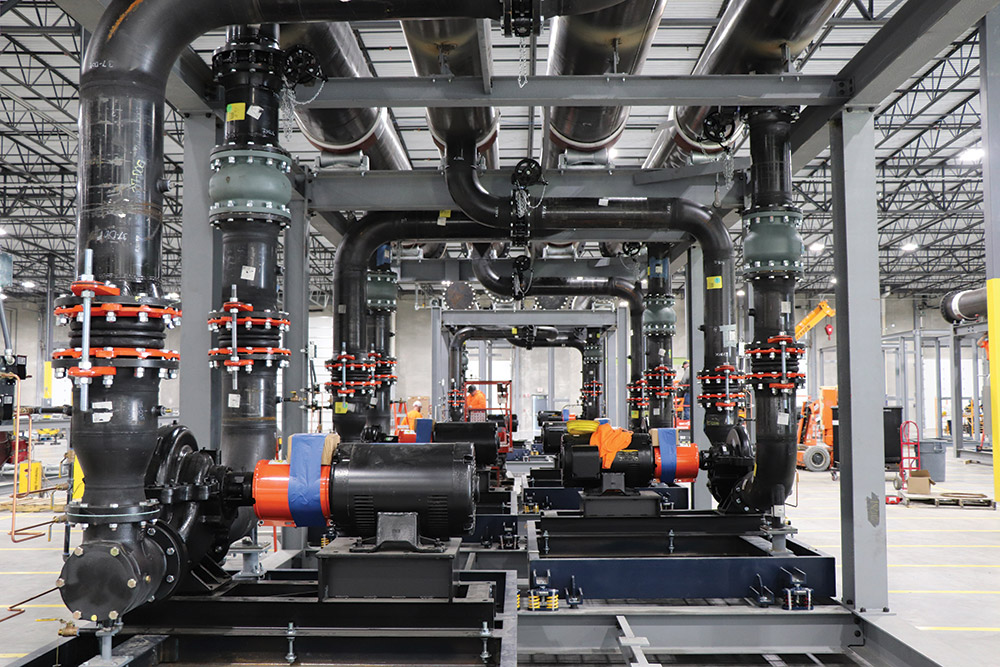
Photo courtesy of Baker Group
Baker Group (No. 137) provided mechanical contracting services on a hyperscale data center project at a remote site in the upper Midwest. The project team used modular mechanical skids, prefabricated offsite by Baker, to save four months on the mechanical schedule, the firm says. The skids, which contained the critical infrastructure, were then set into place by onsite crews. The largest skid weighed 34 tons.
Tackling Tariffs
For many Top 600 special contractors, the Trump administration’s emerging tariff policy has added a layer of cost uncertainty to supply chain risks.
MTech Mechanical COO John Falzone says the company’s supply chain challenges have improved since the early pandemic years. However, he adds, “tariff price uncertainty has been the most challenging aspect of price control in 2025, adding that it’s “hard to ignore cost increases with the continued uncertainty in markets.” The company is ranked No. 218.
At Bond Civil & Utility Construction, ranked No. 106, President Kane Cuddy says tariffs and supply chain disruptions have directly affected the company’s ability to deliver projects on schedule.

“With the rising costs of higher education, some younger individuals are favoring trade jobs over traditional college degrees. ”
James Barlow, CEO, BZI
“Tariffs, supply chain disruptions and project delays have all tested our resilience,” he says, explaining that delays in receiving electrical panels on a recent transmission project required a resequencing of work and coordination with the owner to mitigate schedule risks. The experience has forced the specialty contractor to rethink its procurement strategies, says Cuddy.
“Yet despite these challenges, we achieved notable successes,” he adds. “Our electrical transmission sector grew rapidly, driven by the urgent need to modernize aging infrastructure and support new renewable energy interconnections.”
For Brock Group, ranked No. 24, “cost increases are a concern,” says CEO Frank Bardonaro. “But we got ahead of this by ordering a lot of our forecasted needs a year ahead of time.” He says the specialty contractor’s “ability to combine large bulk purchasing, identify new U.S.-based vendors and improve fleet and equipment sharing across all businesses” has helped it minimize the impact of increased project costs on materials.

Market Ups and Downs
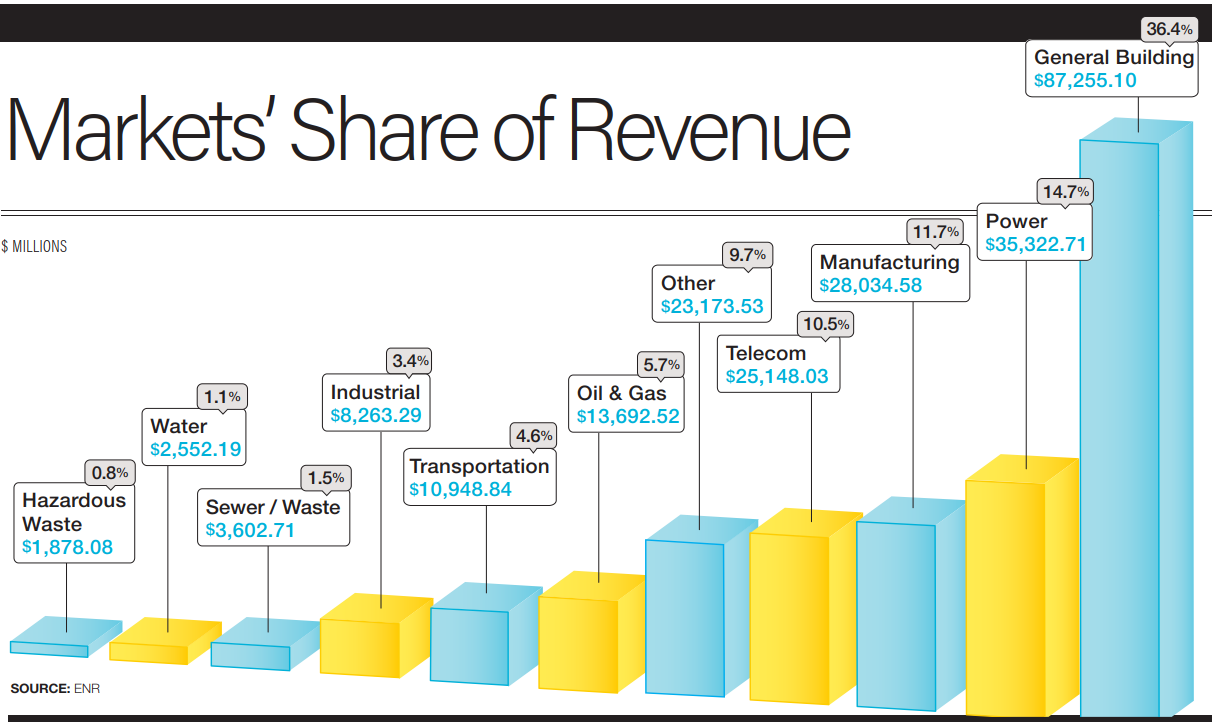
Revenue in most markets that ENR tracks rose by double digits between last year and this year for Top 600 contractors. The largest jumps were seen in telecommunications, up 65.1%; hazardous waste, up 30.3%; and power, up 24.6%. The only market with a significant decrease is oil and gas, which fell 6.3%.
In September, Centuri Holdings Inc.’s separation from its parent company, Southwest Gas Holdings, allowed the ranked No. 14 specialty contractor to build out more resources in its key markets.

“Tariff price uncertainty has been the most challenging aspect of price control in 2025. ”
John Falzone, COO, MTech Mechanical
“For our customers, this means working as one team across our operating companies with union and non-union workforces and the full-spectrum of gas and electric infrastructure services,” says President and CEO Christian Brown. “With this independence, we begin a new chapter as a standalone public company with strong business fundamentals and abundant opportunities in our core gas and electric end markets.”
Overall, median revenue on the 2025 Top 600 list is $128.1 million, up 8.3% from $118.3 million last year. Median new contracts also rose 5.9% to $121.5 million, with median revenue for concrete subs increasing 19.5% on this year’s survey over the 2024 report.
With economists seemingly at odds over when a recession could hit the economy, Clark Bros. Inc. President and CEO Lawrence Clark says some of its “primary challenges” have been in building client confidence to launch projects.
“There has been an overall reluctance to fully commit to projects because of the policy changes that have been looming,” he says of the No. 249-ranked heavy civil contractor’s work across sectors. “Our goal is to diversify our scope of services and continue to provide creativity in our approach to the market."
-copy_ENRready.jpg "Frank Bardonaro")
“Cost increases are a concern but we got ahead of this by ordering a lot of our forecasted needs a year ahead. ”
Frank Bardonaro, CEO, Brock Group
In the mechanical contracting market, SPC Mechanical is seeing cost increases in several key areas due to ongoing market trends. says Vice President of Estimating/Preconstruction Mark Coleman.
“Prices for copper piping and wiring remain high due to global demand and limited supply. Carbon steel products, as well as ductwork and supports, have seen increases due to higher raw material costs,” he says, adding that prices on chillers, rooftop units and air handlers have increased “primarily due to increased production costs and inflation.”
Through proactive planning, strong vendor relationships and flexible project management, “we continue to meet our commitments to clients while managing risk effectively,” says Coleman. The specialty contractor is ranked No. 161.
“In today’s construction market, resilience is no longer a nice-to-have, it’s a core strategy that allows us to thrive in an ever-changing environment,” Charge CEO Mike Robirds adds.
Investing in Technology
For many Top 600 firms, a boom of contracting work tied to data center needs has also jumpstarted their company technology needs, with many reporting that they have accelerated integration of tech such as artificial intelligence and collaborative software to help keep up with their workflows.
Data published by global consultant McKinsey & Co. in August found that artificial intelligence training models have been the primary driver of increased U.S. data center needs. To deliver required data center infrastructure, the firm estimates that the U.S. will need to more than triple its annual power capacity over the next five years—“from 25 GW of demand in 2024 to more than 80 GW in 2030.” Worldwide demand is expected to be about 220 GW by 2030, it adds.
However, McKinsey expects data centers of the future to also evolve into “hybrid facilities that host a mix of training, inferencing and cloud workloads, and their scale and size will surpass those of facilities that were considered large even two years ago.”
SDB Inc., Business Solutions Director Brad Thompson says the No. 247-ranked specialty contractor doesn’t “chase technology because it’s flashy or new. We build our technology stack around our workflows,” he says.

“AI has become a connector, helping bridge information gaps that used to require more hands-on effort or extra hours. ”
Brad Thompson, Director, SDB Inc.
Artificial intelligence “has become a connector, helping bridge information gaps that used to require more hands-on effort or extra hours,” Thompson says. “Whether in the office or the field, automation speeds up routine tasks and keeps our teams aligned. Our goal is not replacing collaboration but instead about making it more efficient and more accurate.”
For O’Connell Electric Co., ranked No. 155, technology investments have been focused on “value,” says President and COO Michael Parkes, “which could be numerous things beyond just labor and cost savings.”
As more specialty contractors find their footing with technology integration, “there will always be challenges,” he says. O’Connell Electric has found success against such challenges in identifying an internal technology and subject matter expert who can lead company-wide trainings and implementation. This expert is also deputized to “continue to be there for our employees to answer questions, host regular user group meetings and keep users informed of changes and updates,” Parkes says.
As building information modeling has become standard across the industry, Nox Group, ranked No. 103. says it is investing in a level of information detail that models down to the “bolt and nut” to increase collaboration and reduce risks.
“This is a new level of precision modeling we’ve employed to strengthen shop-to-field collaboration, boost safety on site and ensure efficiency for our workforce as we navigate both labor shortages and higher demand for industrial infrastructure,” says CEO Justin Martin. “Detailed models feed directly into hazard analysis and phasing, allowing us to anticipate conditions before crews arrive.”
He adds, “In some cases, drone scans and digital surveys help us reduce or even eliminate confined space entries, minimizing exposure to unnecessary risks.”
Lithko Contracting CEO Rob Strobel adds that a single “source of truth” for design and drawings is “critical” to keep all trade partners in the value chain on the same page.
“BIM modeling (3D, 4D) offers huge opportunities. Paper drawings become outdated the moment they’re printed,” he says. “With technology, everyone can input updates in real time, ensuring accurate line and grade information for formwork, engineering and suppliers. Full industry adoption of live models like Revit would allow everyone to build from the same constantly updated source.”
Ranked No. 25, the company has also integrated artificial intelligence into its workflow to fortify its “data quality” and help improve its business operations, Strobel notes.
“As we grow across 30-plus cities, we lose the ‘voltage’ of close-knit knowledge sharing,” he contends. “AI can help keep that voltage high by capturing and distributing knowledge across regions, proactively sourcing answers, housing best feedback and presenting solutions to improve performance and speed growth.”
Technology | By Jonathan Keller
Robots Help ASRC Industrial Find Unexploded Ordnance

Photo by Matthew Newton, Project Manager for NWDD
Tyler Wilson, system developer of the robotics program at ASRC Industrial (No. 37), remotely searches for unexploded ordnance at a former U.S. Navy bombing range on the island of Vieques in Puerto Rico that the industrial services specialty firm is restoring. The training site was in operation for 60 years before the George W. Bush administration closed it in 2001. The project is part of a long term effort to reopen local beaches and turn the area into a wildlife preserve with walking trails. Project scope, which includes excavation and demilling of unexploded ordnance and target removal, involves use of dive teams for underwater operations.
Choosing the Right Partners
As much as technology integration can harvest data to help reduce some project risks, Top 600 firms say choosing the right trade partners goes a long way in increasing project success.
“For the last 65 years, we have partnered with a variety of clients, general contractors and subcontractors to create projects that transform the built environment,” says Matt Allen, executive vice president and chief client officer at McKinstry, ranked No. 36.
“When we look at who we partner with, we work diligently to understand exact needs of projects and facilities. Along with this, we consider long-term service and cost needs to guarantee that if we work together, what we provide will align with their needs. For our team members, building a relationship with a potential client is about collaboration, understanding and honesty.”
Helm Group CEO Brian Helm adds, “With the nature of most projects right now, both GCs and subs realize that the relationship needs to be win-win.” He says the ranked No. 68 contractor has made a habit of checking references for its new general contractors. “Do as much financial due diligence on them as they do on us,” Helm says.
Greenwood Industries Vice President of Private Estimating Matthew Tessier says the ranked No. 190 specialty contractor follows similar due diligence. “Before we work with a new GC, we reach out to our contacts in the industry—other roofers, vendors and GCs—because it doesn’t take long for a company to build a reputation,” he says.
“At the end of the day, relationships are built on performance,” Tessier adds. “The stronger you deliver on a project, from estimating through closeout, the more likely you are to be invited back and shortlisted for the next one.”
Overall, for specialty contractors, Harris CEO Michel Michno says the contract negotiation process is a “huge indicator” of whether a potential partner will be a “good fit.” The Si. Paul, Minn.-based specialty firm is ranked No. 41 this year.
“You learn a lot during the give and take from those discussions to assess whether this will be a culture fit for both organizations,” he says. “You learn how another organization behaves and whether their priorities and values are aligned with your own.”
Business Enterprises | By Emell Adolphus
US Army Veteran Cements A New Career Path
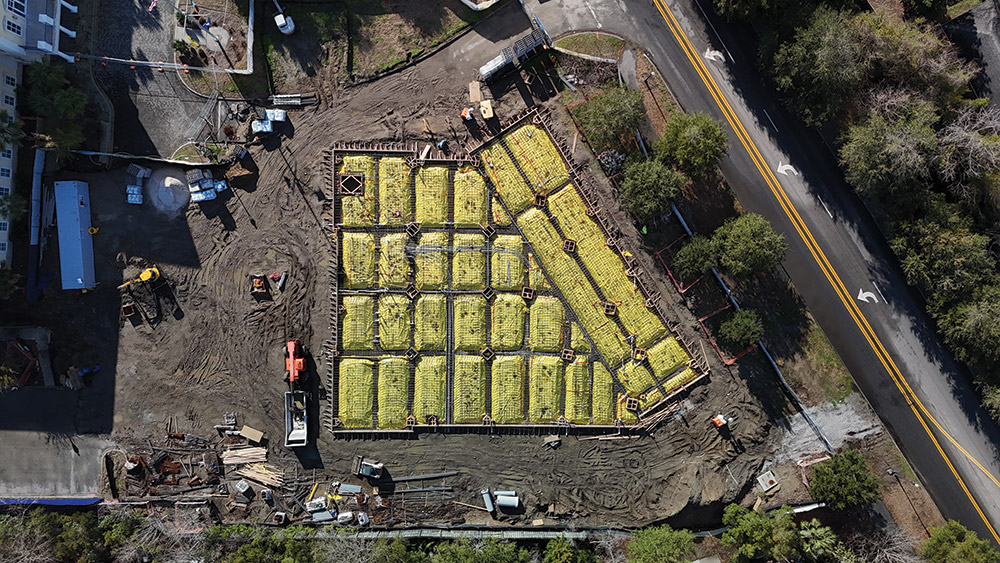
Evans Contracting Group gears up to pour a 650-cu-yd slab at Mediterranean Shipping Co. headquarters in Mount Pleasant, S.C.
Photo courtesy of Evans Contracting Group
Evans Contracting Group (No. 558) President Jack Evans, 29, says the “grit” of his background in the armed services is reflected in the Charleston, S.C.-based concrete contractor’s steady expansion since its founding in 2022. “Our motto is: ‘Where grit meets opportunity,’ and that is something that the company is defined by.”
After an injury forced Evans to medically retire from active U.S. Army service, he says he felt lost until an internship with a heavy civil contractor through the U.S. Special Operations Command’s Warrior Care Program pointed him to the skilled trades and sparked the drive to be able to work with his hands.
“There are a lot of military occupational specialty skills that don’t necessarily translate to the civilian sector,” says Evans. “Being able to go home at the end of the day and seeing what you did really gave a self-rewarding feeling.” With a second office in Chattanooga, Tenn., he helps other veterans “build better” and develop their post-service lives through jobsite experience as a registered disabled veteran business enterprise certified with the U.S. Dept. of Veterans Affairs.
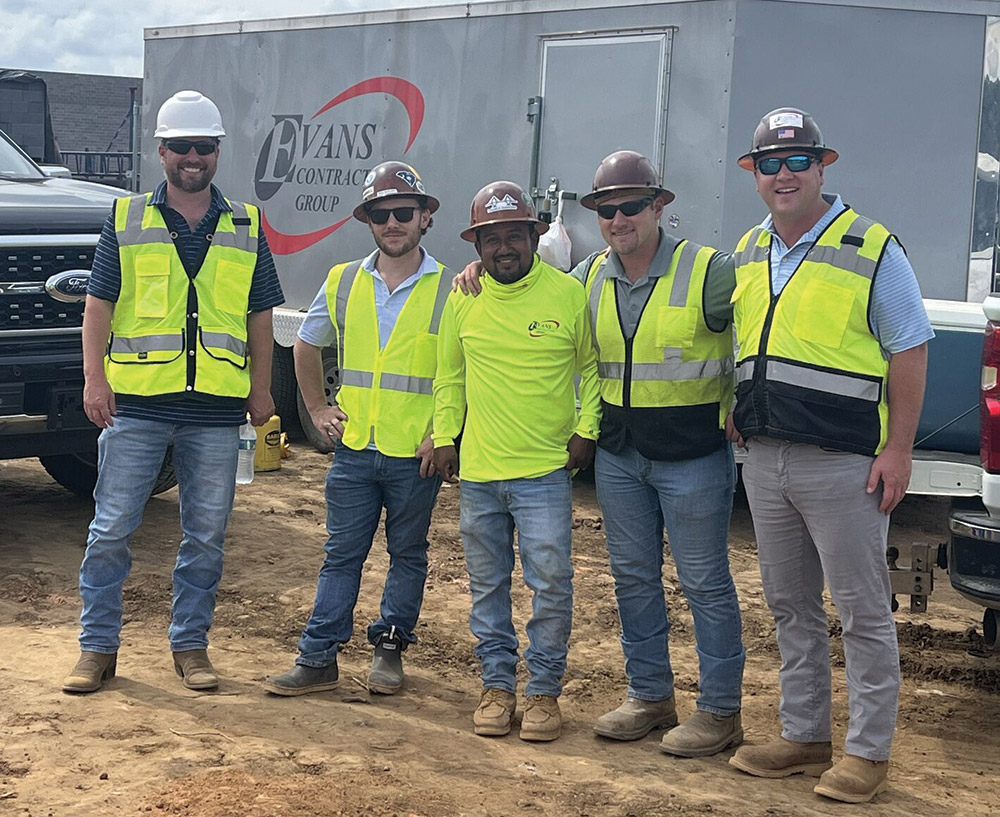
Evans Contracting Group Vice President JP Evans (right) and President Jack Evans (center right) say relationship building has been key to growth of its portfolio and workforce.
Photo courtesy of Evans Contracting Group
“We are still a very small contractor with a large vision,” says Evans, adding that the firm employs about 200 craftworkers on jobsites ranging from wastewater treatment plants to multifamily developments. He adds, “We started out small, one job at a time.”
Serving as vice president, Evans’ brother JP Evans says the contractor’s relationship building has also been a key driver of its success. “It’s all relationships. Every project we are doing is with customers that we’ve done multiple projects with,” he says. Contracting "is a long-term relationship, and we are going to be doing it for a very long time. Our goal is to build an organization that our family can be in for a long time and that people working with us can be with us for a long time.” He adds, “With our business, we are only as good as the people that we have.”
Contracting Gamechangers
In addition to market ups and downs, managing labor resources and technology adoption, Top 600 specialty contractors have also celebrated myriad achievements that they say have been “game-changers” for their companies.
“With all the cyclical demand in markets, when some are off, some are on fire. Despite these cycles, we have managed to keep the business consistently on track, and still need to be prepared for growth and scaling as multiple cycles get in sync with each other,” says Seth L. Pearlman, North America chairman of Menard, ranked No. 156.
If anything, “The last three years have exposed how fragile the industry’s supply chain really is,” says Joe Micallef, COO at Power Design, ranked No. 31.
To manage more control and consistency over switchboards and critical power supply, the company built LFG, its switchboard and critical power manufacturing business.
“By building switchboards in-house, we’ve created a model our partners can trust: consistent 20-week lead times, with the ability to accelerate to just six weeks when schedules demand it,” says Micallef. “It’s more than speed, it’s about delivering confidence, quality and beating schedule expectations.”
At National Construction Enterprises Inc., ranked No. 144, Pino Mancina says bringing in guest speakers to talk about safety has proven to be a small change with a big payoff. “The guest speakers seem to be able to deliver the message clearly and directly,” he says.
As specialty contracting work continues to evolve, so must the industry’s approach to work and safety, says Michael McCann, president and CEO of Limbach Facility Services, ranked No. 89. The company’s Hearts and Minds Safety Program has also been a game-changer for jobsite safety, with an added focus on mental health care, he says.
“The challenges we face today are different from those of five years ago, making it essential for our safety practices to adapt,” says McCann. “This isn’t just about rules, it’s about building a culture of care that protects the whole person. That shift is strengthening both our people and our performance.”