History
From the Archives: September 3,1942

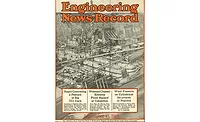
The explanation for the unusual device depicted on this 1942 ENR cover reads: “Developed by Harold Buckley, clearance engineer for the New York Central Railroad, as a means of insuring passage of bulky wartime loads, this ‘Porcupine’ railroad car is now in operation on the company’s lines.
Equipped with 112 wooden ‘fingers,’ mounted on wing nuts to permit the wooden rods to swivel backward on contact with some object, the car is pushed head first through tunnels and bridges to determine minimum clearances.
When any of the fingers strike a projection and are bent back, they hold their position for measurement by an operator who uses a large steel pantograph on the outside of the car.
This pantograph is connected to a smaller one inside the car that reduces the measurement to a scale of one inch to the foot.
Thus, the railroad is able to obtain an accurate picture of the inside of its tunnels and bridges—a picture that will give minimum clearance protection.
Railroad engineers transfer the readings obtained by the car onto working charts, for the reference of freight agents and loading officials and for future use by the maintenance forces and work crews.”
Looking for quick answers on construction and engineering topics?
Try Ask ENR, our new smart AI search tool.
Ask ENR →

.webp?height=200&t=1760896328&width=200 "ENR-12-6-1928-cover-(2)")
