Viewpoint
Can Driver-Facing Cameras Make Heavy Construction Trucks Safer?
A commentary says overcoming driver skepticism is key
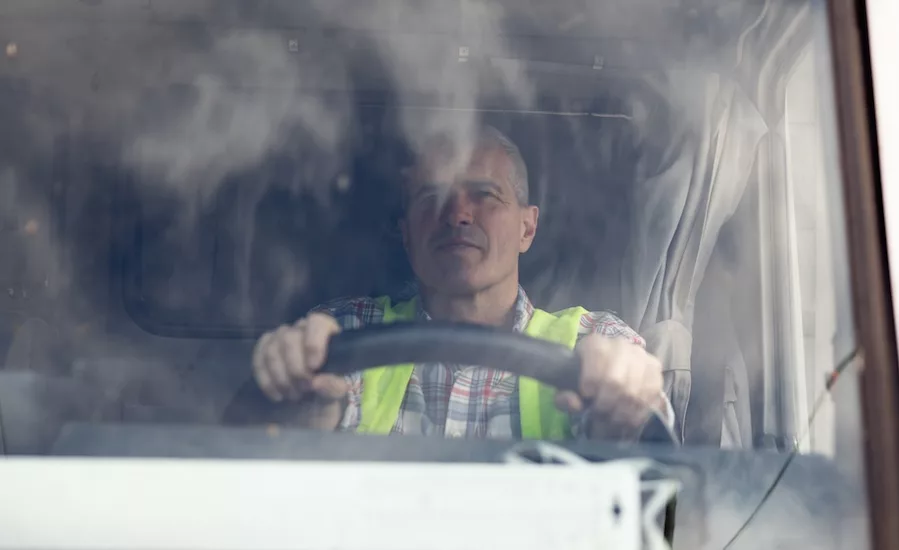
Is there a future for such cameras in construction vehicles? Recent studies show they can help if used right.
Photo: Hispanolistic/Getty Images

Silver
Last February, a ready-mixed concrete truck driver driving on Interstate 60 in Mesa, Ariz., swerved to avoid a stopped vehicle in the road ahead of him—and steered right into a group of roadside workers clearing garbage and debris along the shoulder. The workers scattered, video of the accident showed, but one of them, Jordan Curtis, was slammed by the truck and thrown several feet. He sustained serious injuries that landed him in the hospital.
In construction's long history of heavy vehicle use, the favorite methods to prepare truck drivers for hazards—such as blindspots and long stopping distances—have included meticulous training, telematics that record vehicle operation and cameras to increase drivers’ field of view. But a newer method—in-cab cameras that record a driver's actions—has sparked controversy over whether the camera’s unblinking eye is an invasion of privacy.
Is there a future for such cameras in construction? Recent studies show they can help if used right.
The trucking industry has also used driver-facing cameras for a long time. In 2012, after Canadian trucking company Sysco Quebec began installing them, the union representing its drivers objected, and in arbitration, the drivers prevailed. The Quebec Superior Court agreed with the drivers on appeal by Sysco Quebec and the cameras were kept out of its trucks.
In the U.S. two years later, then-California Attorney General Kamala Harris decided that driver-facing cameras were not a civil rights violation and could be used to discipline employees.
The National Labor Relations Board had filed several lawsuits on behalf of drivers against companies using the cameras, however. Last year, the board lost a case in which it supported a driver whose supervisor warned that he should not cover a surveillance camera in the cab of his truck. In Stern Produce Company Inc. v. NLRB, the Wahington, D.C., federal appeals court overturned the decision, finding that Stern Produce did not violate federal labor law by warning a driver not to cover a driver-facing camera during his lunch break.
The court found that since the company’s policy was to have cameras on at all times, the trucker’s rights were not infringed on by the supervisor’s reprimand.
Looking for quick answers on construction and engineering topics?
Try Ask ENR, our new smart AI search tool.
Ask ENR →
The camera controversy has inflamed trucker online chat forums, with drivers alerting one another about which companies require the cameras and which do not. Companies have hesitated to use them in an already tight construction driver employee market.
Can they help construction companies increase safety?

A driver enters an aggregate plant. Photo: Getty Images
The cameras “can offer valuable safety and training benefits but they also raise valid concerns,” notes Lisa Lamons, driver trainer and DOT director at Concrete Strategies, a national concrete contractor. One of the biggest issues is driver perception, she says, because drivers “feel like they’re under constant surveillance, which causes distraction to [those] behind the wheel when their main task is focusing on being aware of their surroundings while driving safely.”
Recent research highlights the problem and potential solutions. One important solution is event-based recordings that automatically delete any recording unless there is an incident or event such as hard braking or speeding. When there are no events, recordings are usually stored for a specified period of time before being overwritten.
Event-based driver-facing cameras were preferred over continuous recording by drivers, legal experts and insurers, the research showed. One advantage is that such a system reduces irrelevant footage. Driver approval increased when the footage recorded was used for safety programs, coaching and training.
A report by the American Transportation Research Institute, a non-profit trucking industry group, has recommended limiting access to recorded footage to safety directors, developing transparent policies and prioritizing positive coaching to build trust.
Reduced Legal Exposure
The cameras significantly reduce an employer’s legal exposure and liability, the institute’s study also found. Another advantage is that cameras exonerate drivers in 49% of lawsuits, according to legal experts consulted for the research, although there is a risk that some footage might be used against drivers.
Insurers reported 10% to 45% claims reductions when driver-facing cameras are used in tandem with proactive coaching. Settlements were also reached more quickly, transportation institute researchers found.
For construction employers, this means fewer accidents involving heavy equipment, reduced liability for worksite incidents and improved driver behavior.
Another study, of what was termed heavy-goods vehicles, was carried out in England and published in the journal Accident Analysis & Prevention in 2020. It examined fleets of more than 250 at two separate companies and analyzed data they collected, comparing results where there was monitoring with driver facing cameras and without them.
The cameras significantly reduced risky behaviors, the journal authors found. In Company 1, harsh braking incidents decreased by 16.82% and speeding by 34.29%, while Company 2 saw reductions of 4.62% and 28.13%, respectively. Drivers who were watched by cameras and coached had significant reductions in harsh braking compared to camera-monitored driving alone.
Training drivers along with ongoing coaching seems to be the key to successfully using driver-facing cameras.
For bigger construction fleets, where equipment damage and liability risks are high, these two studies show that the savings from driver-facing cameras could amount to millions annually, justifying the investment and potential difficulties in winning the confidence of drivers. But they must be introduced cautiously as part of an overall safety plan and ongoing driver coaching.
California-based correspondent Elaine Silver, who writes about business, legal and safety issues, can be reached at esilver.enr@proton.me.